Lifestyle/Community
Telfed volunteers give back-to-school gifts to Israel’s frontline children
Three years after 7 October and in a relatively quiet time in Israel, Telfed volunteers continue to support soldiers, families, and children. This included a large group in Ra’anana packing back-to-school gifts for 1 000 children in frontline communities in the north and south.
Across Israel, the beginning of September brings familiar scenes. New school bags, sharpened pencils, excited children, and parents trying to get everyone out the door on time.

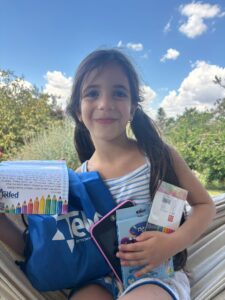
A little girl from Galil Elyon excited to receive her school startup gifts
In the north and south, most evacuated communities returned home some time ago, families have rebuilt routines, and children are once again learning in their own communities. But being back home doesn’t mean everything is back to normal.
For families living along Israel’s borders, the new school year comes with a mixture of excitement, optimism, and lingering uncertainty. Some have family members still serving in the army. Many children have lived through evacuation and months away from home, while parents are trying to restore a sense of stability after an extraordinarily difficult few years.
One mother from the Upper Galilee described life now as “a kind of routine”, while acknowledging that “the reality here isn’t simple and the Galilee hasn’t returned to itself”. Still, she added, “we’re very optimistic that things will be better here soon”.
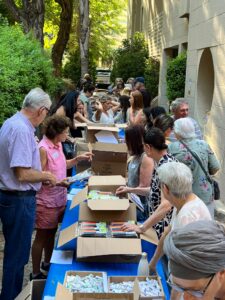
Telfed volunteers in Raanana packing children’s school startup gifts
It was against this backdrop that Telfed volunteers came together in Ra’anana to take on the 1 000 Bag Challenge, packing the gifts for frontline community children from Kita Aleph (Grade 1) upwards.
The entire project was made possible by the generosity of an anonymous donor, who sponsored the 1 000 bags and their contents. Pencils, markers, games, other school supplies, and treats filled each one. The project carried a simple message to these families: we are still with you.
That commitment extends far beyond one project.
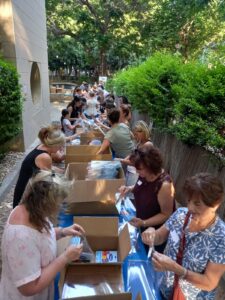
Telfed volunteers packing the school startup gifts in Raanana summer
For the third consecutive summer, a team of Telfed volunteers travelled to Nir Am, near the Gaza border, to plaster and paint walls, clean and organise rooms, and tidy playgrounds, helping create welcoming spaces where children can learn, play, and simply be children.
The reality surrounding them was difficult to ignore. Shortly after the volunteers left Nir Am, two kites from Gaza landed in nearby communities. Less than a decade ago, incendiary kites launched from Gaza caused widespread fires along the border, destroying agricultural land and nature reserves.
A Nir Am resident told volunteers that even during quieter periods, a sense of unease remains and communities continue to carry the effects of what they have experienced.
Nearly three years after 7 October, the willingness of volunteers to continue giving their time has made a particular impression on Telfed chairperson Maish Isaacson.
“People talk about volunteer fatigue. We’re seeing the opposite. It can be 40 degrees outside. People are sweating, working hard, and they leave energised, wanting to come back and do more” he said.
“I’m honestly in awe of how resilient and generous our community is. Time is precious, and yet people keep choosing to give it. I think that says something pretty special about our community and it’s something we should be proud of.”

And the work continues. As Rosh Hashanah approaches, Telfed is preparing packages for soldiers who remain on duty along Israel’s northern border.
Over the past three years, Telfed’s support for communities affected by the war has evolved as their needs have changed, from emergency assistance to rehabilitation, educational support, community projects, and volunteering.
Today, children are heading to school, parents are returning to familiar routines, and there is room for optimism. But there are also soldiers still serving, families still dealing with the impact of war, and communities where the return to everyday life has not erased the trauma.
The emergency may no longer dominate every headline, but recovery doesn’t happen overnight.
Being home isn’t the end of recovery. And for Telfed, it’s not the end of its commitment.