Achievers
A good deed: Khaya Lam turns tenants into homeowners

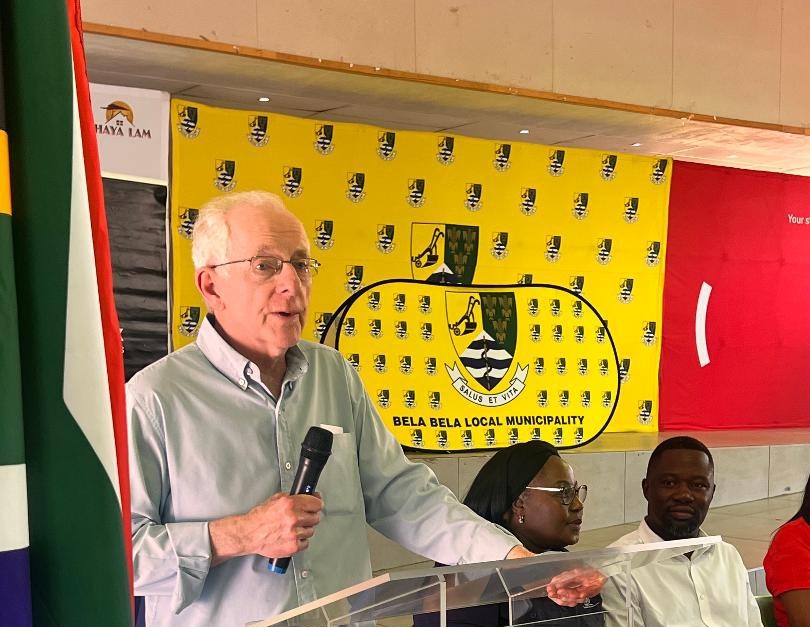
Khaya Lam executive Terry Markman is audibly moved when speaking of the joy that emanates from those who receive title deeds to their properties after decades of being denied this right. It’s the result of the work of Khaya Lam (My Home), an initiative of the Free Market Foundation (FMF). Khaya Lam has been awarded the Bertie Lubner Humanitarian Award in honour of Chief Rabbi Cyril Harris.
In some cases, those who receive title deeds to their property have been living in their houses for 30, 40, and even 50 years, says Markman. “These handovers are what it’s all about. You might see a woman in her late 90s, who hasn’t owned a property all her life, getting her title deed. “She says, ‘Now I can die, and my children can get the house.’” I’m emotional just talking about it.”
Searle Sacks, the manager of the Free State Khaya Lam branch, says the handovers make the immense frustration that come with dealing with sometimes dysfunctional municipalities worthwhile. “When you hand out the title deed to somebody who is 106 years old, who walked to and from the venue to collect her title deed, I can’t explain the feeling that you get.”
David Ansara, chief executive of think tank and policy advocacy group the Free Market Foundation (FMF), active in South Africa for 50 years, says Khaya Lam reflects the group’s philosophy. “One of the FMF’s core principles is private property rights, around which we do a lot of advocacy work,” he says. “Providing people with these rights is a way of empowering them to be free individuals, to make their own choices, and to be agents of their own future.
“We believe that as an individual, you have the inalienable right of ownership, and that your rights as a human being extend to your possessions. That’s critical not only for economic development, but also in terms of respect for people as human beings, you don’t arbitrarily seize their wealth or property.
“So, while we’re critical of expropriation without compensation, we believe in affirming people’s property rights. Unlike many other think tanks, we therefore have a very practical component, which is the Khaya Lam project.”
The project dates back to apartheid, which instilled a long history of deprivation of private property rights. This came in the form of the Group Areas Act and other pieces of legislation which controlled where people could live and denied many black South Africans ownership rights. Yet, at the end of apartheid in the 1990s, the state in most relevant municipalities relinquished ownership of council-owned properties. “So, people who used to be tenants of the council, effectively became the owners of these properties,” Ansara says.
In many instances, there are families who had been living, sometimes for generations, in these properties that they had always rented, he says. “While everybody in the community now recognises them as the rightful occupiers of that home, they don’t have a title deed to prove their ownership status. That’s where the Khaya Lam project comes in – to assist with the transfer of the title deed from the municipality to the owner. And so, that individual, and by extension his or her family, becomes a legitimate owner of that property.”
The economic benefits this brings include intergenerational wealth transfer and having an asset that can be leveraged to acquire a loan or to use as collateral, Ansara says. “Beyond the upward mobility and economic advancement this offers is the principled moral argument that poor South Africans deserve the same protections as wealthy or middle-class citizens do. It recognises their fundamental dignity as human beings.”
Ultimately, Khaya Lam is about formalising property ownership rights. “We work with the municipalities, signing a memorandum of understanding to help identify which properties fit these criteria,” Ansara says. “Then we commission conveyancers to facilitate the transfer process. As the volume of the transfers is so high, conveyancers can give us beneficial rates, enabling us to do a successful full ownership title deed transfer for R3 750.” Funds are provided by private donors, and are separate from the institutional funding of the FMF.
The Khaya Lam idea germinated between FMF directors Leon Louw, Eustace Davie, and Temba Nolutshungu. Khaya Lam was spearheaded in 2010 by businessman and farmer Perry Feldman, who, upon retiring, decided to work on acquiring title deeds for applicable property owners in his hometown of Parys. As early as 2008, Feldman approached Markman, a close friend associated with the FMF, which he thought would be an effective collaborator.
In 2010, the FMF received funding from First National Bank to do a pilot project formalising 100 transfers in the Free State, a process that took three years to complete. The successful transfer of 100 title deeds in 2013, 100 years after the Natives Land Act of 1913 which deprived many black South Africans of private property, was symbolically significant.
Perry continued running operations on the ground in the Free State until he passed away from COVID-19 in 2021. Thereafter, Markman came to the fore as the leader of Khaya Lam. Though he admits that the role came with a steep learning curve and still requires constant perseverance, the project has grown exponentially.
By early 2023, Khaya Lam had facilitated 10 000 title deed transfers; today, just two and a half years later, about 21 000 deeds have been transferred.
Khaya Lam is funded by many private donors, but the majority of its funding has come from billionaire businessman Johann Rupert. The team attributes a big part of the project’s success to Rupert, whose father, Anton, was involved with the FMF in the late 1970s. Yet, Khaya Lam remains a capital-intensive project that will require recapitalisation in the new year, they say.
In terms of operations in the Free State where much of the work is done, Markman has been supported by Searle and Lorna Sacks. The couple also live in Parys, and took over upon Feldman’s passing. “Perry and I were partners in business forever,” says Searle, “and he married my cousin, Veronica.” Through their close relationship with the Feldmans, the Sacks couple were familiar with Khaya Lam.
“Perry was so passionate about this, we felt, it’s just such a good cause,” says Lorna, who serves as associate manager, explaining how she and her husband got involved. “We would also like to give back to Parys; we’ve had such a wonderful life here.”
Lorna says Feldman would have been thrilled by Khaya Lam winning a Jewish Achiever Award. “I wish he could see it. It would have meant absolutely everything.”