





News
Visiting Palestinian pastor pushes Christians to reject Zionism

Many South African Christian leaders have rejected a call by a visiting Palestinian pastor urging Christians to abandon Zionism, arguing that his claims distort scripture, erase Jewish history, and collapse theology into political activism.
The pushback has come despite the visiting Palestinian Lutheran pastor, Reverend Dr Munther Isaac’s stated aim of persuading Christians to rethink their theological relationship with Israel.
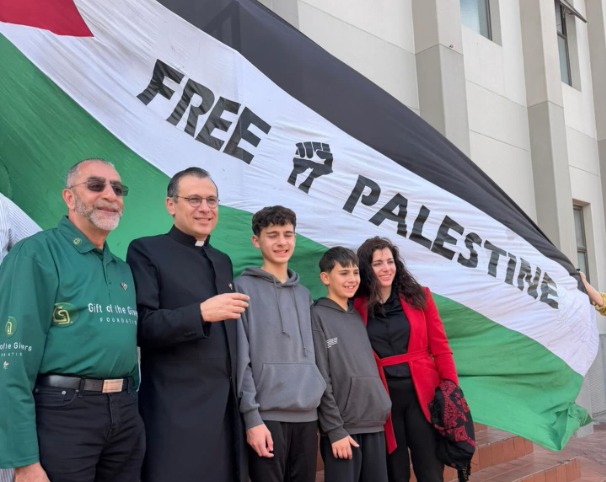
Isaac was brought out to South Africa as a guest of Gift of the Givers, which has framed his visit as a break from life in Palestine, allowing him, his wife, and two sons time to rest and enjoy the city. He spoke out at a public address at the Gatesville Mosque in Cape Town on Friday 2 January 2026.
Isaac, who is based in Bethlehem in Israel’s West Bank, serves as senior pastor of the Christmas Lutheran Church and is widely known for advancing Palestinian liberation theology through sermons, books, and international speaking engagements. He has also been a prominent figure in global Christian debates about Israel, Zionism, and the Palestinian cause, often positioning his theology as a moral challenge to Christian support for the Jewish state.
Gift of the Givers maintain that he was only speaking at Gatesville this visit, but a tour of South African churches is planned for later this year.
His talk on 2 January was organised by the Coalition for Good, Gift of the Givers, and the mosque, and was said to be a humanitarian and solidarity interfaith gathering.
However, Isaac’s speech at the pulpit was focused on urging Christians worldwide to reject Zionism, arguing that it is incompatible with Christianity. Although he has made similar claims in books, sermons, and articles over many years, critics say the setting of this address gave the message a sharper political edge, placing Christian theology within a broader activist framework rather than an internal church debate.
The South African Zionist Federation (SAZF) maintained that Isaac’s call forms part of what it described as “a growing, coordinated campaign urging Christians to reject Zionism”.
SAZF spokesperson Rolene Marks said his speech “is not a neutral moral intervention but a strategic attempt to delegitimise Jewish self-determination by targeting Christian Zionism and, by extension, challenging Christians’ fundamental biblical beliefs about the Jewish people, the State of Israel, and the theological foundations of their faith.
“Christian Zionism remains one of Israel’s most enduring sources of international support precisely because it is rooted in scripture, not political expediency,” said Marks. Reframing those beliefs as morally suspect, she said, seeks to fracture support for Israel by casting biblical conviction as ethical failure.
A central concern raised by Marks is what Isaac’s appeal omits. “Reverend Isaac’s open letter and petition (circulated on 20 October 2025) makes no reference to the 7 October massacre, the murder of Israeli civilians, the taking of hostages, or terrorism. Hamas is not mentioned once,” according to Marks. “A moral appeal that erases Jewish victims, omits the perpetrators of violence, and reframes biblical covenantal beliefs as moral failings forfeits ethical credibility.”
Many objections have also come from within South Africa’s Christian community, particularly from pastors who argue that Isaac’s message reflects a theological departure rather than a prophetic corrective. Pastor Brad Espin of Church on the Rise links growing Christian hostility towards Zionism to replacement theology, which interprets biblical promises to Israel as symbolic and transferred entirely to the church.
“I am so disappointed that because of replacement theology many have no understanding of the church and its role towards Israel,” Espin said. “Many Christian pastors are deceived and are misleading their congregations.”
Espin warned that the church stands at a critical juncture. “We are at a crossroads and in 2026 there is going to be an even greater divide in the church,” he said, adding that “those that have experienced the realisation of Islamist ideology are rising up in the Western world and South Africa and the church needs to wake up before it’s too late”.
Pastor Thom Thamaga of Without Walls Christian Family Church offered a more extensive critique, challenging the framing of Isaac as a neutral Christian voice for peace. “This announcement deserves careful scrutiny, not emotional applause,” Thamaga said. “Munther Isaac is being presented as a neutral ‘Christian voice for peace’, yet his theology and public messaging tell a very different story.”
Thamaga argued that Isaac’s message is “not balanced, not reconciliatory, and not biblically grounded”, describing it as “a form of political theology that selectively condemns Israel while remaining largely silent on terror, extremism, and the persecution of Christians across the Middle East”.
“Theology matters,” Thamaga said. “Calling something ‘Christian’ does not automatically make it biblical. Reverend Isaac’s theology reduces Christ to a political symbol and recasts the Gospel into an ideological weapon.”
He also criticised what he described as selective moral outrage. “Any theology that condemns Israel while ignoring Hamas terrorism, Iranian sponsorship of violence, and the collapse of Christian populations in Gaza, Syria, Iraq, and parts of the West Bank is not pursuing justice, but promoting a narrative,” he said.
Thamaga expressed particular concern about the use of religious material in legal contexts. “The fact that his sermon was cited in South Africa’s International Court of Justice case should alarm Christians,” he said. “Sermons are not legal evidence. When theology is weaponised in international courts, faith is no longer prophetic, it becomes political propaganda.”
Bafana Modise, spokesperson for the South African Friends of Israel, also rejected the premise that Christianity and Zionism can be separated. “The reality is that Christianity is built on Zionism,” he said. “The biblical story itself has always been about returning to the homeland, returning to Israel.”
Modise argued that rejecting Zionism requires rejecting scripture itself. “You cannot then say you are a Christian, but yet you reject Zionism,” he said. “Zionism and Christianity are intertwined. They cannot be separated because one validates the other.”
He warned against what he described as historical revisionism driven by contemporary politics. “We are living in a world where people are trying to reverse history, trying to rewrite history. The words have lost meaning,” Modise said. “We should remain firm in our identity, in our faith, and not allow those who try to dilute or reframe the reality as we know it.” On whether Isaac should be publicly debated, Modise expressed scepticism. “What he’s proposing on its own is debatable, but that will give him credibility,” he said. “Let him sing to his congregation.”
South Africa’s history gives Isaac’s language particular resonance. His use of apartheid-era framing and liberation theology connects with deeply rooted moral narratives. Yet critics argue that applying these frameworks to Israel risks flattening historical and theological complexity. As Thamaga cautioned, “You can care about Palestinian suffering without demonising Israel. You can pursue peace without rewriting scripture.”
Isaac’s address at the Gatesville Mosque has become more than a single speech during a visit framed as rest and recovery. It has crystallised long-standing tensions within South Africa’s churches over theology, identity, and political alignment. At issue is not only the Israeli-Palestinian issue, but how Christian leaders discern the boundary between prophetic witness and ideological activism.





Mark Wade
January 6, 2026 at 9:52 pm
Without Judaism, and without the Torah, and without Jesus – a Jew – there would be no Christianity. They plagiarised the Torah, renamed it the Old Testament, added the New Testament, and re-branded Jesus as the ‘son of (their) G-d’. Even their statues of Jesus nailed to a cross has the inscription ‘INRI’ above his head that translates to English from Latin (written by the Romans) as ‘Jesus of Nazareth, King of the Jews’ (that is totally false too) – it was the same Romans who renamed Judea to ‘Syria Palaestina’, to sever the connection between Jews and their Holy Land. Further, ‘Zionism’ is belief in the self-determination of Jews in their biblical homeland – it’s quite simply ‘nationalism’ – that every Jew has the right and obligation to support.
Ian Levinson
January 7, 2026 at 12:09 am
Thank you Mr Sooliman for establishing that Gift of the givers is not an aid agency but just another antisemitic trade union. Now if Mr Sooliman did his homework he would clearly know this.
A delegation from the leadership of the Zion Christian Church and his Grace reverend Bishop Dr Barnabas Lekganyane is visited Israel from 17 to 25 October to focus on engaging with the Christian Heritage in Israel.
Bishop Lekganyane met with Israeli President Reuven Rivlin and the South African diplomatic representatives in Israel to strengthen relationships between Israel and the Christian community in South Africa.
ZCC is the biggest Christian church in South Africa.
Alfreda Frantzen
January 7, 2026 at 7:36 am
I’m afraid that nowadays anything to do with Suleiman is suspect
jason iblis
January 10, 2026 at 7:17 am
trans-substatiate yourself Rabbi Isaac, and take all your succubi with you.
Every feature of your religion is Jewish.
Most utterances about Jews never feature as original inhabitants in the 19 th Century.
Meanwhile St Sylvester is turning in his grave since as pope he forbad Jews from living in Jerusalem
Now we celebrate Silvester’s night in Jerusalem.(new Year’s Eve”)
Yitzchak
January 12, 2026 at 11:45 am
Furthere more lets not forget Luthers contribution to the growth of antisemitism in germany and Europe.with the massive inferno in the 20 C.
Wittenberg is synonymous with luther but so is the Judensau the Jewish sow where Jews suckle off a pig.Still in the frieze at a church which luther approved of.
SO does pastor isaac understand why Jews live in Israel.Shame on him.
So all the shouts to start the Intifada have begun in Iran.Dirco can send pandor as our emmissary to negotiate