World
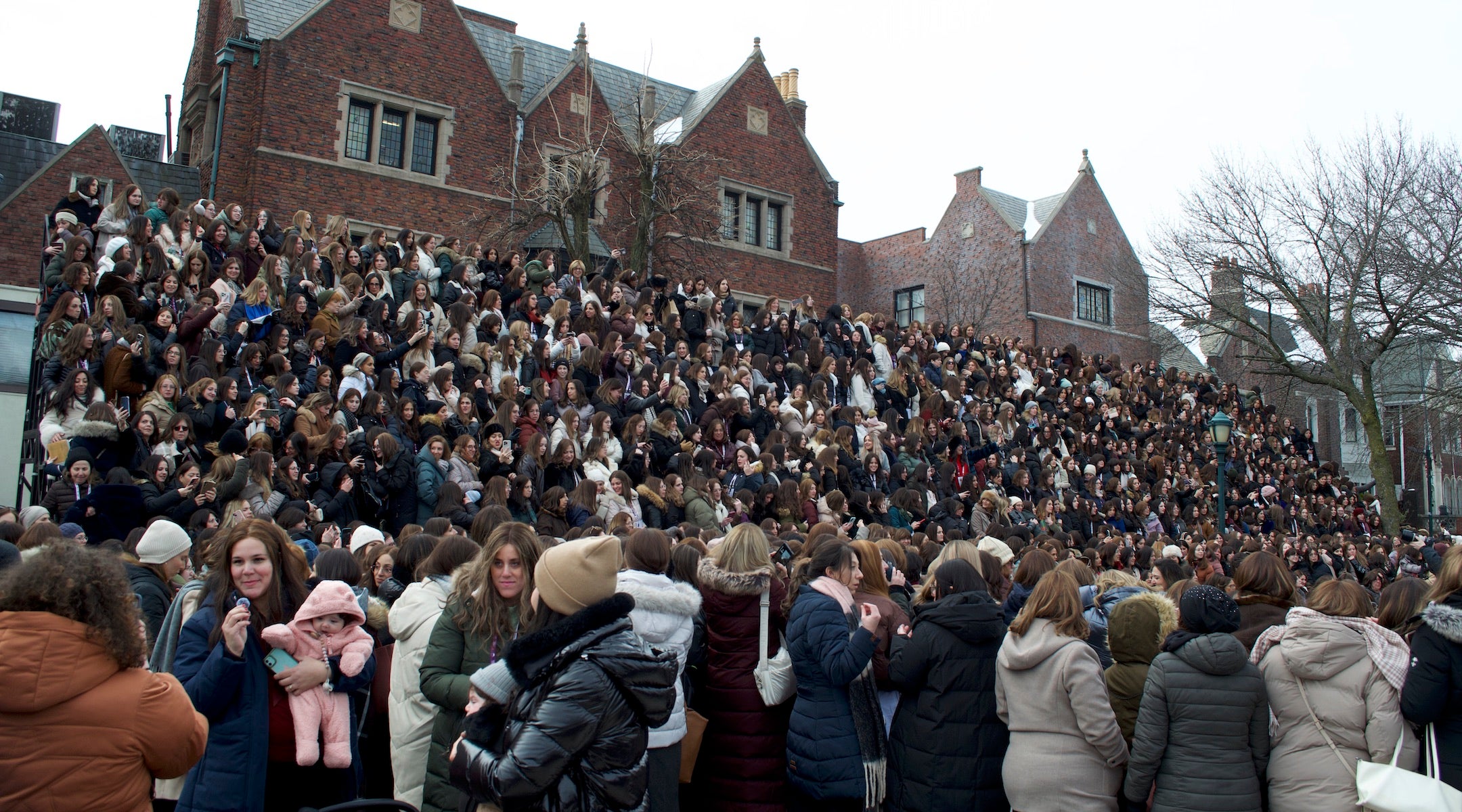
From far corners of the Jewish world, the women of Chabad gather in freezing Brooklyn

JTA – It was close to 90 degrees Fahrenheit (32°C) back home in Dar es Salaam, Tanzania, on Friday, 6 February, but Chani Aziza said she was thrilled to be freezing on a sidewalk in Brooklyn.
Aziza was one of thousands of women affiliated with the Chabad-Lubavitch movement who gathered in Crown Heights this week for the movement’s annual gathering of female emissaries. Aziza, who moved to Dar es Salaam with her husband and two children three years ago as Chabad’s first emissaries there, is used to cooking all of their centre’s food from scratch. No kosher prepared foods are available in Tanzania.
Now, as she braved frosty temperatures to pose in Chabad’s signature group photos, she said she was looking forward to visiting the many kosher establishments in the area, including the sushi restaurant Noribar.
“My friend just told me, like, enjoy it, you can eat whatever you want,” said Aziza. But she said the gathering had a more serious upside, too. “It’s fun also to come here to take power, see this amount of shluchos, everyone in different places and different challenges.”
The women in Crown Heights, hailing from more than 100 countries where the Chabad movement maintains a presence, were taking a rare break from the frontlines of serving as what is often the only Jewish presence in their communities. As their husbands fulfil rabbinic duties, female emissaries take on a wide range of responsibilities, from managing their Chabad centres’ educational programming, to supporting community members through crisis, to making sure that Shabbat meals are prepared, often while raising their own families far from extended support networks.
“We give the entire year. Our lives are all about giving, and today it’s about filling up our cup to make sure that we are receiving,” said Dinie Rapoport, who serves on the executive committee for the conference. “The goal of this conference is for us to come and be renewed and rejuvenated, to be able to continue this mission, spreading Judaism throughout the world.”
Beyond the host of programming offered during the conference, including a visit to the gravesite of the Chabad-Lubavitch movement’s late leader and several panels and workshops, many of the emissaries said they were excited for the chance to connect with peers.
“I was so looking forward to this year,” said Devorah Leah Kalmenson. “You get so much energy just from coming and just seeing people and, like, they take care of you.”
Kalmenson moved to Leeds, England, three years ago when she was 22 to help lead the Chabad centre’s youth programmes, including five day camp sessions per year.
“I have two boys, so a lot of times the hours end up being when my kids are sleeping and just getting the schedules out and planning and registration,” she said.
The Chabad movement operates 500 Jewish day camps in locations around the world as well as six overnight camps. The camp sector of the Orthodox movement’s programming is expanding amid a push to engage more young families.
Though Kalmenson said she had experience helping her parents run the Hebrew school and camps at the Chabad centre in Vilnius, Lithuania, she had received training from CKids, the Chabad movement’s youth programming arm.
“I did a lot of different workshops and programmes. CKids is also very good with educating how to run things and how to work with kids – discipline, I did an early childhood course and things like that,” said Kalmenson.
Kalmenson said she had also often relied on the guidance of other female emissaries as she navigated the challenges of running childcare programming.
Perel Krasnjansky was 25 when she first moved to Honolulu in 1987 to serve Hawaii’s only Chabad centre at the time. She quickly started a Hebrew school which has 45 students enrolled. She said she still works anywhere from 12 to 18 hours a day, seven days a week.
“It was like landing on the moon, and in 1987, don’t forget, there was no internet, no WhatsApp, there were none of these supportive networks,” said Krasnjansky. “I have to say it was extremely challenging, it was extremely lonely.”
But Krasnjansky said female Chabad emissaries today have access to a level of connection and support that simply didn’t exist when she first went out, a shift she said had transformed the experience of serving in far-flung communities.
“Today, the young girls that do go out as far out as they go, they don’t have that extreme sense of loneliness we did in the 1990s, that sense of being cut off and unmoored from everything you’ve ever known and loved,” said Krasnjansky.
The gathering took place in the shadow of two recent Chabad traumas, coming just more than a week after a man was arrested for ramming his car repeatedly into Chabad’s world headquarters, the backdrop of the group photograph at 770 Eastern Parkway. A month earlier, two gunmen had killed 15 people at a Chabad Chanukah party in Sydney.
Rabbi Mendy Kotlarsky, the director of the International Conference of Shluchos, said Chabad had partnered with the New York Police Department and Counterterrorism Bureau to arrange security for the event, and had been “scouring social media” for “mischievous activity”.
“Obviously, in a year like this, the past few years, security is a top item across the board internationally for all of our events,” said Kotlarsky. “It’s a new reality that we live in.”
The danger, he said, “at the same time, recommits us to making sure that we give them the best experience when they come here, that these ladies can go back home to Bondi Beach or to the most remote places in the world, whether it’s Cambodia or Ghana, and are able to stand proud and share the Jewish message”.
Laya Slavin, the co-founder of the Sydney-based non-profit organisation Our Big Kitchen, said many of the female emissaries from Sydney hadn’t come to the Crown Heights gathering in the wake of the Bondi massacre because of the amount of work needed at home.
She said she had debated making the trip herself before eventually deciding to come, saying she had taken inspiration from Rabbi Eli Schlanger, the emissary in charge of Chabad of Bondi who was killed during the attack.
“I had missed my flight, and I said to my husband, that’s it, I missed my flight, I’m not coming, I’m not meant to be here,” said Slavin. “There is so much to do in Sydney. I mean, as I was flying, we have 50 volunteers baking 500 challahs to deliver out on Bondi Beach. I’m like, what am I doing here? I need to be in Sydney. But then again, you have that message from Rabbi Eli.”