





Banner
Watching Iran as fear, hope, and memory collide

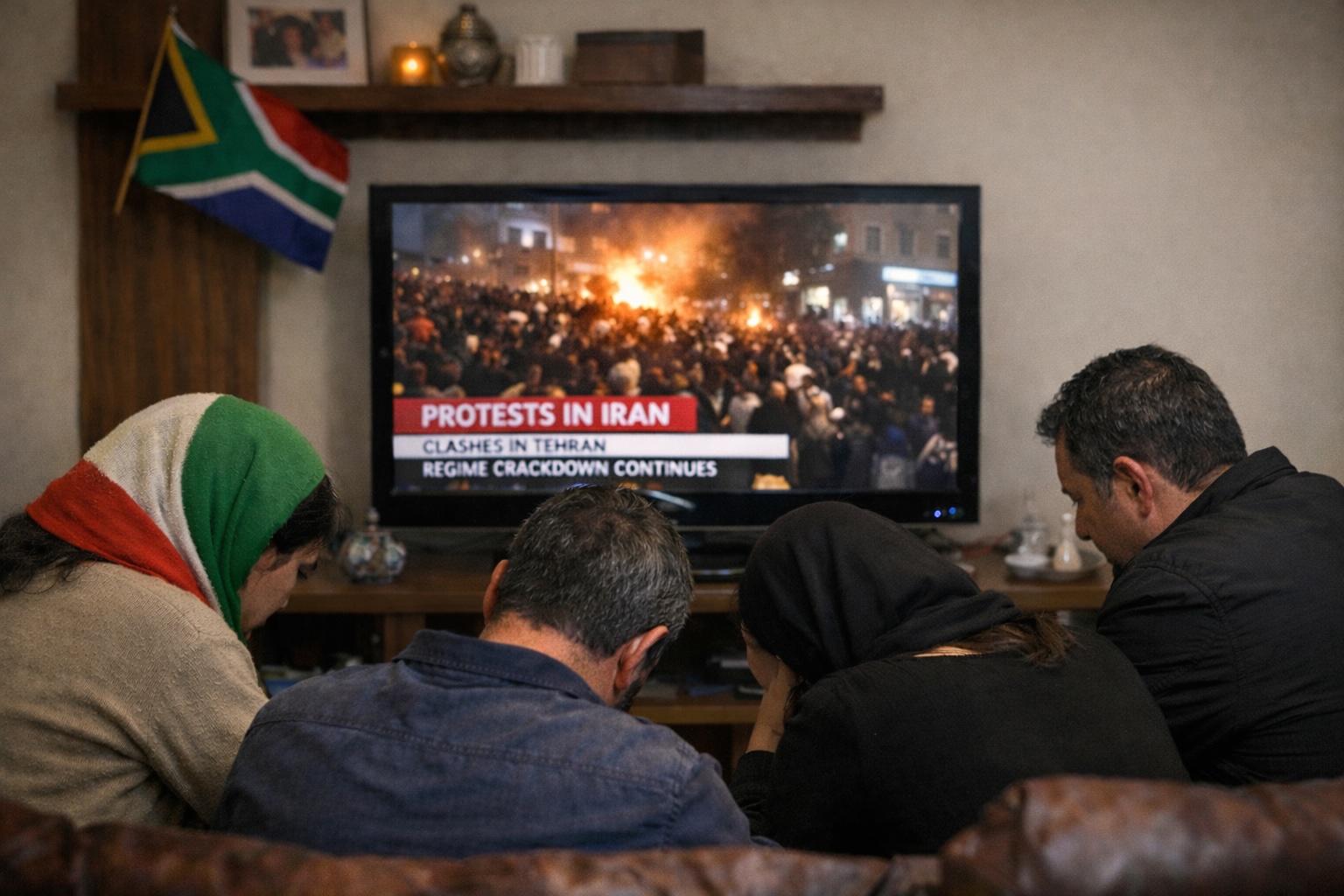
As angry protesters fill Iran’s streets, chanting against clerical rule, the shock waves have travelled far beyond Tehran. They have reached living rooms in South Africa, where Iranians and Jews of Iranian descent watched events unfold with a mixture of hope, fear, scepticism, and historical memory.
Adam*, who left Iran as a teenager and now lives in South Africa, is cautiously optimistic about the protests. “Delighted, to put it lightly,” he told the SA Jewish Report this week.
Having left Iran partly to avoid compulsory military conscription, Adam says he rejects the idea that the system reflects popular will. He estimates that only a small minority benefits directly from the ruling structure. “The people at large are pleasant, welcoming, intelligent,” he says. “It’s a wealthy country kept poor because resources are diverted away from citizens.”
He says contact with relatives inside Iran has become increasingly fraught. Families are careful about phone calls and messaging, aware that surveillance is pervasive and the consequences unpredictable. That fear, he says, creates a sense of powerlessness among those watching events unfold from abroad.
Protests began across Iran in late December continuing into January 2026, with demonstrators in many cities demanding political change. Since then, Iranian security forces have been brutal, using live ammunition on protesters, perpetrating widespread arrests, and orchestrating internet blackouts.
Human rights groups and activists report that potentially thousands of protesters have been killed in the crackdown, though precise figures are difficult to verify because of communication restrictions and state censorship.
For members of the Iranian Jewish diaspora in South Africa, the renewed unrest revives questions that stretch back generations. Some families left Iran more than a century ago. Others arrived more recently, in the decades following the 1979 Islamic Revolution. Their perspectives differ, yet all are shaped by an understanding of Iran as a country with a rich civilisation and a long history of tension between authority, religion, and personal freedom.
Barry*, who was born in Durban, is two generations removed from Iran. His father’s family came from Mashhad in northeastern Iran and left toward the end of the nineteenth century, first for Israel and then for London. His father later settled in South Africa. Barry says the physical distance from Iran has never fully severed the emotional connection.
“My father integrated into an Ashkenazi community here, but he kept Persian customs at home,” he says. “The way he davened, the way he made kiddush. That history was always present, even if we were far away.”
Mashhad holds particular significance in Jewish history. Jews there lived for centuries under severe restrictions and periodic violence, often forced to convert outwardly while practising Judaism in secret. Barry recalls family accounts of Jews treated as second-class citizens, with limited rights and constant vulnerability. Conditions improved under the Shah, he says, particularly for minorities, though the sense of insecurity never entirely disappeared.
Under the Shah’s secular rule, Jews could practise openly and participate in public life. The 1979 revolution fundamentally altered that environment. Though Judaism remains officially recognised, public expressions of support for Israel are forbidden and political dissent is tightly controlled. Barry says Jewish communal leaders often feel compelled to echo state positions in order to ensure communal safety.
“As long as you toe the party line, you are left alone,” he says. Barry believes most Iranians want moderation rather than ideological extremism. He describes Iranians as pragmatic and commercially minded, focused on economic opportunity and stability. In his view, the central grievance isn’t abstract politics but the inability to live with dignity.
“They want a normal life,” he says. “They want the government to focus inward, not on projecting power outside the country, but on fixing infrastructure, water shortages, and the economy.”
His perspective is shaped by growing up in South Africa. “It’s completely antithetical to my way of thinking to see extremism imposed on everyday life,” he says. “Iran could be a great country. The people are educated and capable. What’s missing is freedom.”
Chaim*, who was born in Iran, later moved to Israel, and has lived in South Africa for decades, says he doubts street protests alone can bring about meaningful political change, and believes previous cycles of unrest offer a sobering lesson.
“I do not see them getting rid of this regime,” he says. In his view, lasting change would require rupture from within Iran’s centres of power rather than pressure from the streets or from foreign governments.
Chaim places the current unrest within a longer historical arc. He points to Iran’s ancient civilisation and traditions of ethics and human dignity that predate Islam. He argues that the governing ideology sits uneasily with much of Iranian cultural identity.
For Chaim, the unresolved tension between culture and clerical rule remains deeply painful. He estimates the Jewish population in Iran at between 15 000 and 20 000 people, concentrated mainly in Tehran. Survival, he says, depends on discretion. “They do not get involved in politics. They keep to themselves, and the regime leaves them alone.”
Across these differing perspectives runs a shared sense of sorrow for ordinary Iranians whose lives are constrained by forces beyond their control. Even those who doubt that the protests will succeed see them as an expression of profound frustration and exhaustion.
For South African Jews of Iranian origin, the crisis inevitably resonates with local history, though most are cautious about drawing direct parallels. Iran’s internal dynamics, they stress, are shaped by centuries of culture, trauma, and external interference that resist simple comparison.
What unites these voices is a refusal to reduce Iran to headlines or slogans. They speak of a country richer and more complex than its rulers, and of a people who continue to assert their humanity despite repeated setbacks.
From thousands of kilometres away, Iranians in South Africa continue to watch, worry, and debate. Their connections to Iran differ in immediacy and intensity, but the unfolding events remain deeply personal. As Barry puts it, “All societies should have room for everybody. That is what people are asking for. It’s not radical. It’s human.”
*Names have been changed to protect family members of interviewees still living in Iran.





yitzchak
January 16, 2026 at 7:17 am
so as we wait in suspense ,DT has dispatched the AbrahamLincoln Aircraft carrier to the Persian gulf.
(Now called the Ibrahim Lincoln).AL was a great liberator for freedom inthe civil war in the USA.
That our freedom is recalled this Shabbat Vaeyra where Moses gives Pharoah a shtup in tochos. Khameini is the new Pharoah in a line of tyrants.We all know that including DT.
In ending a chess game we say “check mate” from Persian /arabic Shah mat or the shah is dead.Long live the Shah.!
Failing a strike it seems though that a long civil war awaits Iranians.
Our local “M and M’s”( Moslems and marxists) mistook the pratley putty for chewing gum .Now their tongues stick to their palates.The shtum pills have taken effect. So will the Iranians be celebrating Al Quds day this year at the end of Ramadan? Has DT outlawed the local branch of the Moslem Brotherhood and their ancilliaries? They are like the old Commintern of communism now relabelled the “Islamintern”
Ian Levisnon
January 19, 2026 at 7:52 am
The ANC struts around as the “champion of justice” at the ICJ, yet when Iran slaughters 16,500 protesters in cold blood, they vanish into the shadows. Where are your marches, your varsity protests, your fiery speeches? You mobilize students against Israel, but when Tehran’s bullets tear through young Iranians, you’re mute. Selective outrage is cowardice. If the ANC truly stood for human rights, Pretoria would already be at The Hague filing charges against Iran. Instead, you prove your “solidarity” is nothing but politics dressed up as morality