





OpEds
One hundred percent conspiracy, real-life consequences

In my world – the film industry – I deal in narratives. I know how stories are built. I know how angles are chosen. I know how a villain can be created with lighting, music, and selective editing. And I also know how easily an audience believes what it’s shown when the framing is confident enough.
That’s why what happened recently between our Jewish school and a prominent Johannesburg girls’ school over a simple tennis fixture hit differently.
Because it wasn’t about tennis.
It was about narrative.
It reminded me how quickly a minority can become a storyline.
In South Africa, we are approximately 65 million people. Roughly 0.05% of the population are Jewish. Statistically insignificant in size, and yet, somehow, consistently significant in accusation.
That disconnect fascinates me.
As a producer, if someone pitched me a script where 0.05% of a country secretly held overwhelming power over the other 99.95%, I’d push back on the logic. The maths doesn’t track. The premise feels lazy. It’s too convenient. It’s a trope that’s been written before, and it never ends well.
But outside of filmmaking, that trope still gets traction.
Because here’s the uncomfortable psychology. It’s easier for a majority to feel threatened by a minority if that minority is visible, cohesive, and resilient. Especially if that minority values education, community, and ambition. Success in pockets can be misread as control. Unity can be misread as conspiracy.
And when tension exists, either politically, socially, or globally, it becomes even easier to pass the buck.
Who cares about the small kid? Who cares about the tiny group? It’s easier to isolate them than to interrogate bigger systemic issues.
In film, we call that a shortcut. A lazy device. A way to move the plot forward without doing the hard character work.
In real life, that shortcut has consequences.
The tennis-match situation wasn’t about rackets and balls. It was about how quickly people are willing to believe a narrative about Jews that doesn’t match the numbers, doesn’t match the reality, and doesn’t match the individuals involved.
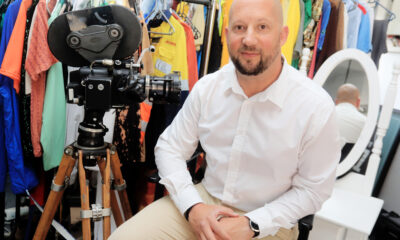
We are doctors, lawyers, creatives, entrepreneurs, teachers. In my case, I produce commercials and films. I employ diverse crews. I work across communities. I spend my life trying to tell authentic South African stories.
No ulterior motive, it’s just work … something I enjoy doing!
But minorities don’t get the luxury of just being individuals when a narrative kicks in.
And here’s the irony I keep coming back to. If our small community genuinely had the kind of coordinated power that conspiracy theories assign it, wouldn’t the evidence be obvious? Wouldn’t the structures of society look fundamentally different?
The reality is far less dramatic. Jews survive not because of hidden dominance but because of visible resilience. We invest in education. We build institutions. We look after each other! We also argue with each other constantly. Most importantly, we hold onto identity tightly because history has taught us what happens when we don’t.
That resilience can look like “power” to someone who feels insecure. But resilience isn’t domination. It’s survival.
As someone who lives in storytelling, I know how powerful framing is. And I also know how dangerous it becomes when fiction bleeds into public belief.
The majority is not numerically threatened by 0.05%. That fear is psychological, not mathematical.
And maybe the real strength of a society isn’t measured by how comfortable the majority feels when it’s unchallenged. Maybe it’s measured by how secure it feels when a minority thrives openly beside it.
Because when a tennis match becomes political, when school sport becomes ideological, when children inherit adult narratives, that’s when we should pause.
Not because a minority is powerful, but because a majority is uncomfortable.
And that discomfort says far more about the storyteller than the subject.
- Adam Thal is a multi-award winning South African filmmaker and executive producer, who is known for bringing powerful human stories to global audiences.




Ben vd Merwe
February 15, 2026 at 8:51 pm
Hi
My name is Ben vd Merwe. I am 70 years old and a christian that would like to learn Hebrew so that I can understand some Hebrew in the original scripts of the Old Testament.
I live in Vereeniging and would love to meet some real Hebrew people near me.
Ian Levinson
February 17, 2026 at 12:56 pm
As someone who’s worked in film as well, I know how framing can turn perception into “truth.” That’s why the tennis fixture saga hit hard — it wasn’t about sport, it was about narrative. A 0.05% minority being painted as all‑powerful is a lazy trope that wouldn’t survive a script meeting, yet it thrives in real life because resilience gets misread as dominance. The danger is when fiction bleeds into belief — and when kids inherit those adult narratives, the consequences are real.
Noga Patz
February 19, 2026 at 4:29 pm
When the State of Israel was established Jews around the world walked taller. No longer the stateless nomads, they now had a place to call home. Recently, however, (and especially since the 7/10 atrocities) there has been a reversal. Jews everywhere are being held responsible (by association) for the Israeli Government’s policies and actions. Thus, the King David tennis team was perceived as a threat to a small group of parents within the Roedean community. We are all painted with the same crude brush of anti-Semitism masquerading as anti-Zionizm. Love All?