





Featured Item
Putting people first – setting a clear line on SA’s foreign policy

South African foreign policy has strayed from Nelson Mandela’s intentions to put human rights first. In a world of great shifts and challenges, we have to take care to be on the right side of the line that divides prosperity from poverty, democracy from authoritarianism, and the national interest from radical interest groups.
To remain true to South Africa’s once emblematic foreign policy brand of negotiation and reconciliation, we would be better off maintaining lines of diplomatic communication with Israel than attempting its isolation.
“‘If a man knows not to which port he sails, no wind is favourable,” reminds the Roman philosopher and statesman Seneca.
We live in a time of enormous geopolitical change and confusion. In this world, we need to be sure of our foreign policy direction.
It should be directed at promoting the interests of South Africa and all of its citizens – not just the elite or members of one political party – in the international arena.
The world should see a great country at work, managing its differences, and making a positive contribution to regional, continental, and global affairs.
There’s a line separating what is in South Africa’s interest from what isn’t. And on that line are several important waypoints.
The most important of these is to deliver economic growth and security at home. Between 2013 and 2024, the wealth of the average global citizen increased – in real terms – by more than 21%, and across East Asia by nearly 48%. However, over the same period, South Africans became 7.5% poorer, while sub-Saharan Africans remained relatively stable.
If we don’t gear our foreign policy to address this growth deficit, we are dooming South Africans to lives of joblessness, social upheaval, and insecurity. Jobs hinge on growth, and that is driven by more investment and trade.
In this way, foreign policy begins at home. This requires removing constraints to trade, whether logistical or political, and in the process, managing interest groups.
Democracy is our second waypoint on this divide between right and wrong.
There is a clear, empirical correlation between democracy and development across Africa, whatever the case elsewhere.
Kofi Annan, the great African multilateralist, often emphasised that “democratic systems of government can help them develop habits of compromise, cooperation, and consensus building” when addressing deep-rooted conflict. He also stated that “democracy will remain the system best suited to protect and deliver peace, development, human rights, and the rule of law” in containing safeguards against military adventurism and by promoting transparency.
South Africa’s transition from apartheid to democracy has made this a foundation stone of our constitutional order.
And yet, at the heart of our foreign policy dysfunction, is a drift away from projecting our core identity, which values democracy, strong independent institutions, openness, transparency, and accountability.
Under state capture, these values were set aside in favour of transactional politics intended to enrich the ruling elite and a preparedness to prioritise relationships with undemocratic societies so long as they contributed to elite enrichment.
This shift resulted in South Africa prioritising its relationships with autocracies such as Russia and Iran because of the opportunities for enrichment through nuclear deals, communications, investment, and the like. Under the African National Congress, relationships within BRICS, (an organisation comprising 10 countries: Brazil, China, Egypt, Ethiopia, India, Indonesia, Iran, Russia, South Africa, and the United Arab Emirates), were given prominence, despite their members’ patchy human rights standing and absence of shared values.
On the right side of this line, and of history, are our constitutional values of justice, democracy, freedom, equality, and human dignity. These values are contested and threatened by economic failure at home and abroad, by insecurity, inequality, and authoritarianism. South Africa’s embrace of rogue states such as Iran, which actively fuels conflict in the Middle East and supplies Russia in its imperial ambitions in Ukraine, while violently suppressing political contestation at home, has compounded the impression that South Africa is willing to sacrifice its democratic reputation if it assists in the enrichment of the ruling elite.
On the wrong side of this line is selective, hypocritical posturing.
Foreign policy should seek to be consistent in its application of principles of sovereignty, human rights, and humanitarian international law, from Gaza to Ukraine. There’s an enlightened self-interest in doing so, since unless the lines on human rights, sovereign protections, and the ability to choose freely are drawn everywhere, they are drawn nowhere. If Africans want others to be concerned about their plight, they need equally to be concerned about the human condition elsewhere. Without a firm and united response to the Kremlin’s anachronistic imperialism, or putting an end to the ravages of Sudanese militias, we will only be postponing the next aggression.
Foreign policy must be driven by the national interest, not the selective interest of national institutions and special interest groups. The tail should not wag the head. The Department of International Relations and Cooperation and its diplomats, business groups, and the South African National Defence Force (SANDF) are all tools of foreign policy, not the other way around. The Will for Peace naval exercise in South African waters hosting Russia, China, and Iran among others is counter-productive to our national interest, a case of the SANDF running with and potentially ruining the national interest.
Foreign policy is as effective as national power is perceived. Power equates with a strong economy, but also a strong military, political cohesion, a strong and appealing culture, deep domestic capital markets, and a welcoming and safe environment.
Our emblematic foreign policy brand of negotiation and reconciliation is a further waypoint. We would be better off maintaining lines of diplomatic communication with Israel than attempting its isolation, which risks costly blow-back for our trade and investment ties elsewhere.
With the United States, we need a foreign policy that puts aside personal insult and ideological whimsy and instead focuses on mending the tatters of shared interests, focusing on security, growth, new technologies, agriculture, industry, and energy. Our citizens and our companies cannot be left at the mercy of the ideological sympathies of extremists at both ends of the political spectrum.
The Democratic Alliance will seek to drive development and stability across Africa while promoting a narrative of democratic governance and human rights, and accentuating the country’s position as a gateway to Africa.
We acknowledge that all this requires a balancing act. South Africa must return to its home among the democratic nations of the world while pragmatically engaging to further its economic interests. But this balancing act shouldn’t permit compromising our public commitment to core democratic values to please autocrats.
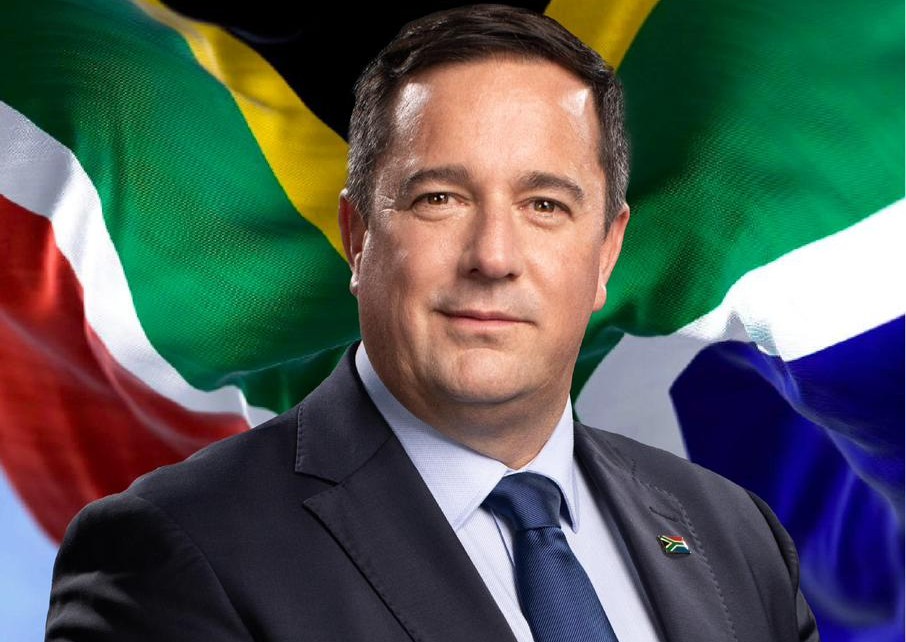
- John Steenhuisen writes in his capacity as leader of South Africa’s Democratic Alliance.





yitzchak
January 17, 2026 at 7:23 am
Three things come to mind:
1) Chinese fishing trawlers are trespassing well onto our continental shelf and within our 200mile limit for foreign fishing.(See DM this week to understand our declining fishing industry and stocks.) Why does RSA not have an adequate navy to police our shores and why are the Chinese our guests for a naval exercise/?
2) The South African soccer team was happy to compete in the Cup of Nations despite the sour relations(like a skokian brew) over Morocco’s occupation and colonisation of the Western Sahara despite an ICJ ruling deeming Morocco’s invasion of Western Sahara and exploiting natural resources such as Phosphates? If BDS militates against Israel, why did the RSA government not boycott this tournament.? Algeria the great paragon of liberation also participated.
3) In the cold war days the USSR had an international communist international committee (Comintern).
Today we have an Islamintern. consisting of
1) Moslem brotherhood including SA’s collaborators. MRN Radio-Islam.
2)Al azhar university imams
3)CAIR
4)ISIS
5)Alqaida
6)Talaban
7)IRGC and Iran
8)Hamas and Hizballah
9)DIRCO
10) Al jamaah party
11)SA PSC
etc.
They meet in different forums at different times or virtually on line no doubt.
Anthony Fish Hodgson
January 17, 2026 at 1:13 pm
Seems fitting that this piece wraps up with the commitment to promoting “a narrative” of democratic governance and human rights rather than simply committing to promoting democratic governance and human rights in and of themselves. Steenhuisen is right that we should be consistent in our principled commitments, but the conclusion that South Africa should do everything in its power to cosy up to Trump’s USA suggests that on his part at least this is largely a performance. Defending rule of law and constistutional order while also advocating for South Africa to prostrate itself before the most persistent violator of these principles is an insult to whoever this was written for.
yitzchak
January 19, 2026 at 4:14 pm
funny I never saw Trump’s name mentioned in this article. One has to disabuse South African politicos of the notion that South Africa is non-aligned,or that she is not anti West. Somehow the duplicity of the SA govt always shines through the hypocrisy.Meanwhile our motoring manufacturers,agricultural exporters etc are wondering where our produce will go to.Our new investors who come with ropes attached have bypassed SA industries even though it would appear that there are enough funds available for in house investments.
No doubt those invetors from India and KSA have greased a few palms with lots of pansella on the way.
Home grown companies will certainly not cough up for our local tender preneurs.
Israel has excellent agricultural and water expertise but no doubt you would rather have poverty persist.
Intellectually the Fish rots from the head and the USA has decided no more handouts.The vampires in Moscow and Beijing are not from the geopolitical South and will bleed us dry in the future.But they have left wing credentials and so are Kosher.