





Banner

Jewish students hide identity amidst campus hostility

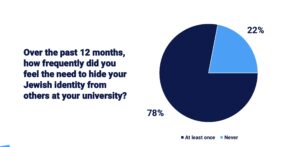
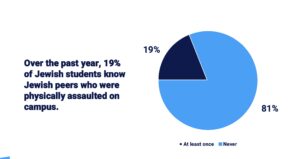
Close to 80% of Jewish students worldwide hide their religious identity on campus, according to the latest Anti-Defamation League (ADL) and World Union of Jewish Students (WUJS) research. One in five of those students know Jewish peers who were physically assaulted this past year.
As the new academic year begins in Europe and the United States, a global survey by ADL and WUJS reveals that more than three-quarters (81%) of Jewish university students worldwide feel they have no choice but to conceal their religious and Zionist identity.
Although most of the countries surveyed were in Europe, and the research included the United States and Australia, South Africa had far more participants than most countries other than Germany.
This survey marks the first comprehensive global study of its kind examining the experiences of Jewish students worldwide. Conducted over the 2024-2025 academic year, it engaged 1 727 Jewish students from more than 60 countries across six continents, complementing ADL’s robust US-based research with critical international perspectives.
“This survey exposes a devastating reality: Jewish students across the globe are being forced to hide fundamental aspects of their identity just to feel safe on campus,” said Marina Rosenberg, senior vice-president of International Affairs at the ADL.
“When more than three-quarters of Jewish students feel they must conceal their religious and Zionist identity for their own safety, the situation is nothing short of dire. As the academic year begins, this data provides essential insights to guide university leadership in addressing this campus crisis head-on.”
Victoria B, a Jewish Studies student at the University of Vienna, said, “There was an ‘Intifada Camp’ glorifying Hamas on campus, and our building already had antisemitic graffiti on it. One day, I was terrified to attend a seminar – there were only 10 of us in the lecture hall, and there were rumours that camp participants would roam campus looking for ‘Zionists’. We cancelled the seminar, and fled through the back exit. For a moment, I felt like it was the 1930s, and Jewish students were being chased from their universities.”
Additional key findings include:
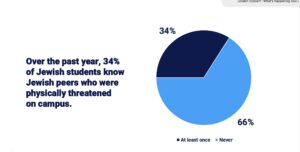
- Threats and attacks: over the past year, more than one in three (34%) of respondents know Jewish peers who were physically threatened; and one in five (19%) know Jewish peers who were physically attacked.
- Orthodox Jewish students experience higher levels of discrimination. They are twice as likely as other Jewish students to be discriminated against.
- Lack of religious accommodation. Nearly 30% of Jewish students requesting academic accommodation for religious observance are denied these allowances or only sometimes granted them. This problem is the most severe in Europe, where religious accommodation denials are twice as high as the rest of the world (44% versus 20%).
- Jewish women hide their identity more: women are more likely than men to hide their Jewish identity (82% versus 73%) and their Zionist identity (85% versus 75%).
- Fellow students drive most discrimination: nearly one in three Jewish students (29%) experience discrimination from their classmates, compared to just 9% who face it from professors and other university employees.
“As the World Union of Jewish Students, we’re distressed and disappointed by the results of this survey, but not at all surprised. Since 7 October, Jewish students around the world have been speaking to the rise in antisemitism and ostracisation in their regions. This survey further highlights how striking the treatment of Jewish students is on campus,” said Josh Cohen, the president of WUJS.
“We call on universities to work in close partnership with their local Jewish student unions who best understand the needs of their communities to ensure that campuses are places where Jewish students can feel safe, respected, and able to thrive.”
To combat this issue, universities should adopt and implement the International Holocaust Remembrance Alliance’s working definition of antisemitism, the organisations said, and appoint designated co-ordinators for combating antisemitism and supporting Jewish and Israeli students, staff, and faculty.
They should also conduct regular campus-climate research, implement peer-to-peer training programmes, and offer a clear and accessible accommodation policy for religious observance. By taking decisive action, universities could guarantee that their campuses are safe and welcoming environments for Jewish and Israeli students, staff, and faculty.




Melinda
September 19, 2025 at 9:00 am
I wonder if it doesn’t also speak to a wider problem, there are adults who try hide there religion in the workplace?
We don’t even know where is a ‘safe space’ anymore
– Where can you wear your yellow wristbands, Magen David Necklaces etc
It has become the norm to err on the side of caution and avoid the possibke risk