Banner
‘We’re still in Gaza,’ say traumatised Siegels

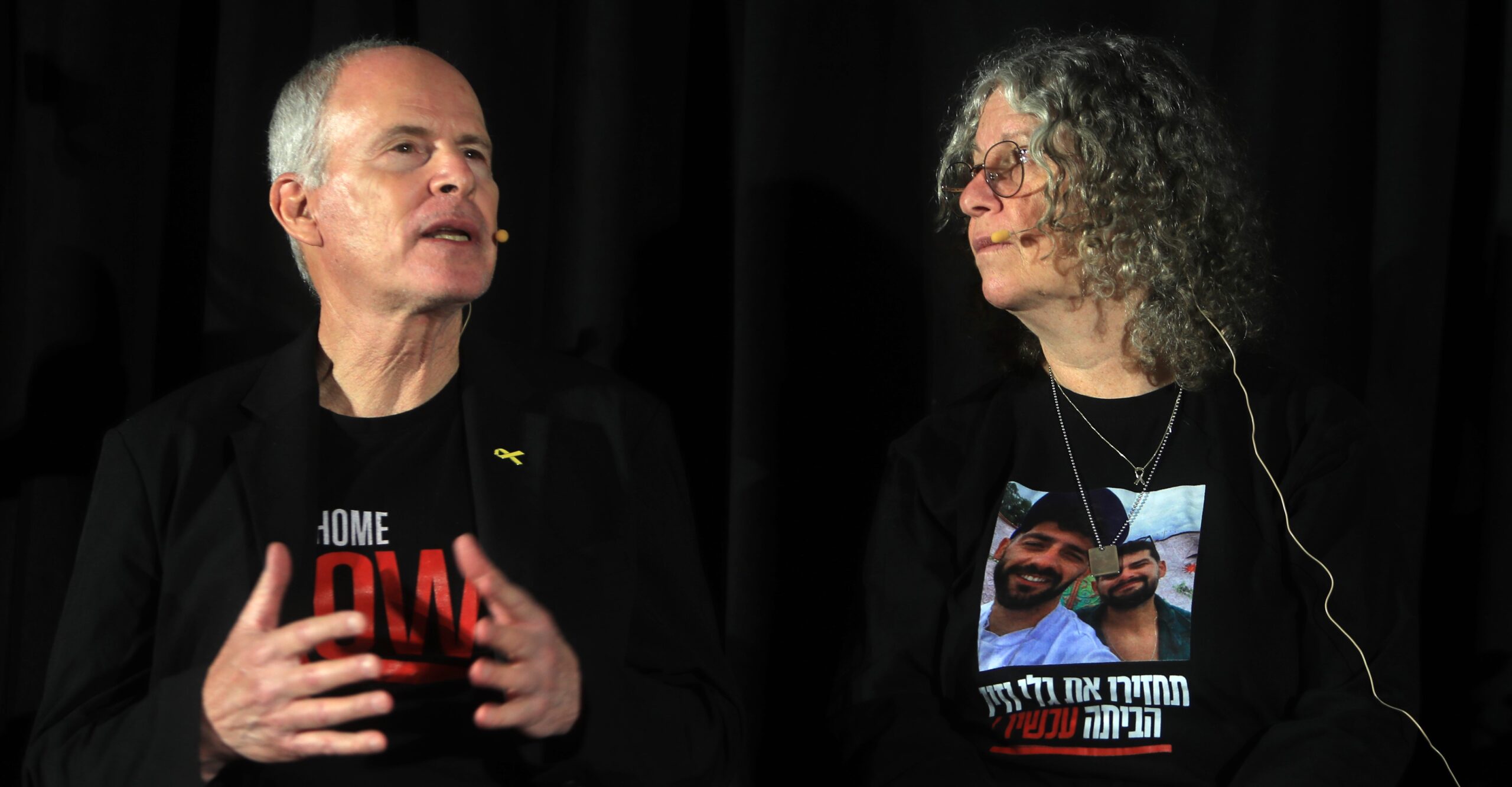
“We’re still in the tunnels,” said South African-born former Hamas hostage Aviva Siegel, who is in Johannesburg this week with her husband, Keith, to raise awareness of the remaining 50 hostages in Gaza.
The shul at Yeshiva Mizrachi was silent, the kind of silence that makes history. On stage, Keith and Aviva sat side by side, speaking plainly about the nightmare that has gripped their lives. They may be physically free from Hamas captivity, but as they told the audience, “We’re still in Gaza. We are not living a normal life.”
True and lasting healing will begin only when all 50 hostages in Gaza have been released, they say. There’s deep trauma etched into their souls.
Aviva, born in South Africa, was kidnapped from her home on Kibbutz Kfar Aza on 7 October 2023. For 51 days she was hidden in Hamas’s underground terror tunnels, moved 13 times, suffocated by fear and stale air, forbidden to speak, cry, or hope.
Keith, her American-born Israeli husband, spent an unimaginable 484 days in captivity, with 33 relocations through tunnels, schools, and apartments, each a fresh hell. He lost 35kg. He was spat on, beaten, threatened with death, starved, denied water for days at a time, and humiliated in ways words struggle to convey.
“Everybody looks at Keith and says he looks so good. But things happened to him. Kidnapped in such a brutal way, hidden and touched by death daily, we went through too much,” Aviva said. “My most terrible moments were when they tortured Keith in front of me or the girls, and I had to watch and couldn’t do anything. It was the worst,” she said.
One memory sears Keith more than the rest. Hamas dragged him into a room where a young Israeli woman lay on her back, gagged, her hands and feet tied. Three terrorists surrounded her – two taking turns beating her with a rod, the third pressing a sharp rod to her forehead. They ordered Keith to force her to “confess” to being an Israel Defense Forces (IDF) soldier, which he knew she wasn’t.
“I did what they told me to do,” he said quietly. “I couldn’t stop them. It was physical torture for her, and psychological torture for me.” Later, they threatened to shoot her if she didn’t comply. Keith still cannot shake the feeling that, in that moment, he failed her.
In the long stretches of isolation and uncertainty, Keith developed his own way of surviving. He told the audience how he would send telepathic messages to his family, beginning each day with his mother, who had passed away two months before his release.
“I would picture them in my imagination, and send them messages,” he said. “It gave me a sense of belonging, a connection, and I developed a stronger Jewish identity.”
During his darkest months, Keith forged a bond with four other hostages – Matan Angrest (22); Omri Miran (47); and twins Gali and Ziv Berman. All four remain in Gaza. Angrest, an IDF tank driver, was the only survivor of his crew defending Kfar Aza. Keith met him with untreated burns and injuries, in constant pain. Miran, the father of two baby girls aged four and two, spoke often of the agony of not seeing them grow and missing their milestones. He reassured Keith that his own daughter, Shir, would wait for her father to be released so that he could stand with her under the chuppah. The Berman twins, injured and inseparable, were cruelly torn apart by Hamas.
“I am a twin,” said Aviva, “I have known those boys their whole lives, remember their mother being pregnant with them. Where is the world’s outrage?”
“I think about them every day,” Keith said. “Even eating is difficult, knowing they are starving. My life cannot truly go on until they are home.”
Last Thursday, the Siegels’ daughter, Shir, stood under the chuppah. Engaged just weeks before 7 October 2023, she had waited for both her parents to return before marrying. The family called it a “miracle simcha”. Former hostages Emily Damari – Shir’s best friend; Amit Soussana; Liri Albag; and Agam Berger – with them in the tunnels – stood together under the chuppah. They came together to dance, to hold joy and pain in the same embrace.
“It was beyond happiness,” Aviva said. “One of the happiest moments of my life.” But it was happiness with an ache. “Our joy is never complete. Part of us is always in the tunnels with the others who are suffering extreme deprivation.”
Their visit to South Africa with some of their children and grandchildren was a homecoming for Aviva and a reunion with a community that prayed, campaigned, and wept for them. It was made possible by the South African Zionist Federation; the South African Israel Centre; and the Jewish Agency.
Before an audience at Yeshiva Mizrachi, they spoke of violence, abuse, beatings, and death threats. Aviva recalled believing they would suffocate underground. Keith remembered seeing Aviva’s release on television, surrounded by a hostile crowd, not knowing if she had made it home safely.
They condemned the world’s silence. “The same people who committed the atrocities of 7 October are with the hostages now,” Aviva said. “They are going through the worst nightmare any human can go through – in 2025. Just think about Nelson Mandela when he stood for human rights. Where is the world?”
Keith and Aviva’s love story has been tested in darkness and strengthened in fire. Their four children – Shay, Gal, Elan, and Shir – and five grandchildren have been the heartbeat of their survival. Keith’s brother, Lee, and Lee’s wife, Sheli, born in South Africa, were key figures in the global fight for their release.
But no celebration, no family reunion, can erase the knowledge that 50 hostages remain in Gaza, at least 20 of which are believed to be alive. “We can’t truly move on,” Aviva stressed.
For the Siegels, 7 October isn’t a memory, it’s an open wound, one they carry not just for themselves, but for those still in the dark.