Community

SA community donates to upgrade Israeli bomb shelters

The South African Jewish community has raised enough money in the past few weeks to refurbish more than 30 urgently needed bomb shelters in Israel, according to the Jewish National Fund South Africa (JNF-SA).
“We don’t realise that the existing bomb shelters or public bomb shelters aren’t being maintained. They need to be upgraded quite desperately for the kind of missiles being launched towards Israel,” JNF-SA chairperson Michael Kransdorff told the SA Jewish Report.
Due to the unfortunate reality that Israelis live with, bomb shelters are needed more urgently than ever, he said. The Jewish National Fund (JNF) partnered with Keren Kayemeth LeIsrael to refurbish existing public bomb shelters across Israel.
The JNF then put out an appeal on a recent SA Jewish Report webinar about the Iran-Israel war and the money was raised.
Kransdorff said that as the war with Iran escalated, civilians across Israel once again faced the devastating consequences of regional aggression. It became evident that many communities in Israel didn’t have access to safe and secure bomb shelters. According to the June JNF newsletter, up to 60% of local authorities are estimated not to have any access to public shelters at all.
Kransdorff said that in the past, JNF-SA was involved in building bomb shelters in the Gaza envelope, including one funded by the Samson Foundation. A few years ago, the organisation built a nursery school with a covered play area designed to be a bomb shelter, essentially a protected space where children can play safely.
JNF-SA National Director Bev Schneider said she believed they would raise enough for 18 shelters, but were grateful that they had almost doubled that.
Because the South African rand isn’t very strong, she said, “We’ve focused on upgrading existing bomb shelters. For a relatively small amount of money, we can make a big impact, because the structure is already there, it just needs some investment to bring it back to full functionality.”
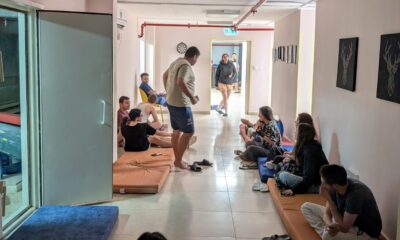
The refurbishment process is dependent on the state of the shelter, she said. “They’re in various states of disrepair. Some just have mould and need to be cleaned and repainted, while others are filled with rubbish or have plants growing out of the walls. It really depends on the location and condition of each shelter.
“The doors have been repaired, air conditioning units installed, walls repainted, and in some cases, toilets have been added. It’s a big project and we’re proud to be part of it,” she said.
Each refurbished shelter will have a plaque somewhere within the space showing gratitude to the South African Jewish community and giving those who donated some credit. The public bomb shelters are located across Israel, including areas such as Tel Aviv, Beit She’an, Tiberius, Ashdod, Ramat Gan, Be’er Sheva, Sderot, Ashkelon, as well as many other cities in Israel.
“A lot of them are located in older buildings, and in those, people don’t have their own mamad in the apartment,” said Schneider. “They have to go out to a public bomb shelter. That’s what these are, public shelters meant for the whole building or neighbourhood.”
SA Jewish Report Chairperson Howard Sackstein, who ran the webinar, said, “During the war between Israel and Iran, Iran launched more than 1 000 drones attacking Israeli civilian areas and more than 500 ballistic missiles, many of which contained cluster bombs. Twenty-nine Israelis were killed, about 3 500 civilians were injured, and 9 000 people were made homeless.
“There was an urgent need for bomb shelters to protect civilians, and it was clear that many of the older bomb shelters in Israel needed to be upgraded to protect the population from these Iranian war crimes. We were hosting webinars with Colonel Miri Eisin in collaboration with the JNF, and we wanted to use the opportunity to allow people to participate in this humanitarian mission.
“We were deeply moved by the generosity and commitment of so many people, who each wanted to help in whatever way possible. That’s what it means to be part of a community. Each of us is responsible for each other.”
Said Schneider, “The funds have already been remitted to Israel, and the work has been done or is in the process of being done.
“It also feels good to know exactly where the money is going. Donating to something so tangible helps all of us feel like we’re contributing and even saving lives, even while we’re sitting here in South Africa,” she said.