Community
Holocaust exhibition runs more than skin deep

Walking through Beneath the Skin, an exhibition at the Johannesburg Holocaust & Genocide Centre (JHGC), part of its week of international Holocaust remembrance, visitors are confronted with history and the lingering echoes of lives lost.
Artist Mike Fisher, whose work will be exhibited there until 25 March, explores the Holocaust through sculpture and installation that speak to loss, dignity, and moral rupture. Rather than illustrating events, the exhibition asks viewers to pause, reflect, and consider what remains when humanity is stripped away, especially at a time when antisemitism is at an all-time high.
“I became interested in bringing that side of myself into the conversation – the part of me that is serious, committed, and determined never to forget,” Fisher said. “Thematically, that commitment lies at the heart of this exhibition. While I’m not particularly religious, I was born a Jew, I will die a Jew, and I’m proud of that identity. In a world facing profound moral challenges, exhibitions like this are fundamental, not only to this work, but to my role as an artist.”
It was, however, a trip to Budapest that crystallised this focus. There, Fisher met a renowned Hungarian ceramic artist whose parents had survived the war by working as Jewish artists and forging documents to save lives. “When I saw his first piece, a monumental work that took him three years to make, it hit me in the heart. It just blew me away,” Fisher recalled. That encounter inspired him to create art that delves into the history of the Holocaust, making his work deeply personal and a meaningful reflection of the experiences of his people.
“This work is not about representing the Holocaust, it’s about standing in its shadow,” he said, “I want viewers to feel the weight of what was taken, what was erased, and what still demands responsibility from us today. Art for me is a form of moral witnessing.”
Fisher spent a lot of time at the JHGC carefully planning how his exhibition would be given full effect.
It starts with the death march, in which many individuals in the camps were forced to walk many kilometres from one camp to another, most notably from Auschwitz to Birkenau (Auschwitz II). During these marches, thousands dropped at the side of the road. Those who did survive the journey were either sent to the gas chambers or to work.
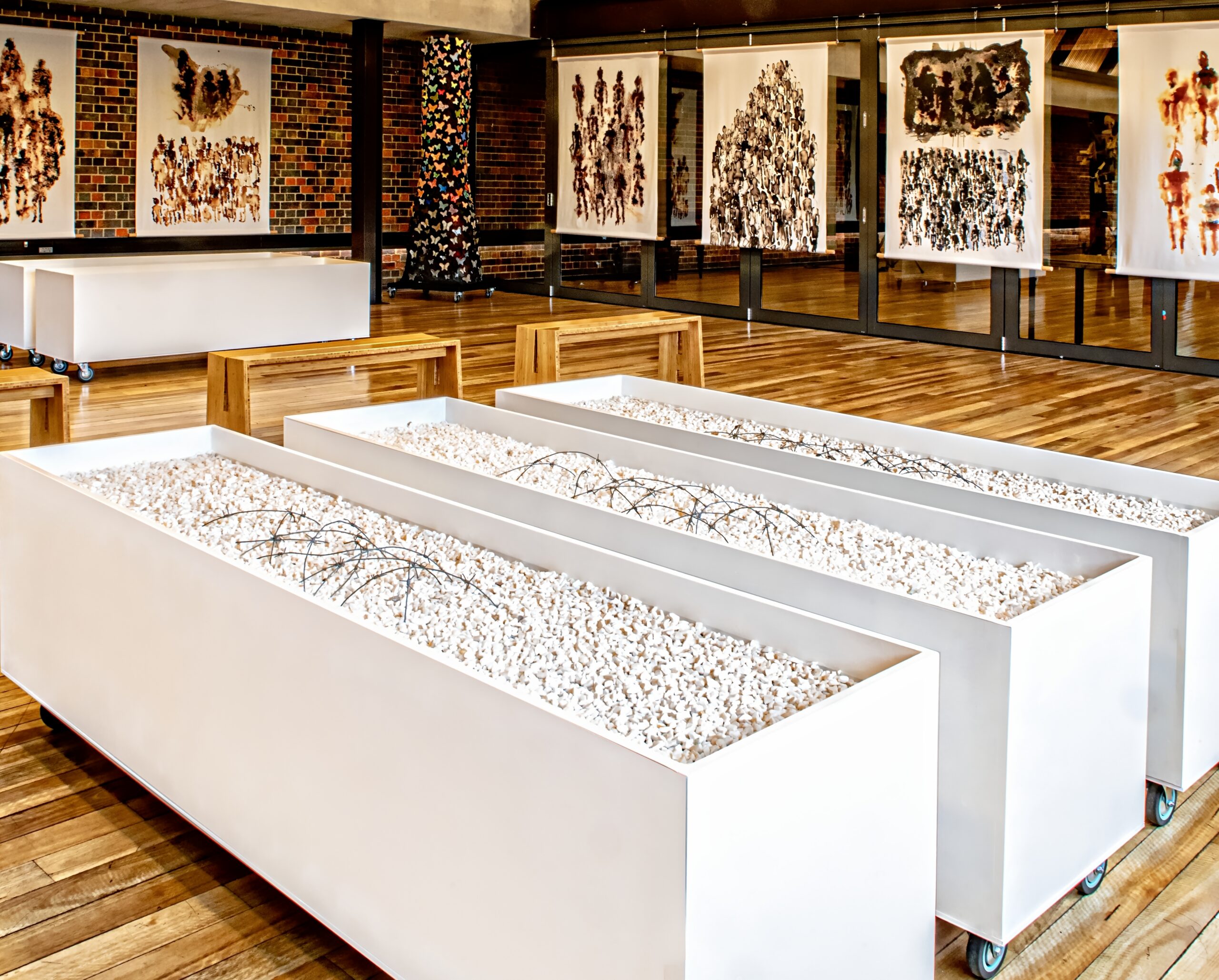
Fisher depicts these haunting scenes using hordes of faceless figures on canvas using bleach, ink, and salt, representing the bleach used to remove the smell of death; the ink of the tattoos of the prisoners; and the salt of the tears.
He wanted to showcase birth and death. He does this through the use of white boxes with white stones to symbolise coffins.
In two white coffins, along with the stones, there are small ceramic pieces of body parts; the yellow star stained with blood; and the remnants of machine guns, evoking the violence of the mass killing of Jews. Victims were executed by being shot in the back of the head, and their bodies were stacked in mass graves that they had dug themselves, with lime used between layers to speed up decomposition. Thousands of people were killed this way, contributing to enormous burial mounds that are still visible today.
“This is really representing and honouring a very undignified death in a dignified way,” he said. “There is a number, and there’s a name. There’s barbed wire; there’s the protector of the evil eye; there are pieces that represent the machine gun firing; and then, of course, the Star of David that they would wear on their arm, which was bright orange or yellow, and of course here it’s just blood.”
Said Fisher, “It’s just an impression of what that must have been like. But at the same time, what I’m hoping is that it touches people in the way that I was historically touched. And it’s not as explicit as the last series I did.”
The other three boxes are simply filled with white stones and barbed wire. “I think it says it all. And I don’t know how many I’d have, but I’d love to be able to do a show with at least maybe 50 or 60 of these,” he said, “However, this is part of linking into what I call a transcendence. So, here we have the remains, and here we have the spirit, and here we have the ascension going up to heaven.”
One of the focal points of the exhibition is the Tree of Life, or “Tree of Lies”. These are three trees made from material that was used by Jews in concentration camps to build the barracks – the wood.
“If you look outside, this is where the inspiration came. I want to bring the outside inside. So, if you look at those trees, if you go to many of the Holocaust concentration camps, around those concentration camps are the most beautiful, beautiful trees. And it’s interesting because the trees were meant to hide who was living from the outside, seeing what was going on inside.”
The first tree is square with hard edges, where the other is thinner, painted black, and uses Polyurethane, which represents the burning human flesh.
“I call them the ‘Tree of Lies’ rather than the Tree of Life. And that comes out of an interesting quote that, in terms of my research, doesn’t say that it was specifically Auschwitz, but there was graffiti that was scratched into the walls saying, ‘There’s only one person that is responsible or was responsible, [which] is G-d.’ Which I just found extraordinary.”
Finally, the last tree is filled with ceramic butterflies, symbolising that even after all the violence, there’s still hope. Butterflies, Fisher said, signal rebirth and hope, but also a lot of Jewish children started drawing butterflies during the Holocaust.