Sport
Tennis academy builds champions on and off the court

Anthony Harris is a former professional tennis player who has turned his love of the sport into creating South African tennis stars, particularly those for whom it would have been out of reach. He and his wife, Dionne, created the Anthony Harris Tennis Academy (AHTA) and MATCH Development Foundation 10 years ago.
Today, the foundation supports 20 players and, according one of the foundation’s board members Chip Blythe-Onal, it has achieved a 100% success rate in sending players either into professional tennis or into college programmes in the United States.
The academy’s first graduate, Lloyd Harris, remains its most prominent success story. A former world number 31, Harris is regarded as the foundation’s flagship product and primary ambassador. His progression from the academy to the professional tour continues to serve as a reference point for younger players moving through the system.
On 27 January, the tennis academy marked its 10-year milestone. Supporters, players, coaches and donors gathered at their Bantry Bay campus to celebrate the anniversary of the AHTA and MATCH Development Foundation, a programme that has quietly reshaped what elite tennis development looks like in South Africa.
MATCH has grown into a combined tennis, education, and residential initiative designed to give talented young players access to opportunities that might otherwise remain out of reach.
Speaking at the anniversary event on behalf of Kirsh Philanthropies, Dr Dennis Goodman described the academy as a place where success is defined beyond sporting outcomes. “What we care about more than anything else is for every child to understand that they’re a champion,” he said. Though competitive tennis is central to the programme, Goodman said education, structure, and personal development are equally important to its mission.
MATCH was established to support promising players who lack the financial means to pursue elite training. Based in Bantry Bay, the academy integrates high-performance coaching with academic learning and a structured home environment. Players train alongside privately funded academy athletes, attend school and, in some cases, live on site, with no distinction made between those supported by the foundation and those paying privately.
“There’s no discrimination between foundation players and academy players. Everyone is equal,” said Dionne, who is closely involved in the recruitment and day-to-day running of the programme. Prospective players are assessed not only on court performance but academically. “If they are not keeping up academically, they don’t qualify,” she said, pointing out that the goal is to equip players with confidence and dignity. “We give our players the dignity to step on the court with confidence in great clothes and proper shoes, excellent equipment, and with world-class coaching backing them.”
Education has been a central pillar of the programme’s growth. Goodman said the introduction of a formal school component was key to expanding the foundation’s impact. “You can’t just get people out of a situation. You have to give them a fishing rod,” he said, explaining that education allows players to build independent futures. Kirsh Philanthropies funds 10 scholarships at the academy, supporting tennis training and schooling.
Goodman framed the foundation’s work within a broader ethical context. “There’s a concept in Judaism that says when you save a life, you save the world,” he said. “What we are doing in our philanthropy, and what every one of you needs to feel, is that we are saving lives.” He credited the academy’s coaches, support staff, and administrators for creating an environment where players feel valued. “These kids walk away feeling like champions,” he said.
Sustaining such a programme requires significant financial and organisational support. Blythe-Onal became involved after initially approaching the academy as a recreational player. With experience serving on charity boards in the United Kingdom, he was drawn into helping the foundation address a budget shortfall at a critical point. “Two-thirds of the budget was sorted, but it needed help with the remaining third,” he said. “We wanted to double the Kirsh Foundation’s generous donation.”
The scale of MATCH’s operations is detailed in its most recent annual report. The average annual cost per player exceeds R700 000 and includes coaching, tournament travel, academic tuition, accommodation, nutrition, and equipment. In 2025, players competed extensively across local, national and international tournaments, collecting junior ITF (International Tennis Federation) titles and representing South Africa abroad.
Not all of the foundation’s work is visible on court. Its residential programme has expanded from an initial apartment behind the academy into a fully equipped house in Green Point accommodating eight foundation players. The residence provides structure, supervision, and daily support, led by a full-time house mother. For many players, it represents their first experience of a stable and secure home environment.
Material support from sponsors and partners helps sustain this ecosystem. Dionne highlighted longstanding contributions that ease operational pressure. “Woolworths donates food to us every Tuesday, which is a great help for our food budget,” she said. Adidas also regularly provides shoes, which assists players, who during a tournament can go through a pair of shoes in a week. “Adidas once gave us 52 huge boxes of shoes for our players. We had surplus shoes, which we sent to Hammanskraal along with two of our foundation players to donate to players there who were previously sharing shoes.”
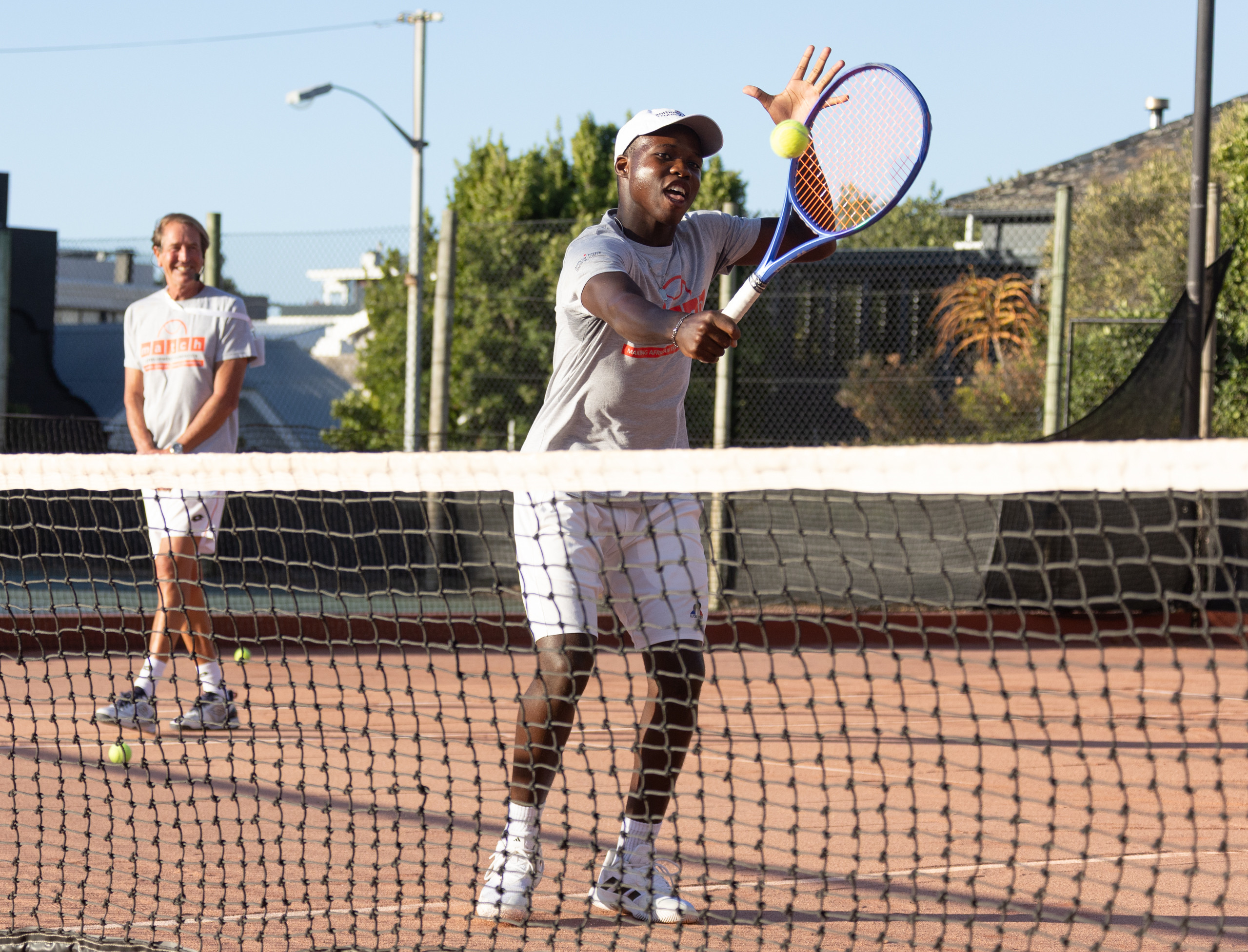
For the players themselves, the impact of the programme is immediate and long term. Oluhle Senti, 17, joined the foundation four and a half years ago after being scouted at a tournament and invited for a two-week trial. “I had the best time during the trial,” he said. Raised in Port Elizabeth, he now lives in Bantry Bay and is completing his final year at the academy.
Senti hopes to pursue professional tennis or college tennis in the US, but says the environment has broadened his ambitions beyond sport. “Living in Bantry Bay, surrounded by amazing architecture and constant property development, has inspired me to want to study either engineering or architecture at university,” he said.
Because foundation players return home only once a year for a short period in December, the academy places emphasis on building a sense of normality and belonging. “We’re like a family here. Everybody is very close-knit,” Dionne said. Weekends often include excursions around Cape Town, designed to give players balance outside training and competition.
Ten years after its founding, AHTA and MATCH are a model for elite sport and education not being competing priorities. By pairing high-performance tennis with academic accountability and long-term care, the programme has shaped a generation of players whose futures are defined not only by how they perform on court, but by the opportunities they are equipped to pursue beyond it.