Sport
Alcatraz t-shirt inspires intercontinental swimming feat

When Milton Brest saw a man wearing an “I swam Alcatraz” shirt on a London Tube 22 years ago, it inspired him to follow a path that would lead to him completing his first intercontinental swim series in May this year.
Though his love affair with swimming began back then, his around-the-world series was conducted over the past 12 years, culminating on 3 May 2025 with a combined 42.28km in varying conditions.
Brest was always an active person, however, he was never that interested in swimming. His focus was on karate. But when he saw that man in the t-shirt in London in 2003, he went up to him and heard that there was a race at Alcatraz, and the rest is history.
He started swimming in open water, including doing the Robben Island Crossing four times. At the time, he wasn’t aiming for the intercontinental series.
“I never planned for this to be a series. I started with crossing [the Strait of Gibraltar], and then from there, we just wanted to go around the world basically, to go from one continent to the next. I’ve seen places that we’ve never been to or dreamed of going to before,” Brest told the SA Jewish Report. “It’s just the most incredible feeling. You can’t explain it to anybody. When you start, you think to yourself, this is what I wanted to do, and it’s just the most incredible feeling.”
His first swim, which sparked the rest of his swims, was the 14.4km Strait of Gibraltar crossing, from Tarifa, Spain, to Almansa Point, Morocco. Brest completed this swim on 9 September 2013 in three hours, 17 minutes. This swim ticked off the Europe to Africa leg of his intercontinental series.
The next swim was from Asia to North America with a 3.8km assisted crossing from Big Diomede Island in Russia to Little Diomede Island in Alaska in the United States, on 30 July 2014 in one hour, nine minutes across the Bering Strait. He and the other swimmers with him completed the 3.8km in cold open water with a wetsuit across strong currents while navigating challenging geopolitical and environmental conditions. He was escorted by a safety vessel and support crew for navigation and emergency readiness.
“It was cold. We started with 3.2 degree waters,” Brest said. “We were still in the water when it got to two degrees. There were even walruses there.”
Brest said that throughout his intercontinental swims, which have been fairly spread out, sometimes with years in between them, he has always trained with his group. He travels to various open-water lakes around Johannesburg so that he can stay in shape for his next swim, whenever that may be.
“I go to a sports scientist twice a week. And I train four times a week. I have a group of guys that I swim with. We train in Morningside, but it’s different swimming in a pool compared to open water. But when it’s summer, we’ll go to Cradle Moon, and we’ll go to some dams outside here,” Brest said.
For him, swimming is the last step in the whole process, with the administration needed to do the swims sometimes harder than the swims themselves.
“We must plan. We’ve got to get the police to give us clearances, we’ve got to get home affairs to give us clearances; and only then can we go to these places to swim,” he said.
He completed the Samsung Bosphorus Cross-Continental Swimming Race, one of the most iconic open-water swims, on 26 July 2015. The 6.5km crossing from Kanlıca, Anatolia, to Kuruçeşme, Istanbul, in Turkey was swum in one hour, 14 minutes, 52 seconds in 22 to 24-degree water.
“The race is one of the most iconic open water swims globally, drawing thousands of swimmers annually to traverse the natural waterway that links two continents. I competed in the 60 to 69 age group, finishing third under clear skies with optimal water conditions and mild currents for a swift and safe crossing.”
Four years later, on 2 August 2019, he completed the Tiran Island Intercontinental Swim, a 10km crossing between Tiran Island in Saudi Arabia to Ras Gamila in Egypt, in one hour, 40 minutes on the first leg, and two hours, two minutes on the second leg.
“The water was clear,” he said, “and you saw these little tropical fish. It was warm as well, so it made it a great swim.”
This was the first officially recorded swim on this route across tectonic plates, verified by Captain Kelvin Brian Deacon of Sinai Blues Diving and Water Sports Centre, with an intercontinental swim between Saudi Arabia and Egypt. The swim started at Tiran Island on the Arabian Plate together with Tyrel Manson and Neil Ralphs in a tandem swim. The turnaround point was Ras Gamila in Egypt on the African Plate.
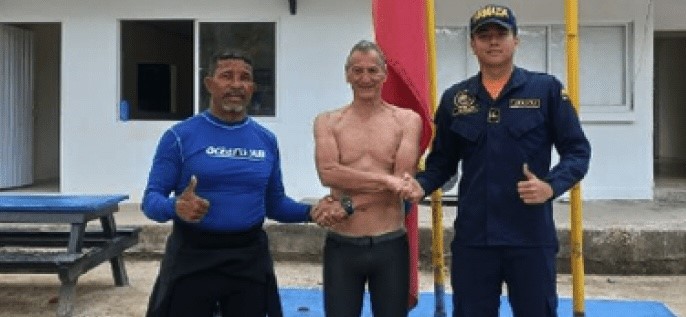
The Panama to Colombia Intercontinental Swim was completed on 18 April 2023, when Brest swam 4.39km from La Miel, Panama, in North America to Sapzurro, Colombia, in South America in one hour, 22 minutes in the Caribbean’s 27 to 29-degree water. Brest said that in every country he has been to, he has had to find someone to guide and swim with them.
“In Colombia, I had a master diver who took me nearly three years to find. The complication of the other swims is that you’ve got to find somebody who can take you and be with you because you can’t go to the sea by yourself. You’ve got to have support. We had the Coast Guard with us.”
The swim which completed this intercontinental series was the Papua New Guinea to Indonesia Intercontinental Swim, a 3.19km crossing from Sandaun in Papua New Guinea to Jalan Skouw in Indonesia. Brest completed this swim on 3 May 2025 in one hour, 13 minutes in 29-degree water.
Once he finished this series, he sent all of his documentation to the World Open Water Swimming Federation so that he could get this series verified, making it easier for any swimmer in the future who wishes to do it.
“It paves the way for other swimmers to do what I’ve done,” he said. “Now it’s easy because I can advise others. There was nobody to advise me where to go and what to do, so I can do that for others.”