


Banner
‘Palestine’ recognition pledges signal Western exasperation with Netanyahu

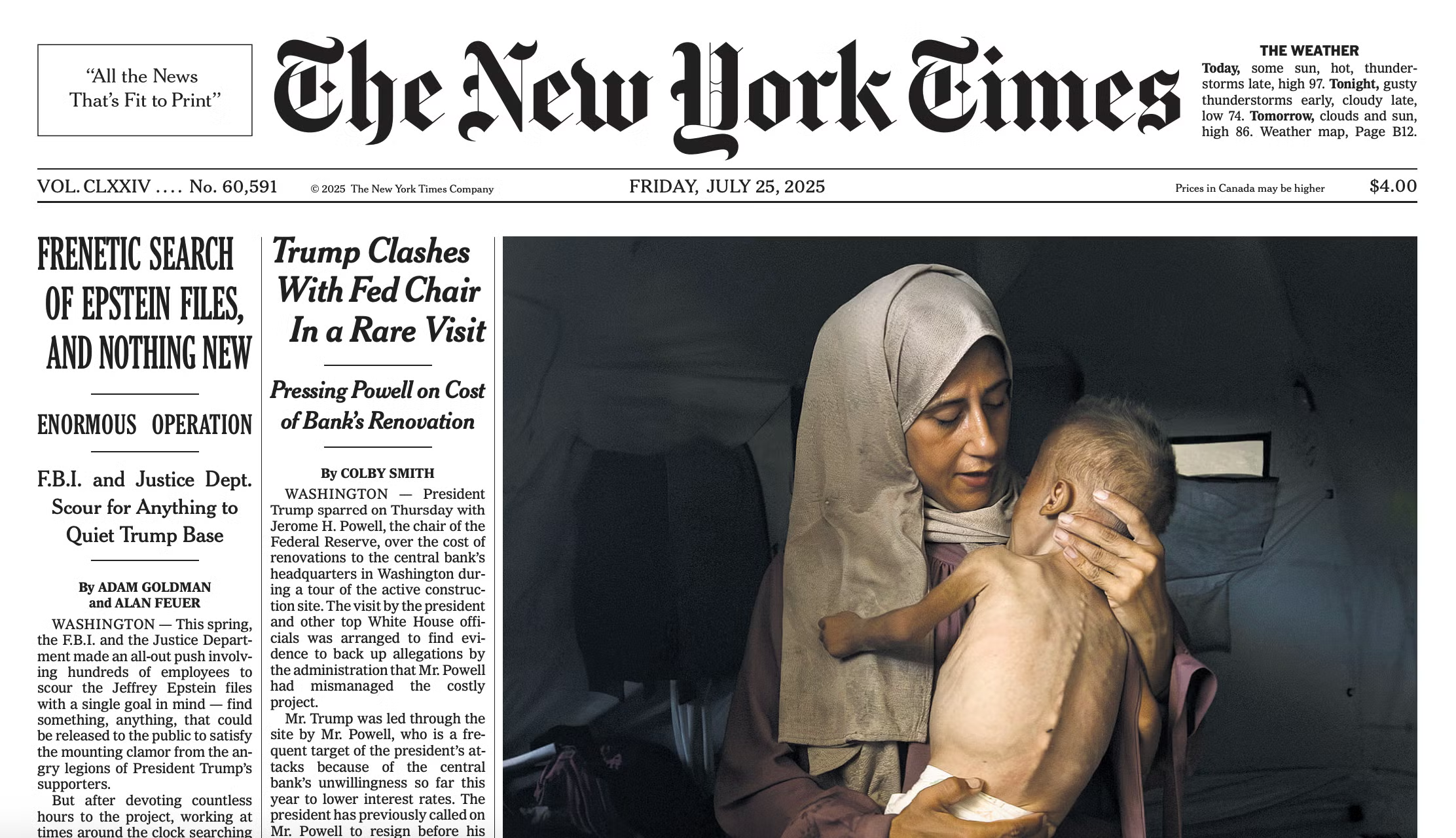
Emotive images of malnourished, starving Gazan children – many faked, some all too real – have dominated news coverage. Cynically exploited for propaganda by Hamas, it has ratcheted up pressure on Western capitals to do something – anything – about the 22-month war in Gaza.
Partially in response, France, the United Kingdom (UK), and Canada announced that they would recognise “the state of Palestine” at the United Nations (UN) in September, barring a full ceasefire; an Israeli pledge not to annex the West Bank; and the revival of a two-state solution. These are Western countries usually supportive of Israel. It’s unlikely that Jerusalem will comply.
Recognition is a card states can play only once. Currently, more than three-quarters of UN member states recognise “Palestine”. South Africa did so in 1995. Pretoria talks about “two states, side by side”, but never acknowledges that one should be a Jewish state.
Why does recognition matter? Malte Brosig, professor of international relations at the University of the Witwatersrand (Wits,) said states are social constructs. “A state becomes a state when it is recognised by others as one. In a state-based world, states tend to control tightly who belongs. Peer-recognition is important. Non-recognised statehood is no statehood. The tipping threshold is usually UN membership, but this requires UN General Assembly and UN Security Council approval. It’s a political process more than a juridical one. Taiwan is not a fully recognised member of the UN de jure, so it’s not a state, but de facto, it’s fully in charge of its territory. For Palestine, it’s the opposite – increasingly recognised but de facto not controlling its own business.”
Analysts are divided on the recognition issue. Larry Benjamin, a Middle East expert at Wits said that recognising a Palestinian state now is symbolic, but “nonetheless reaffirms the commitment of these countries to push for a two-state solution in Palestine, a position they have held for decades. It’s also a reflection of the abhorrence felt by many, including political elites, at the starvation currently afflicting Gaza, creating one of the most devastating humanitarian crises in recent memory.”
“There is also, behind the scenes, little love lost for [Israeli Prime Minister] Benjamin Netanyahu and his right-wing extremist government,” Benjamin said, “and the latitude given to them by the Trump administration. And clearly, the international community wishes to send a signal that the war in Gaza is now being prosecuted by a government putting its own narrow interests and ideological proclivities ahead of Israel’s national interest.”
In contrast, Israeli journalist Rolene Marks said, “President Trump said the way to end this is for the hostages to be released immediately, and for Hamas to lay down its arms. France, Canada, and the UK and any other country that wants to see a just and lasting peace should have said the same thing. It’s absolutely premature to recognise a Palestinian state.”
“Brits are fuming at this decision. So are Canadians,” said Marks. “A lot of them feel that their prime ministers have misled them on their campaign promises and should be focused on domestic issues like migrants. [UK Prime Minister Keir] Starmer’s approach has really rubbed us the wrong way. The intervention from British hostage families, who said Starmer would reward terrorists by recognising a Palestinian state, was very unusual for them.” She said Germany had been more measured, seeking dialogue with the Israeli government.
Jonny Gould of Jonny Gould’s Jewish State podcast said, “One way or another, this signals an existential threat to Keir Starmer’s premiership. If he U-turns, which he’s done under pressure from his members of Parliament already on key issues, he’ll become a lame duck vulnerable to a leadership challenge. If he stays with it, he reduces his relationship with the White House to mere pleasantries. Furthermore, Britain will no longer have a stake in true peacemaking except through meaningless coalitions with the UN’s worst despots and the soundbites that emanate from it.”
Leftist activist Gershon Baskin, who worked for five years to free Israeli soldier Gilad Shalit from Hamas captivity, said, “Recognition of the state of Palestine by countries that have supported the two-state solution for years but only recognised one of them isn’t a reward for Hamas or for terrorism. It’s a correction of a policy of duplicity and places action where only [empty] words were uttered until now.”
He said those making this claim aren’t supportive of peace, including right wingers the world over, although Baskin acknowledges that Hamas has never supported a two-state solution. “The way to resolve the conflict and make peace is for both peoples to have the right to self-determination, and the moral and historical obligation of the international community is to recognise the national rights of both peoples” – the seven million Jews and seven million Palestinians living on the land.
The last word goes to Ittay Flescher, the author of The Holy and the Broken: A Cry for Israeli-Palestinian Peace from a Land that Must be Shared. He said, “While I welcome the affirmations of France, the UK, and Canada to see Hamas disarmed as a prerequisite for a two-state solution, the Israeli-Palestinian conflict can’t be solved by declarations alone. What’s needed is a radical change in how both peoples see one another.
“As a resident of Jerusalem,” he said, “I was surprised to see that a bus advert reading, ‘A child is a child is a child: compassion knows no borders – Israelis mourn all sides’ was removed by Egged this week for fear that it would offend the sensitivities of the Israeli public.
“Beyond our city, I see a growing number of pro-Israel and pro-Palestine people having no place in their heart for acknowledging or caring for the suffering of the other at a time when this pain is more acute than ever. While understandable given the horror of 7 October, hostage suffering, and the subsequent devastation of Gaza in response, I find this sentiment deeply distressing. When this war ends, may it be tomorrow, both the Israeli and Palestinian people will need generations of healing to reconcile all we have done to each other. At that time, messages like the one on this bus will be at the heart of what will secure a safe future for all of us.”