


Israel
From Johannesburg to Jerusalem, Hirschson fights a digital war

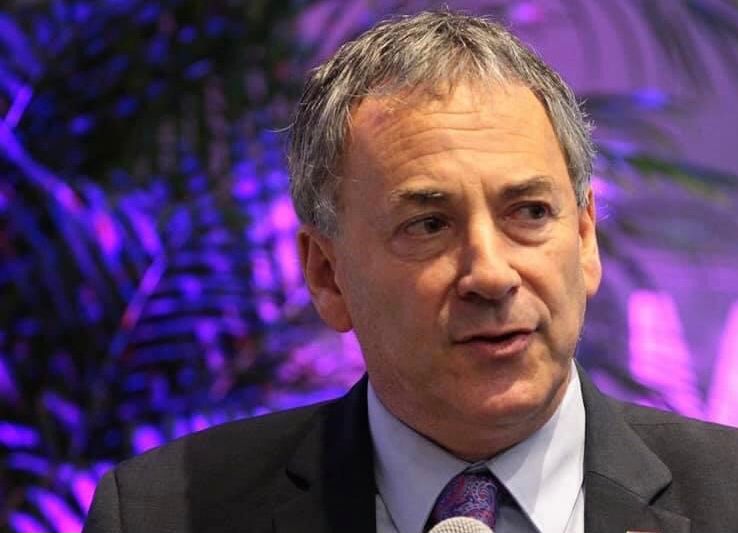
There is a moment in every war when the battlefield shifts. For Paul Hirschson, that battlefield is no longer defined by tanks or borders, but by timelines, algorithms, and attention spans. Hirschson, a South African-born Israeli diplomat, has spent more than two decades in the Israeli Foreign Ministry. Today, he leads a team shaping Israel’s global voice on social media.
Hirschson grew up in Johannesburg and studied at the University of the Witwatersrand before moving to Israel about 40 years ago. His early career was in high-tech “In the decade that I worked in the high-tech sector in Israel, I started doing business development between Israeli companies and the Arab world,” he said.
He joined the Foreign Ministry in the early 2000s and was part of the first Israeli diplomatic presence in the United Arab Emirates, years before the Abraham Accords. Hirschson later served in the United States, as a Foreign Ministry spokesperson, and as an ambassador to West Africa.
More recently, he spent four years as Israel’s Consul General in Montreal, Canada. His posting coincided with a dramatic shift in global dynamics following 7 October. “The first two years were more about economic diplomacy,” he said. “Then of course 7 October happened, and things became a little different.” His role shifted to addressing rising antisemitism and advocating for the hostages in Gaza.
After returning to Israel, he moved into digital diplomacy, overseeing content across multiple platforms and languages. He now manages messaging that reaches audiences in English, Arabic, Farsi, Spanish, and other languages. “At the heart of it all is the conversation in English on X,” he said.
The scale of that work is vast. During the recent war with Iran, Hirschson said the Foreign Ministry’s social media output went viral. “In those six weeks, we had more than a billion views of our posts in all languages from Jerusalem,” he said.
He divides the digital effort into two main areas. One is the work done centrally in Israel, and the other is carried out by embassies and consulates around the world, which operate with relative independence. “They’re largely running their own show,” he said of overseas missions, though they work within official policy guidelines.
The second division is linguistic. While English content is created centrally, other language teams adapt and translate it for their audiences.
Hirschson described social media as both a challenge and an opportunity. “What we’ve learned from lots of research is that social media does not reflect public opinion,” he said. “But that doesn’t mean that it will not impact future public opinion.”
He believes the volume of hostile content online can be misleading. Much of it, he said, comes from a relatively small but vocal group. “It sometimes looks ugly,” he said. “But the vast majority of people who see our work just see the post. They’re not interested in the talkback.”
Hirschson argued that negative engagement can amplify Israel’s message due to how algorithms work. “The more replies you get and the more reposts you get, the more the algorithm will distribute your post,” he said. “The anti-Israel people are the biggest engine for distributing Israel’s voice.”
At the same time, he acknowledged serious risks. Misinformation spreads quickly, and verifying facts takes time. “We do our absolute best not to compromise on fact,” he said. “The challenge is how to be fast.”
He described the difficulty of responding to viral claims during conflict, when information is incomplete and verification requires coordination with military sources. “If you’re not first, sometimes you don’t exist,” he said, but added that accuracy must come first.
Another challenge is the presence of bots and coordinated campaigns. “You have no idea what’s a person and what’s a bot,” he said. “There are hundreds of thousands, millions of accounts that aren’t people.”
Despite this, Hirschson remains optimistic. He sees the current conflict as part of a longer historical trajectory. “We’ve moved from armies attacking us to terror attacks to intellectual campaigns to hatred,” he said. “That’s all that they’ve got left.”
He linked this shift to broader diplomatic developments, including peace agreements with Egypt, Jordan, and countries involved in the Abraham Accords. “In parallel, we signed peace treaties and agreements,” he said. “We’re moving towards more peaceful relationships.”
Hirschson also spoke about the impact of global tensions on Jewish communities outside Israel. “One of the worst parts is that diaspora Jewry is really feeling the heat,” he said.
He reflected on how his career has shaped his own media consumption. Years working closely with international journalists left him sceptical of both traditional and social media. “You learn how to read a newspaper not less by what’s not printed than by what is printed,” he said.
He described social media as “shallow and polarised”, but said he believes audiences will eventually recognise the difference between noise and substance. “People aren’t stupid,” he said. “The message gets across.”
His experience in Montreal reinforced a distinction between public discourse and economic reality. While public sentiment often appeared hostile, he said business leaders remained confident in Israel. “Whenever I spoke to somebody from the business community, I left absolutely confident that things are going to be good,” he said. He pointed to economic indicators in Israel such as a strong currency, rising employment, and increased exports.
Although Hirschson has lived in Israel for decades, he said his connection to his South African roots remains. “You never replace childhood,” he said. “There’s always a soft spot.”
He expressed hope that South Africa would improve its trajectory, describing it as a country with significant potential. For Hirschson, the world of diplomacy has changed beyond recognition. Yet his approach remains grounded in persistence. On his wall is a simple message: never quit. “We’re on the right side of history,” he said.