Lifestyle/Community
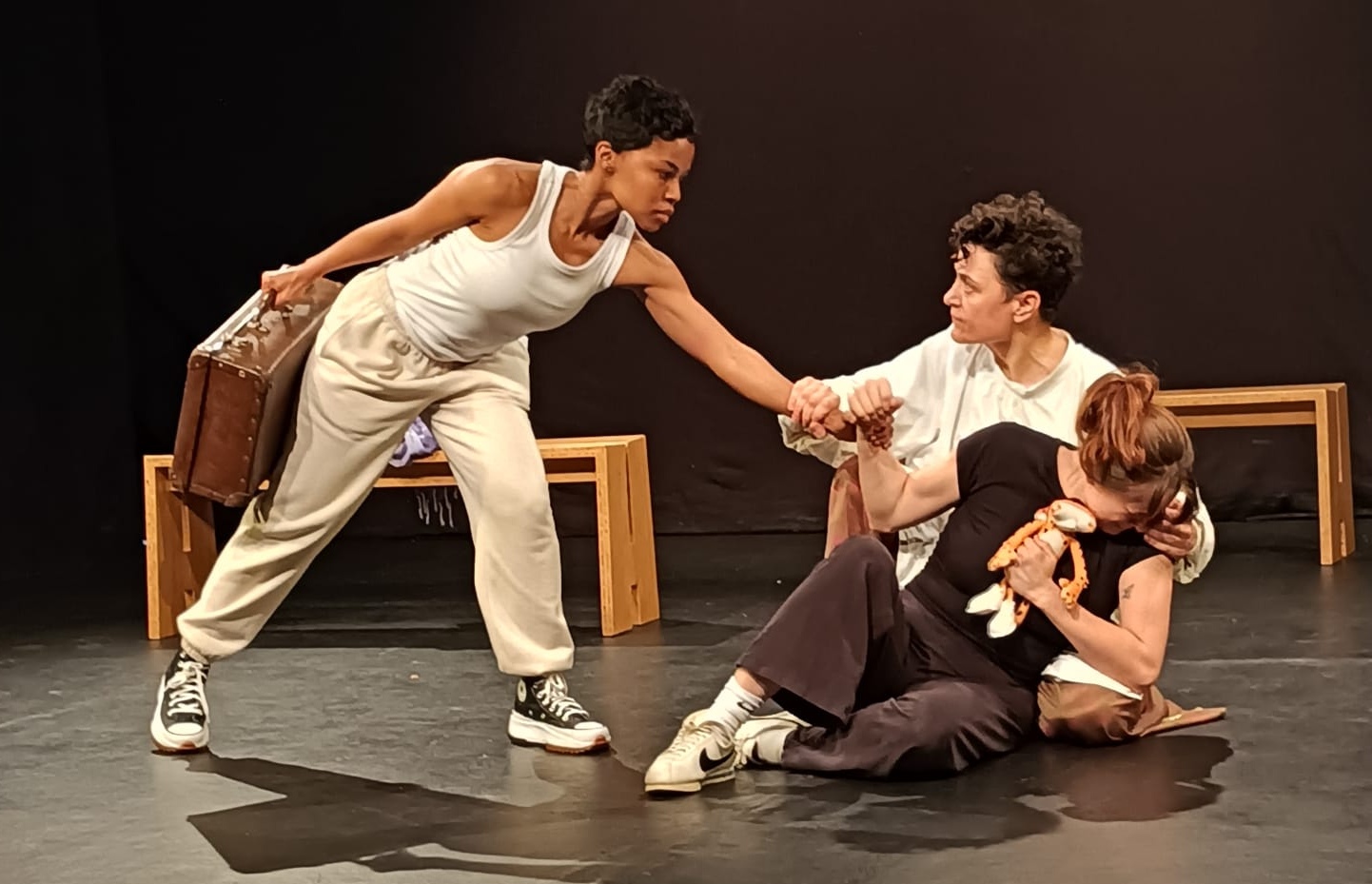
Wrenching drama brings family’s Holocaust memory to stage

Writing about family is never simple, especially when the story spans generations. For Luc Albinski, bringing his mother and grandmother’s lives to the stage was both a creative challenge and a deeply personal act.
Nobody Told Me, running at Theatre on the Square from 28 January to 7 February, tells the story of Albinski’s mother, Wanda Helena Albińska, and his grandmother, Dr Halina Rotstein, in a fictionalised account of Rotstein’s extraordinary effort to save thousands of lives, including her own daughter’s, in the Warsaw Ghetto.
The play follows conversations between Wanda, now in her eighties, and her son, Luc, as he gently presses her to confront a family history she has kept hidden for decades. As they talk, fragments of Wanda’s childhood surface, carrying the audience back to 1930s-1940s Warsaw and to her mother, Dr Halina Rotstein, a Jewish physician working at the Czyste Hospital inside the Warsaw Ghetto.
Fiercely principled and often difficult, Halina’s uncompromising devotion to medicine set her apart, a trait that earned her near-legendary status among her university peers, who called themselves “Halina’s talmidim”. Through their yearly gatherings at Café Sztuka, the play charts Poland’s shift from interwar optimism to occupation and loss, as the group confronts impossible choices inside the ghetto: patients they cannot save, lines they cannot cross, and the daily struggle to remain humane.
Though the story centres on Halina, it also weaves in real and fictional figures from her life and the wider wartime world, including her first husband, Stefan, her daughter, Wanda, resistance members such as Dr Andrzej Trojanowski, who took in Wanda after getting smuggled out of the ghetto, and Maria Steckiewicz, the courageous director of a Jewish orphanage.
Albinski said that though he had made a documentary and written a book detailing his grandmother’s story, during the COVID-19 pandemic, he became inspired to tell the story of his grandmother in a more emotive, fictionalised way since everyone was stuck at home and he felt that that story needed to reach a wider audience.
He felt ill equipped to write a play, as he had never studied drama and mainly operated in the business world. However, along the way, he received loads of advice from Stephen Brown, a playwright in the United Kingdom; South African playwright Liz Morrison; as well as his own mother.
“Every time I wrote a draft, I got my mom to read it as well,” he said, “I was always a little concerned that maybe I was striking some false notes and not really doing her story justice or misreading things because it was obviously 80 years ago since it all happened and I’m far removed from the realities of wartime. So I always checked back with her and asked her what she thought of the play.”
He said the initial draft of the play was actually more like a TV mini-series than a play because it had 20 different characters and lots of subplots, and the script was completely unmanageable.
“And then, you know, 85 versions later, it was kind of bashed into shape. It was quite a painful process – killing off a whole bunch of much beloved characters to make it something that was more manageable,” he said.
Once the final draft was completed, he searched high and low to find a director who could bring it to life.
“Some of the difficulty was my own kind of sprawling, unmanageably long, and complicated script that put a lot of people off,” Albinski said. “But I also think in the current context, particularly while the Gaza war was raging, to be staging a Jewish Holocaust play didn’t feel like a crowd pleaser.”
He engaged with many directors from South Africa and Poland, and finally found Ilina Perianova, a Bulgarian director, screenwriter, and actress who also has Jewish origins.
“Her grandparents are Jewish, and she was keen to take it on,” he said. “She loved the story. It spoke to her own Jewish history, which is also remarkable. Both her grandparents were in the Soviet army. Her grandfather actually has two knives taken from the bodies of the SS men he killed. So she wanted to engage with the material – very courageous – and obviously helped me shape it into the script it is today.”
For Albinski, the hardest part of writing the play was writing the scene where Halina has to say goodbye to young Wanda before she is smuggled out of the ghetto, which also serves as one of the emotional anchors of the play.
“It was difficult writing the goodbye scene between my grandmother and mom, that was a very difficult scene to imagine. It’s emotionally wrenching stuff,” he said.
Watching the play come to life has been especially emotional for Albinski. “Seeing my personal story embodied by talented actors and transformed through directing, choreography, music, and design, has been moving and wondrous, taking the work far beyond anything I imagined on writing it,” he said.
Reflecting on the central theme of the play, he said, “It’s a meditation on duty, how people define it, the promises they make, and the sacrifices they are willing to endure. Halina’s unwavering duty to her patients comes into conflict with her responsibility to her family, while figures like Andrzej Trojanowski risk their own lives and those of their families to honour promises made to save Jewish children. Under extraordinary circumstances, the play shows how duty can shape and fracture lives.”