


World
At Nuremberg, women helped make history. Then history forgot them

JTA – When I began writing The Nuremberg Women, I thought I was writing about a trial. The deeper I went, the more I realised I was writing about hope – the bravest kind of hope: the belief that even after humanity has done its very worst, we can still choose truth over lies, law over vengeance, and civilisation over barbarism.
Eighty years ago, the judges of the International Military Tribunal read out their verdicts to the men in the dock at Nuremberg on 1 October 1946. Nineteen major Nazi leaders were convicted, resulting in 12 death sentences, three life sentences, and four prison terms ranging from 10 to 20 years. Robert Jackson, the American chief prosecutor, called the trials “the most significant tribute that power has ever paid to reason”.
Power paying tribute to reason. That is the essence of Nuremberg. But reason does not speak for itself. Someone has to gather the documents, find the words, look at the photographs, and say aloud what was done. And an astonishing amount of that work was done by a forgotten legion of women.
The trial has fascinated me since I was a child, and when I finally began to research it properly, I found that the story I had unquestioningly digested was wildly misleading. We remember Nuremberg as a room full of men: the judges, the generals, the prosecutors, the defendants. But women were there in almost every capacity. They worked in backrooms as researchers, prosecutors, and witnesses to the questioning of the defendants. Dozens came as journalists and were accommodated in a ramshackle villa where they shared just one bathroom, plumbed with a single urinal. The institution had not been built with them in mind.
They came anyway. They made the record, and then history mislaid them. The story of Nuremberg has traditionally been told as a roll call of famous men: from the mendacious charisma of its principal defendant, Hermann Göring, to the groundbreaking opening address of Jackson, broadcast around the world, and the pioneering legal minds of Hersch Lauterpacht and Raphael Lemkin.
Even the recent Hollywood film Nuremberg, starring Russell Crowe and Rami Malek, portrayed the trials as an overwhelmingly male affair, with a smattering of anodyne female characters serving a decorative accessories to the central drama.
The reality was starkly different. A remarkable cast of women played pivotal roles in shaping both the proceedings and the outcome of the trial, making indispensable contributions in the courtroom, through their journalism, and on canvas.
For Jewish readers, Nuremberg carries a particular weight. It is where the industrialised slaughter of Europe’s Jews entered the legal record, argued from German paperwork and, most powerfully, through the voices of those who had witnessed and survived it.
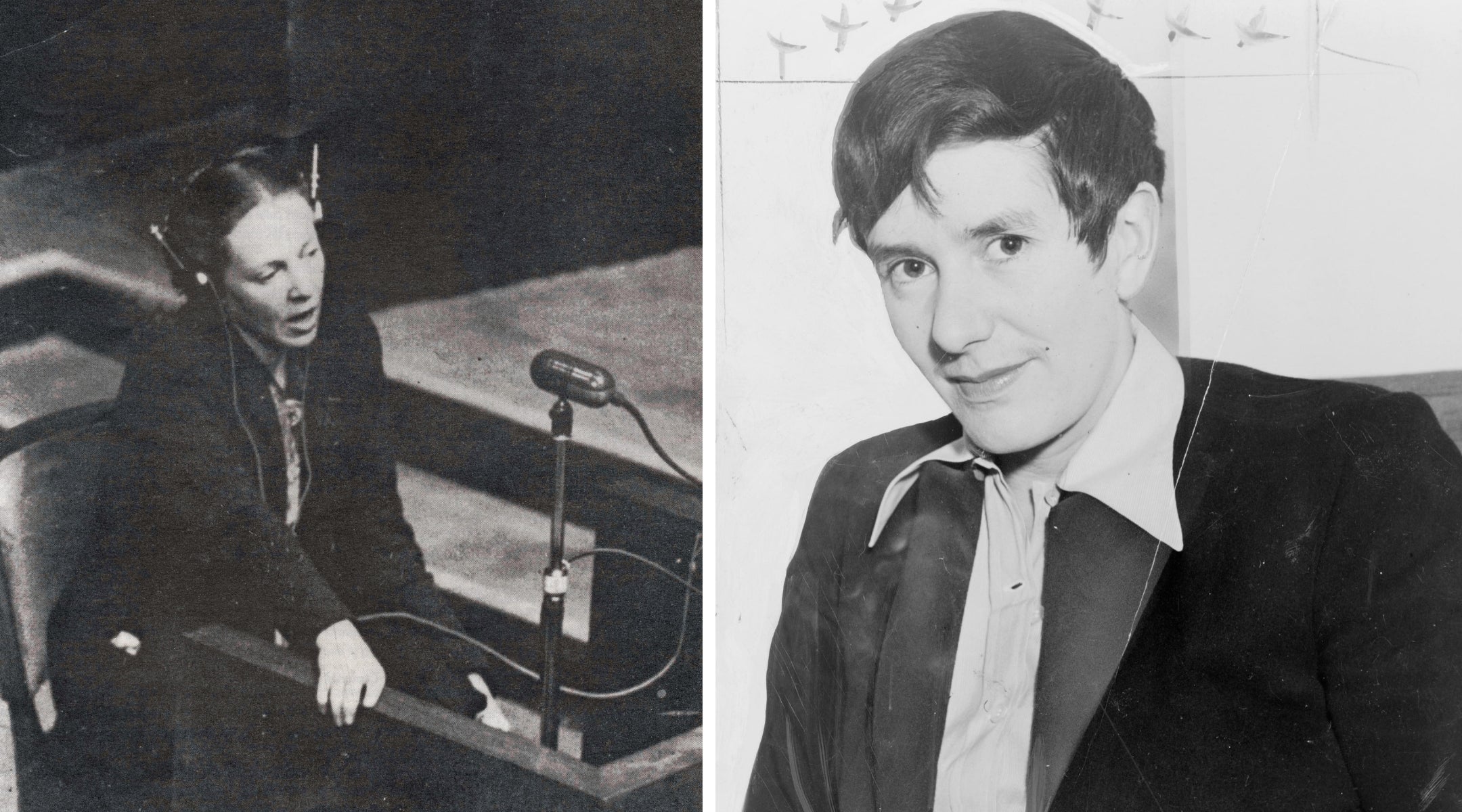
On 28 January 1946, Marie-Claude Vaillant-Couturier, French résistante, deportee, and survivor of Auschwitz and Ravensbrück, stood a few feet from Göring and set out, with forensic detail, the horror of the camps: the selections, the children, the industrialised murder. She did not weep. Her words were spare and unflinching. She would not be shaken under cross-examination.
To a great extent it was because of Vaillant-Couturier that the Holocaust entered the legal – and moral – conscience of the world. She was the first woman to testify at the International Military Tribunal, and over the two hours that followed she changed the course of the trial. She spoke of the people she had been with at the camps and gave them back their names. Those who had been reduced to numbers were restored for the record, and in the course Vaillant-Couturier’s testimony, restored to being human beings.
Today, 80 years on, survivors who witnessed the atrocities that she so meticulously put before the court, and the watching world, are sadly dwindling in number.
Voices that ran to the millions are now a fraction of this. This is why Vaillant-Couturier’s unwavering testimony is central to my book, why her voice needs to be amplified, and why an image of her on the stand features on the book’s front cover.
Although she was one of the first to insist on the truth of the Shoah, there were others who made sure this truth was both prosecuted and publicised. Harriet Zetterberg, a talented young Yale-educated American prosecutor, compiled the airtight case that convicted Hans Frank, the Butcher of Poland. Barred by US military protocols from speaking in court because of her gender, her role was confined to passing papers to a man who read her work aloud.
Erika Mann, the daughter of Nobel-prize-winning writer Thomas Mann – German journalist, polemicist, and anti-Nazi activist – brought fierce conviction and burning anger to her reports on a homeland she had fled and could now only describe as alien.
Tatiana Stupnikova interpreted the proceedings in real time for the Soviet delegation, navigating a political tightrope her Western counterparts could not have imagined.
Many of my eight women were not archetypal heroines, and this book certainly does not aim to be a hagiography. German journalist Ursula von Kardorff came to report the trial from the perspective of a defeated nation. “Nowhere is it more painful to be German as in Nuremberg,” she wrote, yet consistently evaded the question of her own complicity.
And then there are revelations that continue to leave me stunned. Countess Ingeborg Kálnoky ran the guesthouse where witnesses summoned to Nuremberg were lodged, which meant that victims of Nazism and perpetrators of it slept in adjacent bedrooms, passed one another on the stairs, and took meals at the same table. She recorded every detail of this historical aberration in her diaries.
The Nuremberg women testified, prosecuted, wrote, translated, and painted. They provided a vital part of the historical record that has largely been forgotten. They also showed bravery, resilience, and a commitment to the truth. That is why the story speaks so urgently to our own bleak and troubled times.
“Never again” does not enforce itself. Truth is not self-preserving. In an age of denial, distortion, and flagrant ahistoricism, the survival of fact depends on those willing to establish it, repeat it, and refuse to be shaken.
Hope, as these women understood it, was never blind optimism. It was work. They did it. It has taken 80 years to listen.
- The views and opinions expressed in this article are those of the author and do not necessarily reflect the views of the SA Jewish Report, JTA, or its parent company, 70 Faces Media.