


Lifestyle/Community
More parties, less certainty, except in Cape Town

With dozens of political parties competing for voters and established political loyalties under pressure, the local government elections could deliver significant changes across the country. But Cape Town may be heading in a different direction from other major cities, according to elections analyst Wayne Sussman.
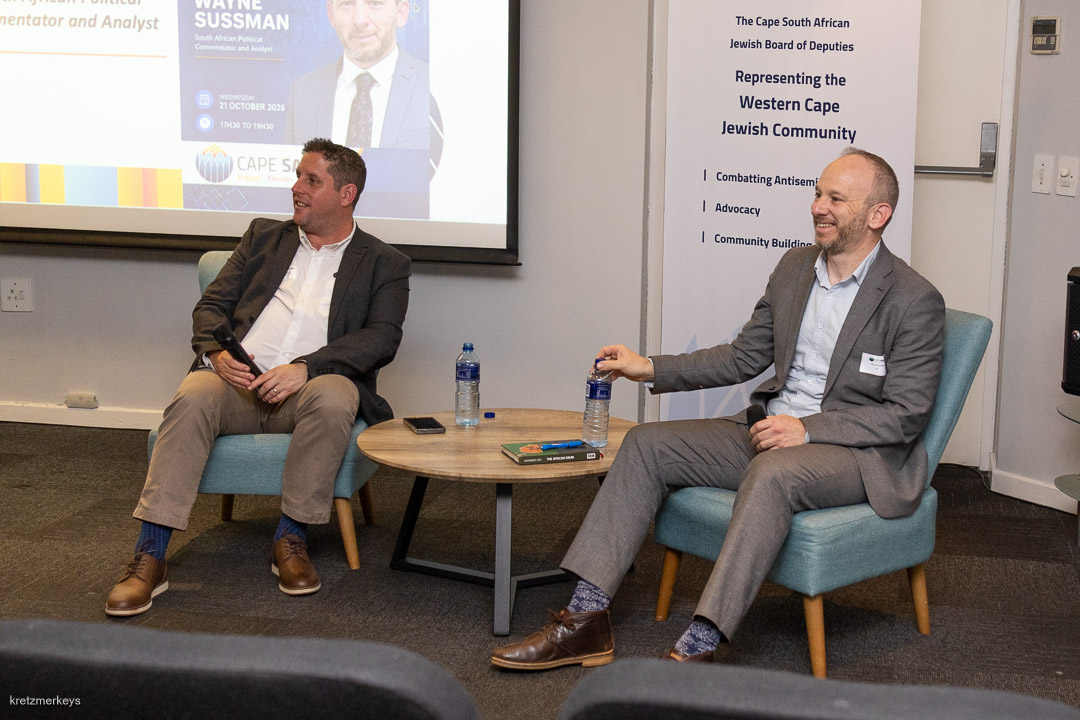
Speaking at the Cape South African Jewish Board of Deputies (Cape SAJBD) annual general meeting on 21 October, Sussman examined the trends shaping the 4 November elections.
Fragmentation was one of the defining features of the current political landscape, said Susman, who analyses elections and polling for eNCA and MarkData. With more parties competing for support, even established political organisations face challenges in retaining voters.
Speaking with Cape SAJBD executive director Daniel Bloch, Sussman suggested that the DA was well positioned to retain its outright majority in Cape Town. Johannesburg, however, presented a more complicated picture, with political fragmentation making the formation of a stable governing coalition uncertain.
One of the clearest indicators came from polling conducted across the country’s six major metropolitan areas. Respondents were asked how they viewed their municipality’s performance over the previous five years.
Cape Town was the only metro where positive sentiment outweighed negative feelings, Sussman said. The city recorded a positive balance of 25 percentage points, while Johannesburg recorded a negative balance of 42 percentage points.
He said the findings helped explain why he expected the DA to retain its majority in Cape Town, although he was less confident that it would match the 58% of the vote received previously.
“I don’t like silver bullets,” he said, cautioning against relying on a single indicator to predict an election result. Nevertheless, he argued that perceptions of municipal performance would play a large role in determining how voters cast their ballots.
The growing number of political parties was another significant factor. Sussman pointed to Tshwane, where the number of parties on the ballot had increased substantially since the 2021 local government elections. In one ward, he noted, the number of parties had risen from 37 to 67.
The proliferation of choices could affect parties across the political spectrum, including the DA in the Western Cape. Sussman expected the Patriotic Alliance (PA) to make gains in some areas, but questioned whether it could translate its growth in by-elections into comparable success across a wider electoral contest.
He also highlighted the importance of campaign organisation and leadership. Smaller parties can experience rapid growth when their leaders attract public attention, but they may struggle to sustain momentum without sufficient organisational capacity.
Sussman argued that the PA’s dependence on its prominent leadership could become a vulnerability. Larger parties, by contrast, generally have deeper structures and more people available to campaign and govern.
He said the final weeks of a campaign could prove decisive, as parties with greater resources and stronger ground operations attempted to consolidate support.
Johannesburg presented a different challenge. Sussman described the city as politically fragmented, reflecting its diverse population and the range of parties competing for support.
He pointed to Helen Zille’s campaign and the DA’s polling performance as significant developments. At the time of the discussion, MarkData polling placed Zille ahead of the ANC, although the DA wasn’t expected to secure an outright majority.
Sussman said the central question was how a governing coalition could be formed if no party won enough votes to govern Johannesburg alone. The result would depend not only on the strength of individual parties, but also on their willingness to cooperate after the elections.
He cautioned that campaign promises and statements ruling out potential coalition partners might not survive contact with the practical demands of governing.
The broader implications extended beyond Johannesburg. Sussman said it was possible that the ANC would fail to win any of the six largest metropolitan areas. He connected this prospect to public dissatisfaction with municipal governance. The polling suggested that voters were increasingly concerned about whether their cities were being run effectively.
Sussman said surveys indicated that 66% of respondents prioritised service delivery when deciding which party to vote for. By comparison, 27% identified political identity and history as their primary considerations.
These findings reflected the importance of practical concerns in shaping voting behaviour, particularly as South Africa moved further from transition to democracy. “South Africans are sending a message that they’re not happy with the way their metropolitan areas are run,” he said.
The results also raised questions about the ANC’s ability to respond to changing voter expectations. Sussman described the party’s position as increasingly vulnerable, particularly where voters associated it with poor municipal performance and unstable coalition arrangements. He also discussed the possible influence of the uMkhonto weSizwe party and the Economic Freedom Fighters, noting that political fragmentation affected these parties as well.
For the Jewish community, Sussman’s analysis touched on the relationship between local politics, international affairs, and political representation. He discussed the electoral prospects of smaller parties whose positions against Israel and the war in Gaza had attracted attention among Jewish voters. These included Al Jama-ah and the National Coloured Congress, as well as other parties campaigning on identity-based issues.
Sussman cautioned against assuming that strong social media visibility or claims made through unofficial polls necessarily translated into electoral support. He expressed concern about misinformation, including the circulation of unreliable polling figures.
He emphasised the importance of distinguishing established polling organisations from sources making claims without credible evidence.
Sussman’s central argument was that the elections could not be understood simply by looking at which parties were gaining attention. Voter sentiment, service delivery, campaign organisation, and the ability to govern would all influence the outcomes.
With the elections approaching, the question was whether established parties could retain their support while smaller parties capitalised on changing political loyalties. The results would also determine whether South Africa’s major cities could produce stable administrations capable of responding to residents’ needs.