


OpEds
Bibi, ballots, and a Brazilian

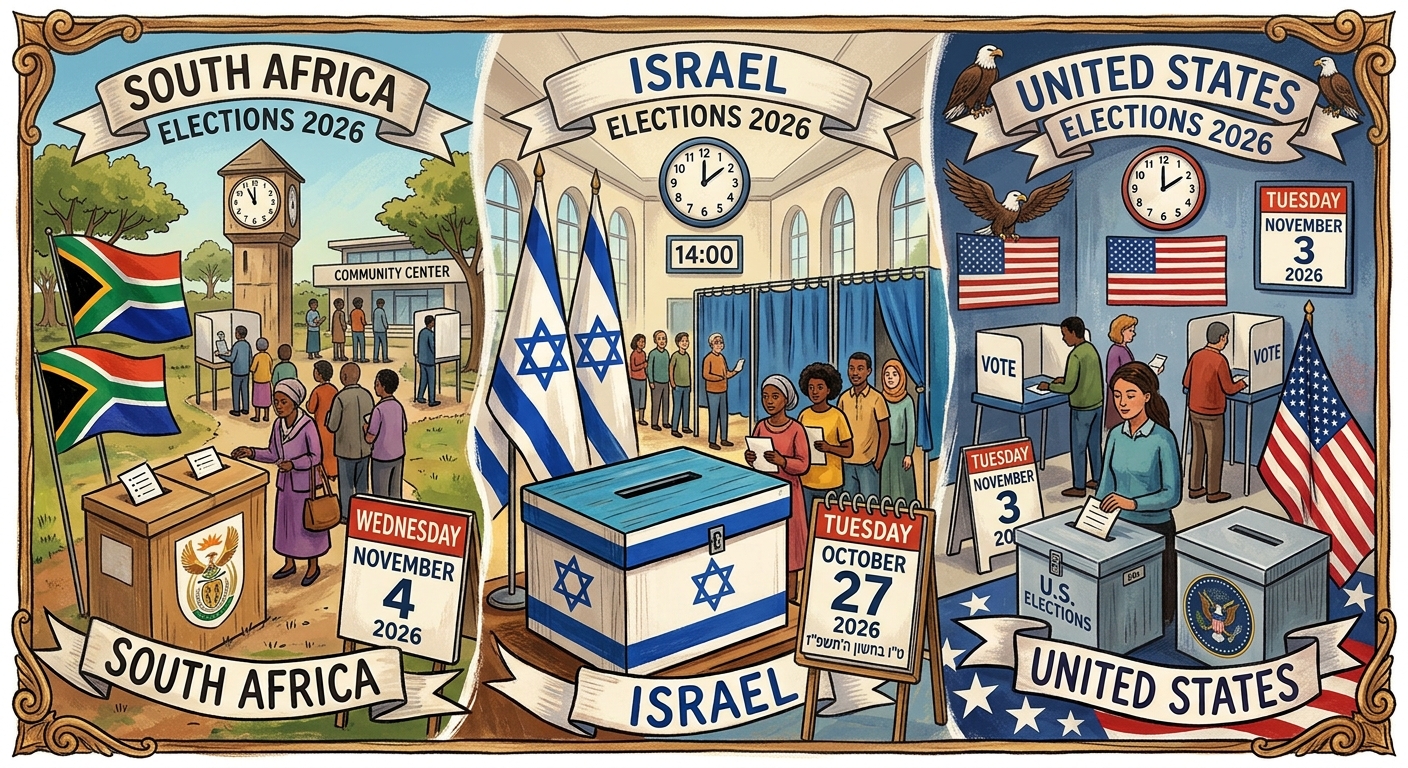
South African Jews should prepare themselves for an extraordinary political fortnight. Between 25 October and 4 November, four elections across three continents could dramatically reshape the global political landscape in which our community operates.
Israelis will decide whether Benjamin Netanyahu remains prime minister. Americans will vote on whether Donald Trump retains control of Congress and the Senate. South Africans will determine who governs their cities, while Brazilians may replace their left-wing president with the son of one of Israel‘s strongest and most Trumpian international allies.
Each election is complicated, each carries enormous consequences, and each will affect South African Jews, whether through our relationship with Israel, our place in South African society, or the international political environment.
Here is what to watch.
Israel: Can Bibi survive again?
When: 27 October 2026
What’s at stake
Benjamin Netanyahu is once again fighting for his political survival. Israel’s longest-serving prime minister faces a challenge from Gadi Eisenkot and other opposition figures seeking to end his remarkable political career.
The election comes after years of war, political upheaval, and extraordinary changes in the Middle East. Netanyahu will be campaigning on his security record despite the failure of 7 October, while his opponents will argue that Israel needs new leadership that will give the nation a chance to heal after the years of upheaval.
But Israeli elections are rarely straightforward contests between two candidates. With a fragmented party system, the winner is not necessarily the politician whose party receives the most votes; it is the one who can put together the most sustainable coalition.
What to watch for
The first question is which party emerges as the largest in the Knesset. This can provide an important advantage in persuading Israelis that its leader has the best chance of assembling a coalition.
But the real magic number is 61: the majority needed in Israel’s 120-seat Parliament. Most polls suggest that neither the pro- nor the anti-Netanyahu block has a majority. This will leave the possibility of outside support from the Arab parties for Eisenkot or the opportunity for Bibi to pick up defectors for his coalition. Some of this will depend on whether certain mostly right-wing parties make it over the threshold, giving Bibi additional potential partners.
If neither Netanyahu nor his opponents can assemble a workable coalition, Israel could find itself heading towards yet another election in 2027.
South Africa: Who will control the cities?
When: 4 November 2026
What’s at stake
The municipal elections could mark another historic stage in the decline of ANC political dominance.
The ANC faces the real possibility of failing to secure outright majorities in any of the major metropolitan municipalities. The DA, meanwhile, has opportunities to retain Cape Town and compete for control of Tshwane, Nelson Mandela Bay, and even eThekwini.
The most important contest will be Johannesburg, where Helen Zille has turned potholes, overgrown verges, and municipal decay into campaign social media sensations.
The big question is whether her willingness to go ziplining, swimming, and spinning while personally tackling neglected public spaces can be converted into enough votes to capture South Africa’s economic capital.
What to watch out for
Differential turnout will be the watchword. If disillusioned ANC voters stay home while motivated DA supporters turn out in large numbers, significant political change becomes a serious possibility.
Another wildcard is Jacob Zuma. His health and political visibility could affect the Umkhonto weSizwe Party’s performance, potentially including a sympathy vote if his condition deteriorates.
The results will also shape the ANC’s internal succession battle in 2027. The ANC election campaign has been disorganised, with mayoral candidates not even announced. Regional performances could influence which factions and personalities enter that contest and with what momentum.
More importantly, these elections will provide an early indication of whether South Africa is heading towards something once almost unimaginable: a non-ANC president following the 2029 national elections.
United States: Will Trump lose the Senate?
When: 3 November 2026
What’s at stake
The American midterm elections take place against an increasingly hostile political atmosphere for Republicans.
The House of Representatives, which represents people in the areas in which they live, appears particularly vulnerable, with the Democrats well positioned to make gains and become the majority. The bigger question is whether Republicans can retain control of the Senate, which represents the states.
Should Democrats capture both chambers, the final two years of Trump’s presidency could become an exercise in political trench warfare, with investigations, legislative obstruction, and constant confrontation between Congress and the White House.
What to watch out for
For Jewish observers, one of the most consequential contests is Michigan, where Abdul El-Sayed, a progressive anti-Israel Democrat, is competing against a security-minded but milquetoast Republican, Mike Rogers.
El-Sayed’s political positions, including his anti-Israel activism, pro-Iran sympathies, and his ties to Islamist organisations and antisemitic online personalities, have attracted controversy, particularly following a terrorist attack on a Michigan synagogue. While he might be more famous, New York’s Zohran Mamdani looks like a youth movement madrich in comparison.
An El-Sayed victory and others in the Senate would represent a significant breakthrough for the Democratic Party’s anti-Israel progressive wing. It could also offer an important indication of where the party is heading ahead of the 2028 presidential election after the end of the Trump era.
And a Brazilian appetiser
Before these three contests, there is an appetiser on 25 October: Brazil’s presidential runoff.
The incumbent left-wing president, Luiz Inácio Lula da Silva, faces Flávio Bolsonaro, son of former president Jair Bolsonaro, one of Israel’s most enthusiastic international supporters.
A Bolsonaro victory could significantly create new tensions within the BRICS bloc of countries, where Brazil and South Africa have frequently found common diplomatic ground in the Middle East. It would also effectively make almost the entire South American continent pro-Israel.
Four elections, 11 days, and enormous uncertainty. For South African Jews, the results will be felt far beyond the ballot boxes. The political world in which we live may look rather different by the first week of November.
- Benji Shulman in the director of the Middle East Africa Research Institute.