


Israel
Cracks in Israel’s education system

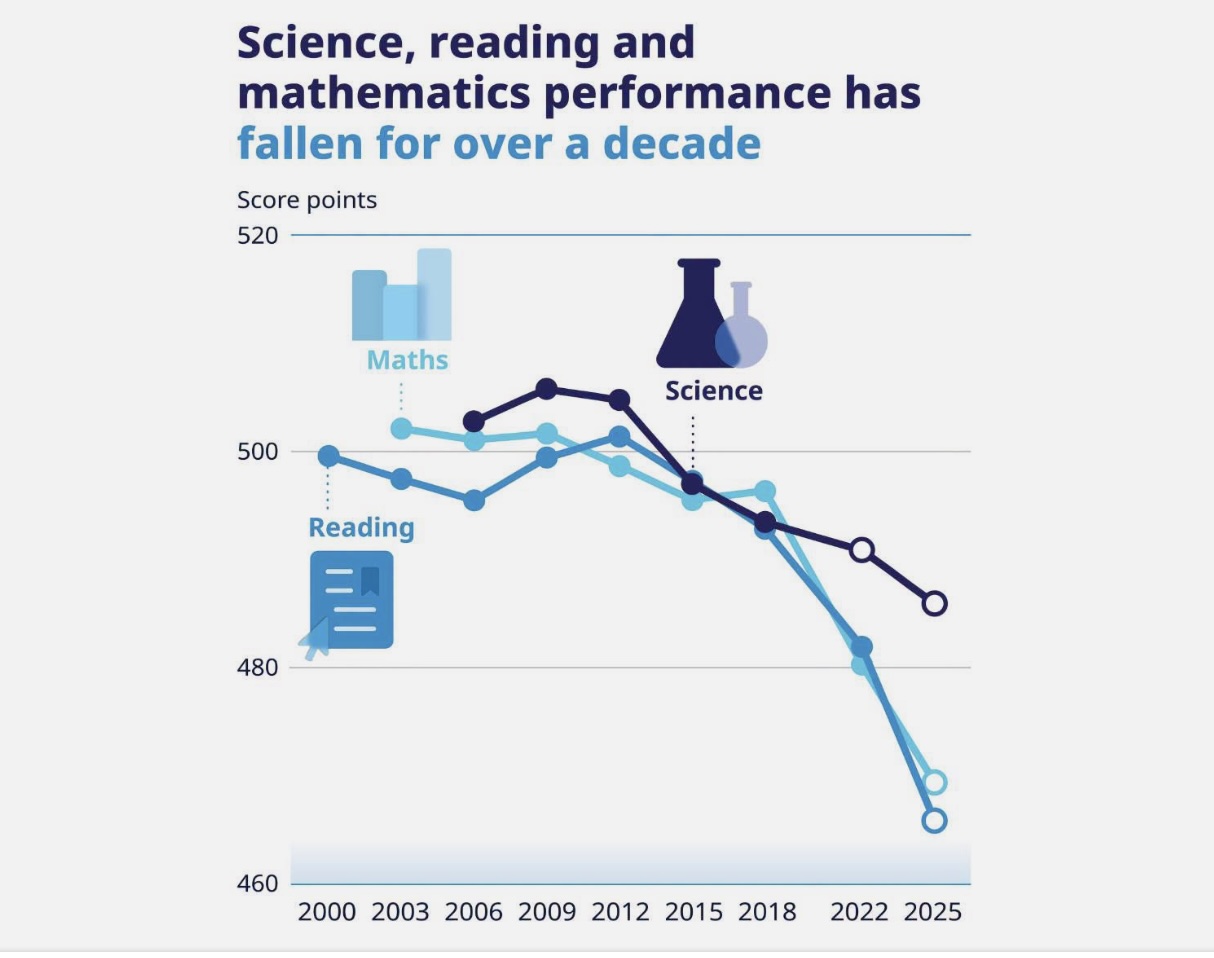
Israeli schoolchildren recently delivered a result that is difficult to ignore. Their performance in mathematics, reading, and science has fallen to its lowest level since the country began taking part in the Organisation for Economic Co-operation and Development’s (OECD) international assessment of pupils.
Teachers and education researchers caution against blaming the decline solely on 7 October and the resulting war.
Professor Ayal Kimhi, vice-president of the Shoresh Institution for Socioeconomic Research, said Israel’s results had been near the bottom since it began participating in the OECD’s Programme for International Student Assessment (PISA) before 2023.
PISA tests representative samples of 15-year-olds in maths, reading, and science. The 2025 assessment involved 760 000 students across 91 countries and economies. In Israel, the average scores were 433 in mathematics, 436 in reading, and 442 in science. The OECD averages were 463, 461, and 482 respectively.
Compared with 2022, Israel’s maths score fell by 25 points, reading by 38 points, and science by 23 points. The OECD recorded declines across many countries, but Israel’s were substantially larger than others.
“It would be too easy to blame it all on the war,” said Kimhi. “Israel’s education system suffers from many deficiencies that seem to get worse over time.”
A study published by the Shoresh Institution in August found that Israeli teachers had lower literacy, numeracy, and problem-solving skills than teachers in most OECD countries surveyed. Israeli teachers also measured lower than non-teachers with academic degrees.
The study found that 37% of Israeli teachers held a master’s degree, compared with 49% in the OECD countries examined. It also found particularly low skill levels among teachers in the Arab education stream and among early childhood teachers.
Kimhi said improving the quality of teaching should be central to any response. He argued that Israel needs to change how it recruits, trains, and rewards teachers.
South African-born teachers working in Israeli schools offer a more immediate view of the pressures in classrooms. Tanya Jayes taught in South Africa for 15 years before making aliya. She now teaches English and science and is a homeroom teacher for Year 12 pupils at King Solomon School, an elite private school in Ramat HaSharon.
Her experience has made her cautious about drawing sweeping conclusions from the PISA results. Her school continued teaching throughout the COVID-19 pandemic and the war. “I don’t believe we’re in as much of a doomsday situation as the PISA report makes out,” Jayes said.
She believes the relationship between teachers, pupils, and parents is particularly important in Israel. “The only thing that works, the only way education works in a school in Israel, is if you develop a relationship with the children,” she said.
Jayes described pupils contacting teachers during emergencies, including when family members were called up for reserve duty and when mental health struggles arose.
For English teacher Shelley Berman, who previously taught in Johannesburg, the impact of the war has been impossible to separate from education. Berman teaches at a religious girls’ high school in Tel Aviv. During periods when schools were closed, lessons moved online and assignments were uploaded for pupils.
Many pupils have experienced loss or have close family members serving in the military. This has affected what and how she teaches. She recalled a pupil becoming distressed during a lesson on Macbeth because the violence in the play felt too close to the reality around her. The pupil asked Berman to avoid content that touches on violent themes.
Lorelle Schwartz, who has taught in Israel for 14 years and currently teaches at a public school, said repeated disruptions had created a cycle that was difficult for pupils and teachers to escape. “We’ve been stuck in this time capsule.”
Schwartz said pupils had become accustomed to moving between classroom learning and Zoom lessons during periods of conflict. She also pointed to teacher shortages, discipline problems, and a lack of support for educators.
Her concerns echo the recent Shoresh research, which found that Israel has difficulty attracting and retaining highly skilled people with academic degrees in teaching. The study argues that schools struggle to compete with other parts of the labour market for highly skilled workers.
Research by Kimhi, Ariela Savin, and Dan Ben-David found that pupils’ educational outcomes in Israel are more strongly linked to their parents’ education than in leading education systems.
The study examined PISA results from 2006 to 2018 and found that gaps linked to parental education were particularly large among Hebrew-speaking pupils. Even after accounting for other differences between households, the relationship remained stronger than in the leading countries.
Israel also faces significant differences between education streams. Most Haredi boys don’t study the material required for PISA and therefore don’t participate in the assessment. Kimhi said their inclusion would probably make Israel’s overall results worse. However, he said that, “the fact that ultra-Orthodox girls did fine in PISA indicates their unfulfilled potential”.
The teacher skills research similarly found substantial differences between education streams. Arab-Israeli teachers recorded lower skill levels than teachers in the secular, religious, and Haredi streams.
Yet the teachers interviewed for this article didn’t describe Israeli pupils simply as failing. Jayes stressed their resilience and said she remains strongly supportive of Israeli education. Berman said her school continued to achieve strong exam results despite the disruptions.
The challenge may be how consistently the system can give pupils the conditions to succeed. Kimhi believes the answer requires structural change. He has called for a more unified core curriculum, greater freedom for municipalities and school principals, and changes to teacher recruitment and training.
He also sees the issue as economic. Israel’s technology sector depends heavily on highly skilled workers. “The economy rests on the shoulders of the technology sector,” he said. “We have no advantage in any resource other than the human resource.”
The PISA results therefore raise a question that extends beyond school reports and rankings. If Israel wants to preserve its economic and technological strengths, it will need to ensure those strengths aren’t carried by a small group of exceptional pupils alone.