





Community
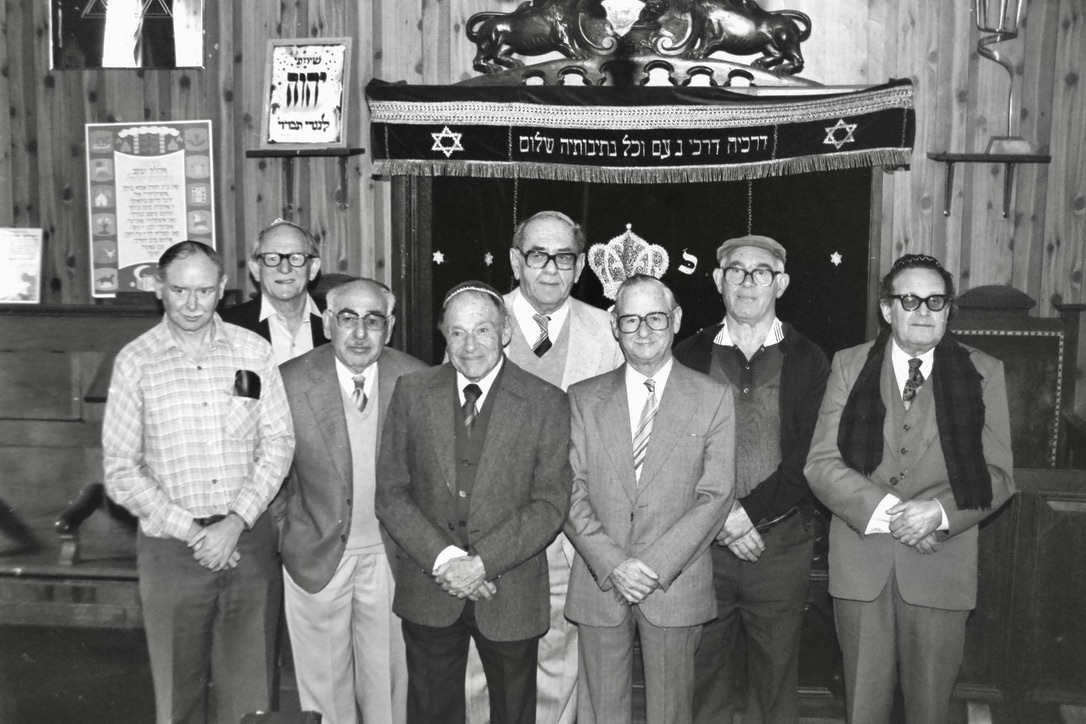
Herzlia’s Minyan Yosef reaches a century

Joseph Homa could not have imagined that the United Hebrew Schools’ Boys’ Minyan that he established in 1926 would still be functioning a hundred years later as the Minyan Yosef of Herzlia High School.
Mr Homa had taken up the principalship of the Cape Town United Hebrew Schools, or Talmud Torah, at the beginning of 1926. He had been born in Jaffa in 1880 and his father, Rabbi Baruch Homa, was an eminent scholar. Young Joseph was a friend of the son of Eliezer Ben-Yehuda, who led the revival of Hebrew as a vernacular.
Among Mr Homa’s innovations at the Cape Town Talmud Torah was the establishment of the Boys’ Minyan, the purpose of which was to give pupils the opportunity to become proficient at leading Shabbat services. The first service was held on 18 June 1926.
Mr Homa died suddenly on the Fast of Esther in early 1928. The members of the Minyan quickly decided to rename it in his honour, drawing their inspiration from the wording on his tombstone that had been composed by Rabbi Moshe Chaim Mirvish. A year later they erected a special plaque in Mr Homa’s memory, a plaque that was later moved to the entrance to the dedicated Minyan Yosef synagogue at Herzlia High.
The first chairperson of the Minyan Yosef was Ellis Kupowitz. He occupied that position for at least the first decade, with the exception of six months in 1929, when Isaac Sudat took the leadership position.
Minyan Yosef has undergone many changes over the years. Originally its services were only on Shabbatot, and occasionally chaggim. At that time, most of the pupils lived in walking distance of Hope Street, where the school was located. Sunday morning services were introduced in 1927, but did not continue for long.
The inaugural weekday morning service at Herzlia was held in the school hall in Highlands on 8 June 1958. The final Shabbat service at the Talmud Torah took place on 7 September 1962, after which these services were held at Herzlia, which was closer to where more pupils then lived. However, in time there were too few pupils in the vicinity of Herzlia to sustain a Shabbat service, the last of which was held in the mid-1980s.
The Shabbat services were controversial from their inception until attendance at them dwindled. This was because they drew youngsters away from the local synagogues, which displeased some parents and shul leaders.
However, a succession of school and community leaders who saw the special value in Minyan Yosef continued to support it. These included Alexander Levin who succeeded Joseph Homa as principal of the Talmud Torah, Zalman Avin, who followed him and who also became the first principal of Herzlia, and then later Myer Katz, principal of Herzlia. Another notable figure was the beloved blind cantor Abraham Immerman.
It was during Mr Levin’s tenure, in 1931, that one of the boys, Joseph Homa’s son Elie, first served as the ba’al kri’a (reader of the Torah). While the boys had previously led the services, the Torah reading had traditionally been done by an adult. In time, it became standard for pupils to read the Torah.
In 1945, at Mr Avin’s initiative, girls started attending. Mr Avin also intensified a practice of Mr Levin’s by inviting prominent people to visit the Minyan, thereby boosting attendance. Visitors included leading South African rabbis such as Israel Abrahams, Michael Kuperman, Eugene Duschinsky, and Louis Rabinowitz, Israeli ambassador Yitzchak Bavly, and Cape Town Mayor Abe Bloomberg.
International events had ripple effects on Minyan Yosef. For example, in 1942, Mr Levin’s son Boris was captured at Tobruk and was held as a prisoner of war until 1944. The end of the war in 1945, and the recognition of the extent of the Holocaust, led to heightened concern about Jewish continuity. The independence of Israel was declared on Friday 14 May 1948, and was celebrated at Minyan Yosef that Shabbat, with a prayer for the State of Israel being recited for the first time.
In 1958, a Torah scroll from the ancient Jewish community that had left Iraq en masse earlier that decade was presented to the Minyan. In 1960, it hosted refugee Jewish children from the Belgian Congo, who led parts of Kabbalat Shabbat, using their Sephardi niggunim (melodies). In 1986, a special service was held to mark the release of prisoner of Zion Anatoly (later Natan) Sharansky.
Alumni of Minyan Yosef range from the current Chief Rabbi of the United Kingdom, Sir Ephraim Mirvis (who was chair in 1973), to Sam Kahn. The latter was the first secretary of the Minyan in 1926. In 1949 he was elected to Parliament by Africans in the Cape Province, but was expelled in 1952 for being a communist. He had long abandoned the Orthodox Judaism of his youth. However, in the mid-1980s, when I was researching and writing a book entitled Three Score Years And …: The History of Minyan Yosef, 1926-1986, he was sufficiently interested to call me from London to share his memories. Our call was mysteriously terminated mid-conversation.
Minyan Yosef’s century will be celebrated at Herzlia on 27 August 2026. At its 60th anniversary celebration in 1986, more than half a dozen of the early members were present. They included Louis Sandler who, at age nine, may well have been the youngest member in 1926, and Mr Levin’s son Isaac.
The pleasure of celebrating a century of Minyan Yosef is mitigated by the knowledge that none of those early members is still alive. We no longer have those living ties to the past. We still have living memory of them, but not for too many more decades. Traditions can last longer, and we can hope that Minyan Yosef will be among them.
- David Benatar is Emeritus Professor of Philosophy at the University of Cape Town. His most recent book is Very Practical Ethics.





Maxine Boyd
July 9, 2026 at 2:27 pm
Such an interesting article. I well remember Isaac Sudat, a wonderful gentleman who also took services at Camps Bay Shul when I was a child and teenager.
Lucille Liebowitz
July 15, 2026 at 1:50 pm
Please advise the names of the people in the picture. I recognise Norman Solin left bottom row and Felix Sachs right bottom row Unfortunately I don’t recognise anyone else As a pupil at Herzlia I attended the Minyan Yosef at the Highlands Estate campus
Jp Burke
July 29, 2026 at 10:53 am
Lovely Prof. Thank You!
Professor Philip Lanzkowsky
July 30, 2026 at 9:28 pm
I am a professor of pediatrics and I am 94 years of age and live in the United States. I went to cheder in Hope Street from a very early age and was active in Minyan Yosef for close on 90 years. I was there when Alexander Levine and Zalman Avin were the principals. I learned a great deal of how to conduct the services from my experience at that time. I remember when the.”new” Talmud torah was built. Norman Solan was in my class in Hebrew school. Felix Sachs was a well-known character in Cape Town at the time. After having read the biography of Alexander Levine and his education in Europe, I have gained amazing respect for him and regret how the children treated him and mocked his accent. Mr.Avin was the best teacher that I ever had and instilled in me a lifelong love for the Hebrew language and literature. Those formative years of my Hebrew education.(I took Hebrew as a subject for my matriculation when I was a pupil at.SACS) formed the basis of a lifelong love for the Hebrew language.