





Featured Item
ANC’s post 7 October keffiyehs a watershed, says chief rabbi

For Chief Rabbi Dr Warren Goldstein, the rupture between South African Jewry and the then African National Congress (ANC) government happened one week after 7 October 2023.
“On 7 October, as time unfolded, the horror grew worse,” he said. but he felt the decisive turning point was the Saturday night a week later. “I switched on my phone, and saw the president and the full national executive draped in keffiyehs, declaring support for Hamas and the Palestinians without any mention of the atrocities. That was deeply horrifying on so many levels.”
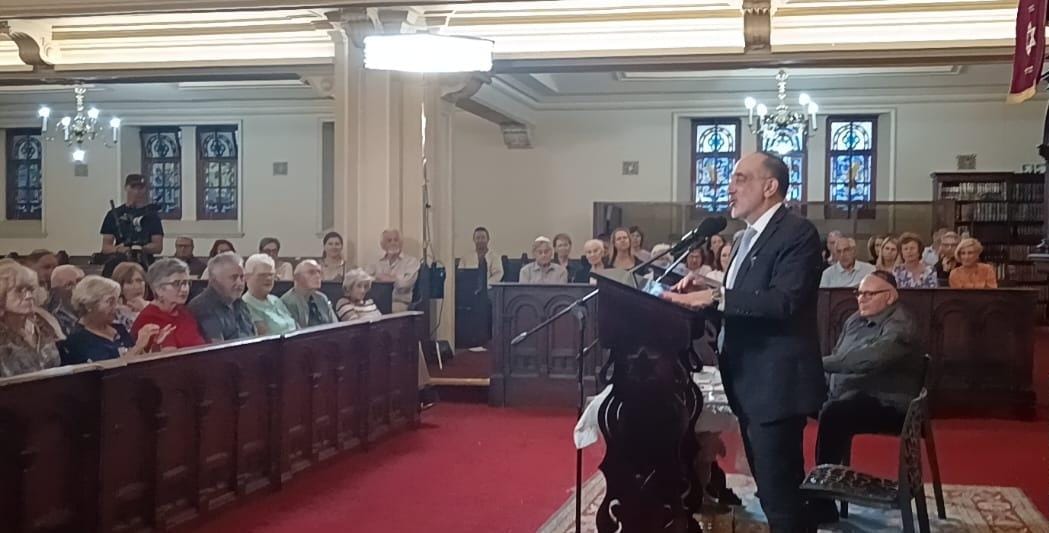
Goldstein was in conversation with Democratic Alliance MP Michael Bagraim on the impact of 7 October 2023 on South African Jewry, hosted by the Gardens Shul in Cape Town. He described not only experiencing political shock, but personal rupture, saying that he believed he had a relationship of trust with President Cyril Ramaphosa. “I used to think it was a friendship. They have since made it clear that it was never that,” he said.
That post-Shabbos moment, Goldstein told a packed Cape Town synagogue this week, forced a decision about how he believed the community should respond to power, pressure, and fear.
Speaking to an audience that included members of Parliament and faith leaders, Goldstein traced the strategic and moral choices he made after seeing members of the national executive appear to support Hamas publicly just days after the massacre in Israel.
The morning after that message, Goldstein arrived at a mass community rally without prepared remarks, uncertain how to frame a response. An encounter moments before he went on stage altered his approach. A community member urged him to remove the South African flag from the platform in protest. His instinctive refusal became the basis of what he later termed “patriotic resistance”.
“That flag stays,” he recalled telling her. “There is the government, and then there is the nation. Those are two different things in a democracy.” Removing the flag, he argued, would concede the country to the ruling party. “This country doesn’t belong to the ANC. It belongs to the people of South Africa.”
That distinction underpinned Goldstein’s public offensive against the government, including his denunciation of the case against Israel at the International Court of Justice. He outlined how his response shifted from rabbinic leadership to sustained civic activism, grounded in legal argument, moral language drawn from Jewish sources, and direct outreach to ordinary South Africans.
“This isn’t a political issue. This is a moral issue,” he said. “To accuse Israel of genocide is wrong for factual, historical, and moral reasons. When you normalise that accusation, you legitimise antisemitism.”
Goldstein said he deliberately bypassed direct engagement with the president in favour of appealing to the broader public. “I’m not talking to him. I’m talking to his bosses. I went over his head to the people of this country and said, ‘His government is betraying your values.’”
He argued that the government’s alignment with Iran, China, and Russia placed it at odds with the moral instincts of most South Africans. “The vast majority of South Africans believe in decency and human dignity,” he said. “That’s why we have among the lowest rates of antisemitism of any country in the world.”
Goldstein credited the spread of his speeches through social media with enabling that direct communication. He told the audience that his online platforms had reached millions of viewers, giving him a way to speak to fellow South Africans outside traditional media structures.
Addressing fear that his confrontational stance could endanger the community, Goldstein rejected the idea that silence offers safety. “If your safety depends on keeping your mouth shut when there is a moral crisis, you aren’t safe,” he said. “We live in a democracy. You cannot be locked up for your views in this country.” Security threats, he said, came not from criticism of government but from Islamist terror. “That remains a real threat, and it’s the government’s responsibility to protect all South Africans.”
Goldstein also challenged the notion that Jewish security depended on political access. “Politics has nothing to do with friendship. Politics is about power,” he said, referring to his former connections within the presidency. “Power is community standing up. Power is reaching out to friends in Washington, London, and Jerusalem. Power is reaching out to our fellow South Africans.”
The evening also underscored the breadth of interfaith support that has emerged since October 2023. Steve Swart, an African Christian Democratic Party member of the National Assembly, addressed the gathering with a message of solidarity from the Christian community. He cited the biblical call to “comfort my people”, and pledging continued public support for Israel. Saying, “We will not be silent in the face of antisemitism,” Swart described longstanding Christian involvement in Israel advocacy, humanitarian assistance, and public demonstrations of solidarity.
Bagraim, who moderated the discussion, praised Goldstein’s leadership and moral clarity, saying it had helped define the communal response during a period of acute vulnerability. He asked what gave Goldstein the confidence that such public defiance wouldn’t expose South African Jews to greater danger. Goldstein replied that fear itself was the greatest risk.
“When we are grasshoppers in our own eyes, then we become grasshoppers in the eyes of others,” he said, quoting from the Torah. “The future is in our hearts and in our souls. It’s not in the hands of politicians.”
He acknowledged anxiety about the long-term future of Jewish life in South Africa, especially among younger Jews exposed to hostile narratives on university campuses. But he insisted that the strength of Jewish education and identity remained decisive. “We will have a future if our children and grandchildren keep Shabbat,” Goldstein said. “The biggest threat is young Jews who check out.”
Goldstein linked hostility to Israel on campuses to ideological shifts within Western academia. He criticised Critical Race Theory for, in his view, reducing human identity to power and race rather than moral character. This ideological framework, he argued, had fed international hostility to Israel and distorted public understanding of the war.
On the question of the ANC government’s motivations, including suggestions of Iranian financial influence, Goldstein said the relationship was deeper than isolated funding. He pointed to longstanding political and economic ties, particularly in telecommunications, as well as what he described as shared ideological alignment on the radical left of global politics.
Despite his sharp denunciation of the current administration, Goldstein drew a distinction between the failures of the past 15 years and the achievements of the first decade and a half after 1994. He described the advent of democracy as “an unmitigated blessing” that had allowed Jews to practise their faith freely and to dissent without fear of state repression.
“The failures of the ANC today aren’t failures of democracy,” he said. “They are failures of leadership within a democratic system.” Throughout the evening, Goldstein returned to the idea that South African Jewry’s struggle after 7 October wasn’t only about Israel, but about belonging in South Africa. “They wanted to isolate us as a tiny community,” he said. “We aren’t alone. We share values with the vast majority of South Africans.”
As the conversation closed, the mood in the hall was resolute rather than despondent. Goldstein rejected repeated questions about whether Jews still had a future in the country. “Of course we have a future,” he said. “Our future isn’t determined by what happens in Parliament or at the United Nations. It’s determined by who we are.”
For many in the audience, the evening offered not only a retrospective on the trauma of October 2023, but a framework for understanding the two years that followed. It traced how a community moved from shock and betrayal to open confrontation with the state, while reaffirming its place within South African civil society.





Les Wittenberg
December 12, 2025 at 2:19 pm
Op sy kop !! As Douglas Murray commented on the choice to support Israel or Hamas, its simple – choose good or evil – its not even for discussion
Maxine Nerwich
December 12, 2025 at 2:28 pm
Thank you Chief Rabbi Goldstein for your words of wisdom and courage to face the ANC who are the epitome of immorality and degradation. You give hope to us Jewish South Africans. I am a proud Jew but often an embarrassed South African based on the stupidity of this useless government.
Mark Wade
December 12, 2025 at 5:44 pm
South Africa’s Jewish youth – and their parents too – realise that the combination of rabid anti-Semitism and anti-Zionism, combined with the racist and discriminatory apartheid laws of BEE, EE, AA and quotas, make their futures in our country precarious (and that’s not mentioning the incompetence and corruption in government). Kids aren’t being accepted into university because of racial quotas, aren’t getting jobs because of racial quotas, and aren’t being selected to national sports teams because of racial quotas. Further, al-Jamah’s recent motion, named the ‘Apartheid Bill’ (see a recent editorial in the SAJR) is likely to be supported by the ANC, EFF and MK and would not be dissimilar to Hitler’s ‘Nuremberg Laws’; the legislated persecution of the Jews.
Errol Price
December 14, 2025 at 3:18 am
So the Rabbi and others had a wake up two years ago.
The UN conference in Durban in 2001 where Zionism was equated to racism should have been clear evidence of the virulent ant-semitism of the ANC.
All diaspora communities are now under threat.
South Africa’s is simply too small and under direct attack from the majority ruling party.The community is living on borrowed time.
Alfreda Frantzen
December 12, 2025 at 10:21 pm
Thank you that reminder of the parlaimentarians with the Hamas-supporting scarves. I had forgotten, to my shame!
Jessica
December 13, 2025 at 2:25 pm
Make no mistake: the ANC-Alliance is fully aware that their support of Hamas and its from-the-river-to-the-sea “two-state solution” equals support for their version of the Final Solution.
That’s because their hatred of the local Zionist community is as virulent as their hatred of the Afrikaner community. QED.
Gary Selikow
December 14, 2025 at 2:50 pm
The keffiyah and Palestinian flag are no different to the swastika and the ANC is no different to the NSDAP.
Sue Randall
December 18, 2025 at 4:39 pm
I felt the same way. Everyone is entitled to their opinion and politics, but seeing our country’s leaders suddenly (and repeatedly) wearing keffiyehs so soon after the murder of innocent Jews and others in Israel cemented my dislike of the ANC forever. It was a point of no return. Not my government.
Choni Davidowitz
December 18, 2025 at 5:27 pm
Bottom Line. STOP DEFENDING THE EXILE. It is indefensible.