





Featured Item
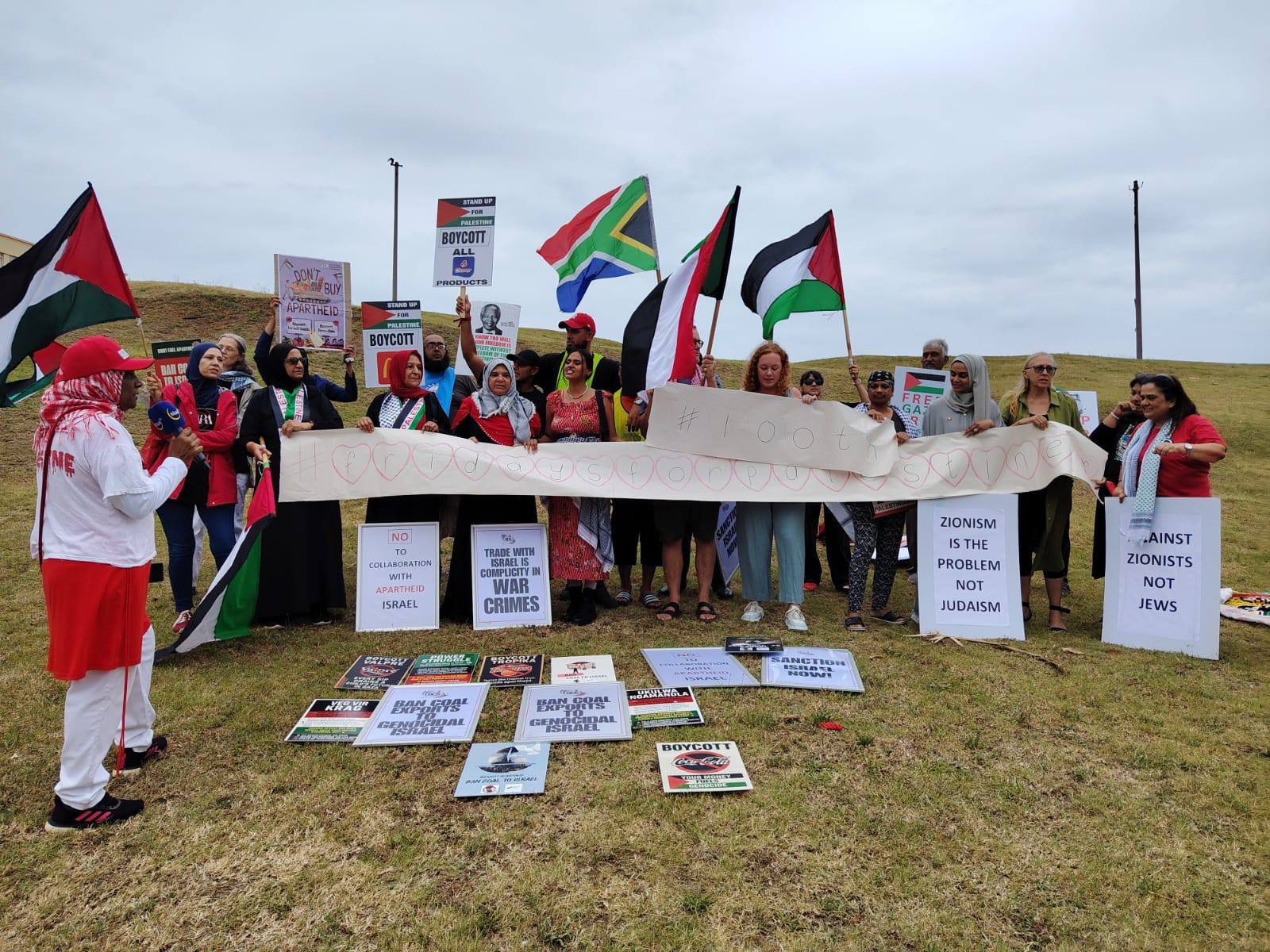
Protest outside Durban shul ‘targets Jewish community’

As worshippers arrived for Friday night Shabbat services at Durban’s Beit David Shul, located in the Holocaust & Genocide Centre campus, they were met by chanting, placards, and amplified sound from a group of protesters gathered just outside the property. Though the demonstration may have been small, its location and timing resulted in heightened apprehension for Durban’s already anxious Jewish community.
The South African Jewish Board of Deputies KwaZulu-Natal (SAJBD KZN) condemned the “deliberate targeting of a Jewish house of worship for political protest”, saying it was clearly “provocative, antagonistic, and unacceptable”.
The protesters’ stated aim to “free the world from Zionism” constitutes incitement and hostility and serves as a thinly veiled attack on the Jewish community itself, according to the SAJBD KZN.
The protest last Friday 23 January was the latest in a series held outside the Durban Holocaust & Genocide Centre over recent months. Although attendance has typically ranged from 15 to 30 people, Jewish communal leaders say the deliberate choice of venue, a site of Holocaust remembrance, Jewish community life, and an active synagogue, has transformed these protests from political expression into something far more troubling.
The Durban Holocaust & Genocide Centre shares its campus with the Durban Jewish Club, a kosher coffee shop, and the Durban Progressive Jewish Community synagogue, Beit David.
Alana Pugh-Jones Baranov, the president of the SAJBD KwaZulu-Natal Council, said the protests began during the Israel-Hamas war and continued even after a ceasefire came into effect. “They started as regular protests outside the Holocaust & Genocide Centre and later became ‘Fridays for Palestine’ protests at various locations around Durban,” she said. “A few weeks ago, on the first Shabbat after the ceasefire, they returned to the centre.”
That return marked a significant escalation. Previous protests had taken place earlier on Friday afternoons when the campus was largely empty. The most recent demonstrations were scheduled for early evening, coinciding with Shabbat services.
“At the previous protest, there was heckling and shouting at members of the congregation as they arrived and left,” Pugh-Jones Baranov said. “For the first time, they also brought a large speaker and played loud music, which was disruptive to the service taking place inside the synagogue.”
The Council maintains that Holocaust centres are memorials to the dead and points out that for many Jewish families, there are no gravesites for relatives murdered in Europe. “It’s disgraceful to desecrate the memory of the dead with hate-filled protests,” the Board said.
A particular source of concern was the language used on protest posters. One widely circulated poster called to “free the world from Zionism”. Pugh-Jones Baranov said this crossed a line. “Internationally and within South Africa, the term ‘Zionism’ is often used as a code for Jews,” she said. “When a protest using that language is held at a Jewish venue unconnected to Israel, it demonstrates that the Jewish community itself is the target.”
The KwaZulu-Natal Council described the phrase as a form of incitement, and warned that hostile rhetoric had historically escalated into violence. The statement referenced the global context in which Jewish communities are facing heightened threats, including documented arson attacks on Jewish places of worship and deadly attacks at Jewish community gatherings abroad.
Lori Goldberg, the president of the Durban Progressive Jewish Community, said the repeated protests had a direct impact on congregants. “We are a small community, and every incident feels magnified,” she said. “When people hear there is going to be a protest outside shul, fear sets in quickly.”
Goldberg said that following the circulation of information about the protest, several congregants decided not to attend Friday night services. “People who had been given honours that evening phoned to say they weren’t coming,” she said. “Some are elderly, others have small children. Even if the protest is small, the anxiety it creates is very real.”
According to Goldberg, those fears are often disproportionate to what actually happens on the ground. “On that Friday, there were more police officers and security personnel than protesters,” she said. “If people came, they would see how controlled it is, but fear doesn’t always work rationally.”
In response to concerns raised by the community, Pugh-Jones Baranov wrote to Durban Mayor Cyril Xaba requesting intervention. The Council formally asked for an enhanced police presence during protest hours; the establishment of a buffer zone to ensure safe access to the premises; and strict enforcement against harassment or intimidation of worshippers.
While no formal response was received from the mayor’s office, Pugh-Jones Baranov said there was cooperation from law enforcement. “Metro Police and public order policing were deployed and protesters were instructed to move across the street to a grass embankment,” she said. “That ensured they weren’t directly outside the Holocaust Centre or the synagogue.”
Pugh-Jones Baranov said the most recent protest, on 23 January, lasted about two to two and a half hours, and drew a somewhat larger crowd than usual partly because organisers described it as their hundredth protest. She noted the presence of a cameraman and journalists from Muslim media outlets, which hadn’t been the case at earlier demonstrations.
Although the protesters framed their message as anti-Zionist rather than anti-Jewish, Pugh-Jones Baranov said the community remained unconvinced. “You cannot separate that claim from the choice of location,” she said. “The decision to protest outside a Holocaust centre and a synagogue during a time of Jewish communal prayer is very concerning.”
Goldberg said the synagogue was frequently caught in the crossfire. “I don’t believe many of the protesters even realise there is a shul on the campus,” she said. “They see the words ‘Holocaust’ and ‘genocide’, and that’s what draws them. Because we are next door, we are affected.”
Despite the strain, both leaders stressed that the community was determined not to be intimidated. “There’s a core group of congregants who said they would come regardless,” Pugh-Jones Baranov said. “They refuse to give in to harassment.” Goldberg echoed that resolve while acknowledging the emotional toll. “It’s exhausting,” she said. “But we cannot allow fear to drive us out of our own spaces.”
As the situation continues to be monitored by CSO and law enforcement, Jewish leaders in KwaZulu-Natal say their focus remains on ensuring that places of worship and remembrance are treated with dignity and that constitutional freedoms are exercised without intimidation.

Bruce Torrance
January 29, 2026 at 8:45 pm
The Jewish communities have my sympathy. Turning up to shul to be met with hostile, abusive comments and placards is not fun, and is intimidating and potentially dangerous. Well done to those Jews who did pitch up, you stepped out in faith and put your trust in the Lord! You stood for righteousness!
May I please explain something from my perspective?
When the eternal word (Isaiah 40:8,) of the Lord G-d Almighty is contradicted by opposing ‘scriptures’ or books, then that author is NOT the Lord G-d Almighty. The Lord gave Moses 10 commandments, to love the Lord and to obey Him, and not to murder. Living to wipe out Israel, Jews and ‘infidels’ for martyrdom and heaven is not from the Lord, and pushes aside the Messiah and the free gift of eternal life,obtained through repentance and faith in Him.
Yeshua will only return to a Jewish Jerusalem. When He comes, the devil, the current ruler of this world, will be bound and cast into the abyss for a thousand years. The devil desires to be G-d in the place of G-d, (see Isaiah 14:12-15, his 5 ‘I wills’,) and when the Messiah comes, those ambitions will cease forthwith. Hence the vicious persecution of the Jews through the ages, to wipe Israel off the map and stop the return of the Messiah.
Open an atlas and prayerfully read Ezekiel 38 and 39, the coming war of Gog and Magog, in the invasion of northern Israel by Russia, Iran and Turkey. Judgement upon those invading forces is coming, a huge wake up call for all on planet earth, especially for those following the Qur’an. The good news of salvation in the Messiah must go out to all. (Read Psalm 22, Isaiah 53, Jer. 31:31-36.)
To the Jewish communities, stand firm, stand strong, don’t buckle, for the joy of the Lord is your strength. We continue to pray for Israel and are standing with you. Shalom!
From an evangelical Christian.
Ian Levinson
January 30, 2026 at 9:25 pm
Screaming at Jews outside a synagogue on Holocaust memorial grounds isn’t “protest”—it’s cowardly antisemitic thuggery, the moral equivalent of spitting on graves.
Pia de Vos
January 31, 2026 at 7:53 am
I agree with the comments above. So sad that these people are making a big noise and expending so much energy on hot air. They are so misled.
In the process making life miserable for the Jewish people of Durban.
May the Lord G-d intervene.