





Banner
New SA-Iran military talks ‘poke US in the eye’

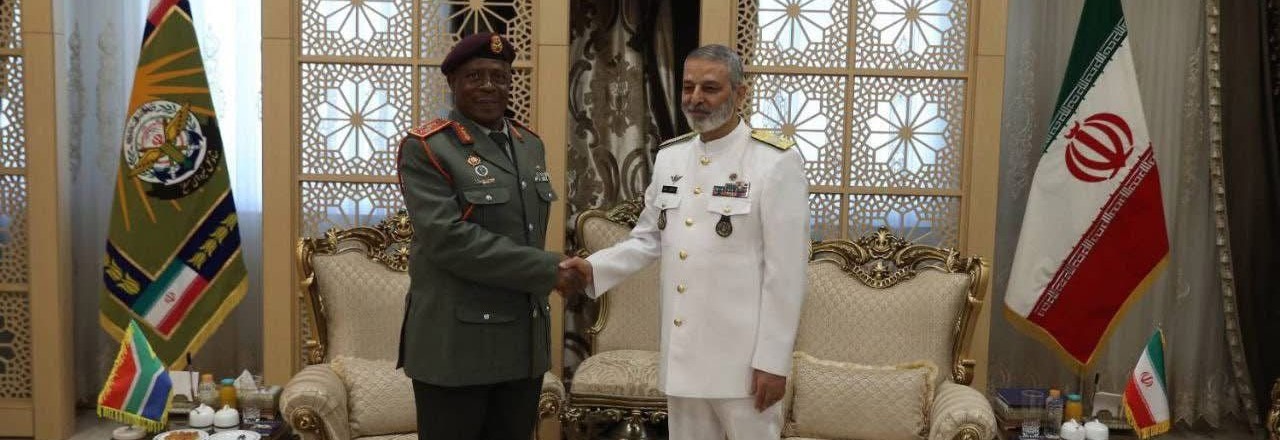
While South Africans desperately hope that our government will work towards reversing punishing American tariffs, another step was taken in the opposite direction when a South African delegation held high-level military talks with Islamic Republic of Iran military leaders earlier this week. In Tehran, both countries’ military leaders stated that they hoped to deepen military co-operation and strengthen their partnership.
Chief of the South African National Defence Force (SANDF), General Rudzani Maphwanya, said South Africa’s visit to Iran “carries a political message” and that “the Republic of South Africa and the Islamic Republic of Iran have common goals”. He called for deeper co-operation, especially in defence.
Iranian media reported that the chief of staff of the Iranian Armed Forces, Major General Abdolrahim Mousavi, said Iran was ready to expand military and defence co-operation with South Africa. “Today, the Islamic Revolution Guard Corps is recognised as the world’s largest anti-terrorist force and possesses valuable experiences that it can share with South Africa,” Mousavi said. He also warned Israel and the United States (US) against “aggression”.
The South African delegation also met Major General Amir Hatami, the commander of the Iranian Army, who called for expanding military co-operation between the two countries. He praised South Africa for condemning Israel’s war with Iran in June, and thanked South Africa for its support during that conflict. He emphasised that South Africa held a “prioritised” place in Iran’s foreign policy, and said he hoped it would lead to joint military projects.
Political analyst Daniel Silke says the meeting is a “provocative gesture” considering rocky US-South African relations, while international relations expert Professor Glen Segell says “such interactions indicate a collapse of governance in South Africa. The Department of International Relations and Cooperation (DIRCO) and the SANDF aren’t aligned on the same policy objectives.
“The nature of the interaction is what’s significant,” Segell says. “The US and Israel have endeavoured to isolate Iran. This visit may be perceived as efforts to bypass or weaken the initiatives being pursued by the US. This situation is characterised more by political factors than military ones, as the SANDF lacks the necessary strategic and tactical calibre to partner with Iran. The bottom line is that there will be stronger trade tariffs and sanctions against South Africa.”
Silke says that by pursuing this closer approach with Iran, “South Africa will come up against pressure from the White House, and this could negatively impact ongoing attempts by South Africa to alleviate tariff and trade pressures. This could really undermine trade negotiations between Washington and Pretoria.”
A recent report from the Middle East Africa Research Institute (MEARI) described how South Africa’s close ties with Tehran have led the country to compromise its democratic and constitutional principles. Now, MEARI’s executive director, Benji Shulman, says these talks will be seen as “aggressive posturing” from South Africa, and “will make it harder for South Africa to push the idea that they’re friendly towards the US”.
As for Hatami saying that South Africa holds a “prioritised” place in Iran’s foreign policy, Shulman says “I think it means that South Africa is Iran’s only democratic ally”, which it sees as valuable.
Professor Hussein Solomon, senior professor in the Department of Political Science at the University of the Free State, agrees, saying, “Iran prioritises South Africa because Iran is quite isolated and because South Africa has been consistently pro-Iran for decades. South Africa also gives it access to BRICS, for example, [the organisation comprising Brazil, Russia, India, China, South Africa, Egypt, Ethiopia, Indonesia, Iran, and the United Arab Emirates], and South Africa makes use of its international position to protect Iran. This is problematic.”
Political analyst Steven Gruzd concurs that South Africa is again “poking America in the eye”, which he believes the US won’t tolerate much longer. In turn, this will drive South Africa even closer to Iran, Russia, and China.
“This appears to be yet another instance of the two countries coming together, using inflammatory rhetoric, railing against the West, and showing they are on the same page,” says Gruzd. “This isn’t going to help South Africa’s troubled relations with the US. This may be South Africa asserting its independent foreign policy, but the optics of it aren’t going to play well in Washington.”
Said Hatami, “The Islamic Republic and South Africa have always supported each other and oppressed nations. This mission must continue until the restoration of a global order based on justice and human dignity.” He praised South Africa’s continued anti-Israel stance, and said its case against the Jewish state at the International Court of Justice (ICJ) was “historic”.
Maphwanya conveyed greetings from President Cyril Ramaphosa and Defence Minister Angie Motshekga. Reiterating South Africa’s solidarity with the Palestinians, he condemned Israel for “bombing civilians standing in line for food”, and said South Africa’s ICJ case aimed to hold the Jewish state accountable. He also criticised Israel’s actions in the West Bank.
Maphwanya also met Iran Defense Minister Major General Aziz Nasirzadeh, who highlighted the close ties between the two countries and praised South Africa for being “independent” and “courageous” on the international stage. In turn, Maphwanya again condemned Israel, and said Nelson Mandela and Ruhollah Musavi Khomeini were similar leaders. He called for the strengthening of bilateral co-operation.
South African Zionist Federation spokesperson Rolene Marks says South Africa’s foreign policy, “dictated entirely by the ANC [African National Congress] with no visible check from its so-called Government of National Unity partners, is being driven by a party still trapped in a Cold War mindset, seeing itself as a revolutionary movement opposed to the West”.
The high-level military talks in Tehran “aren’t harmless diplomacy, they are a deliberate snub to the US and other democratic allies, taken in full knowledge of the economic penalties and sanctions such actions could bring”, she said. “Iran isn’t just another country. It’s a state sponsor of terror, arming Hamas, Hezbollah, and other extremist groups, crushing its own people’s freedom, and openly declaring its intent to destroy Israel.”
Yet “the ANC has chosen to align with this regime over free nations that share its supposed democratic values, exposing the hollowness of its foreign policy and its disregard for South Africa’s real interests”.
The SA Jewish Report reached out to DIRCO for comment, which referred the newspaper to the defence department. There was no response from that department by the time of publication.




Alfreda Frantzen
August 14, 2025 at 10:35 pm
I believe a statement has been made in parliament to court-martial the general