


OpEds
Double standards: How SA applies the rules unequally

Under Cyril Ramaphosa’s African National Congress (ANC), it has become the norm that foreign policy and mechanisms managing South Africa’s relations with others are applied inconsistently – to the country’s detriment.
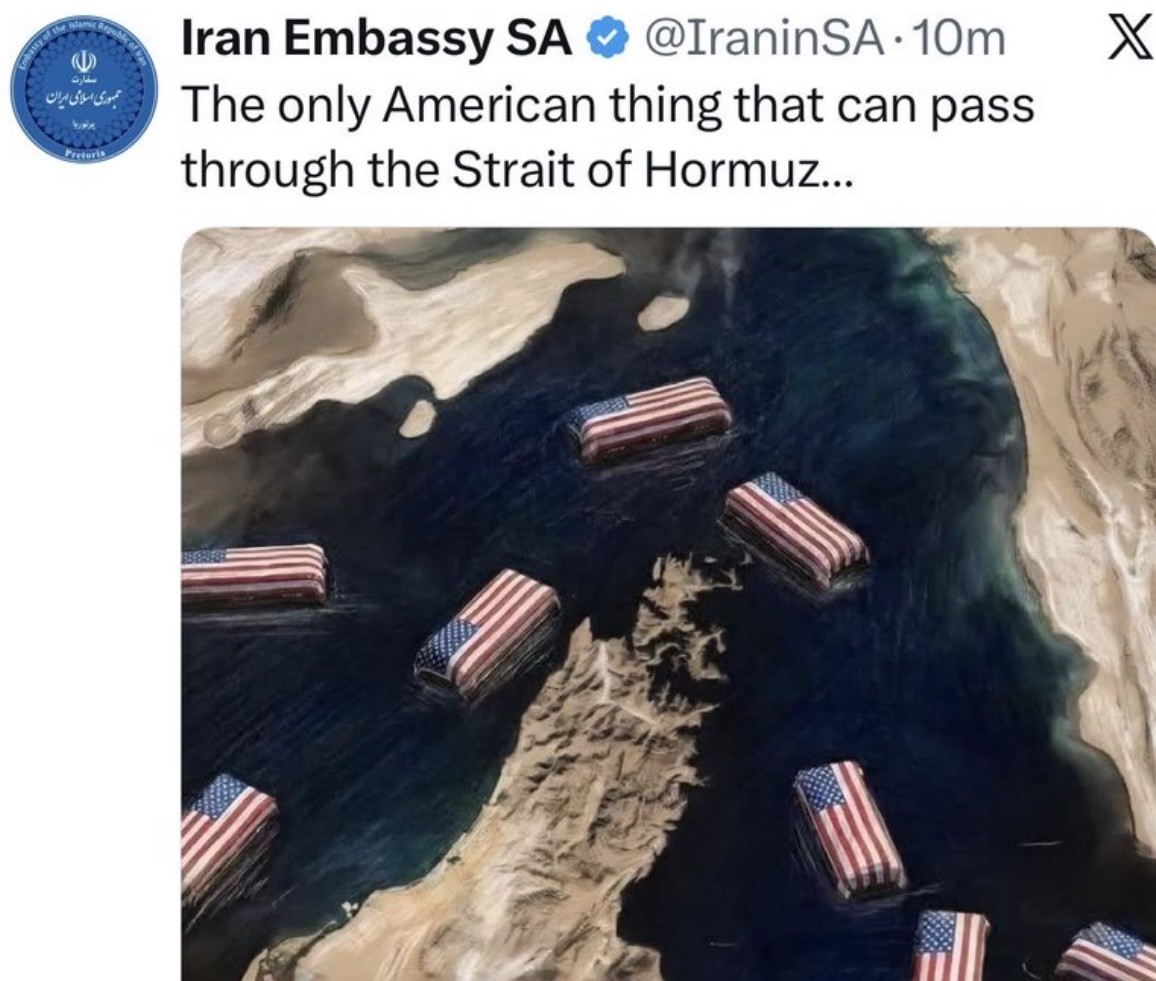
South Africa took action against ambassadors from Israel and the United States (US) for different accusations against them. The most recent Israeli representative, Ariel Seidman, was given 72 hours to leave South Africa, while the US’s Leo Brent Bozell III was demarched. However, the Iranian ambassador has not been reprimanded or acted against for undiplomatic posts on the X platform.
On the embassy’s official X account, pictures were posted of coffins draped in the colours of the US flag going through the much-talked-about Strait of Hormuz, with a provocative caption, “The only American thing that can pass through the Strait of Hormuz.” To date, there has been no sign that the ANC-led government will rebuke the unbecoming behaviour of the Iranian representatives in South Africa. We may not see anything of that sort due to the cosy relations between the two countries, which have come at a huge cost for South Africa and its people.
From observing such episodes, it is safe to say that foreign policy currently exists to defend everything that Iran, Russia, and China do. This is achieved at the expense of poor South Africans, who are supposed to be the priority when engaging with other countries.
There is a deliberate misconception by the ANC and its supporters that the United States desires to cause trouble for South Africa. This is complete nonsense. The tension between the countries is caused by various factors and political actors. While the majority of people of both nations materially benefit from stable relations, a few are working to collapse the relationship that began more than 100 years ago and which has shaped both countries for the better.
There are more than 500 US-owned business establishments on South African soil, providing more than 250 000 employment and business opportunities to ordinary South Africans. Let’s ask ourselves critically how many businesses Iranians own in South Africa, and how South Africans benefit from the relationship with that country.
Generally speaking, the foreign policy of any nation should safeguard the national interest, promote trade and economics, and take these national interests to the global stage. In South Africa’s case, it seems hell-bent on advancing Iranian foreign policy instead of defending its own national interest.
Those who are stuck in history and keep claiming their actions are inspired by past relations should remember the direct and influential role that the American government and people played at the beginning of the 1980s to dismantle the apartheid system. Europe played a role in decapitating apartheid, and so did many other countries on every continent.
It is therefore a significant oversimplification of historical fact for the ANC to invoke Iran as a loyal anti-apartheid ally. Just like other countries at that time, Iran secretly traded oil and weapons with the apartheid regime throughout the 1980s, but the ANC doesn’t remind its audience of that. Formulating the foreign policy direction based on past associations is short-sighted and won’t contribute to the country’s development.
While South Africans should be thankful for the generosity shown by the world during difficult times, they shouldn’t support or associate with governments that have deformed from freedom fighters to oppressors, such as Iran, Zimbabwe, and others. It’s necessary to stand against such authoritarian regimes and coerce them to adopt democratic and ethical values. Zimbabwe has become obsolete because of the ANC’s passiveness – adopted especially during the Jacob Zuma era – when that country and its people have been in dire need of rescue. South Africa is complicit in the atrocities Zimbabweans have been subjected to in their country, and here, where they periodically experience physical and psychological violence.
There’s a great need for South Africa to begin positioning itself as an influential political actor on the global stage, rather than creating unnecessary nemeses and rendering itself redundant. In the current conflict in the Middle East, South Africa cannot begin to talk because it is no longer regarded as “non-aligned”. Many countries in Africa and Europe are sympathetic to the Palestinian struggle but haven’t taken any vacuous decisions, such as associating with Hamas, because they understand the political and economic ramifications.
The countries in the Middle East, such as Qatar, that are reputable in the conflict-resolution area haven’t dragged Israel to the International Court of Justice (ICJ) because they prioritise their own national interests. They know that such a decision would have long-term economic, political, or security risks. South Africa’s decision to go to the ICJ was a waste of taxpayers’ money because it didn’t even come close to addressing the problem.
- Kenneth Kgwadi is a political scientist. He is a research fellow at the Middle East Africa Research Institute.