





World
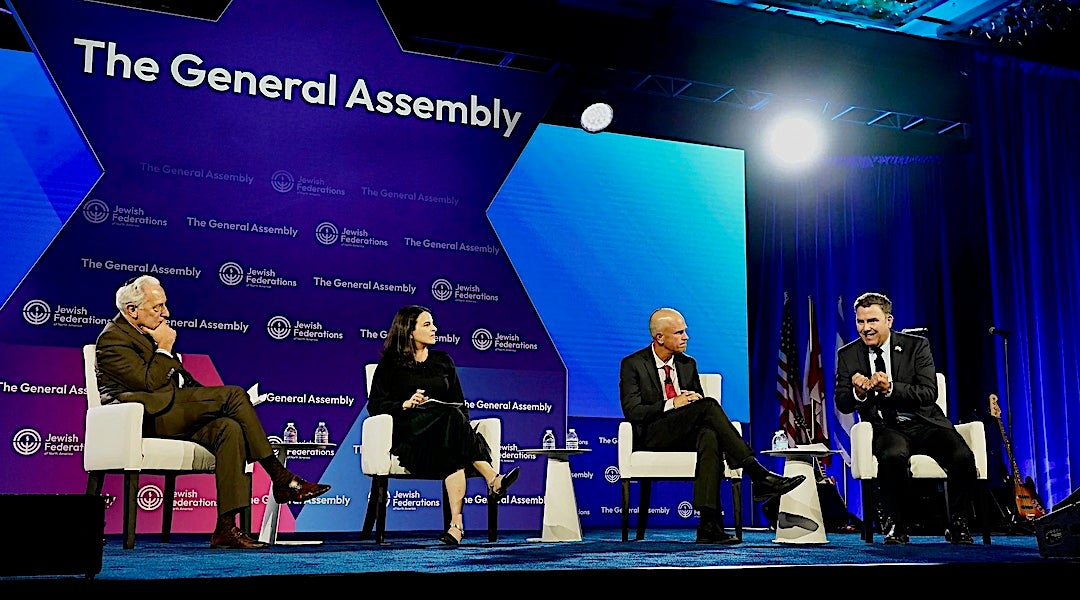
Sarah Hurwitz, former Obama aide, stirs social media firestorm with remarks about Holocaust education

JTA – In the safe confines of a gathering of Jewish fundraising and communal professionals, Sarah Hurwitz’s remarks about antisemitism and Holocaust education earned polite applause. By the time they made it to social media, they’d become kindling in a rhetorical firestorm over the Gaza war, and the uses and abuses of Jewish memory.
Hurwitz, a former speechwriter for both Barack and Michelle Obama who has written two books about her embrace of her Jewish identity as an adult, was one of three panellists on 16 November at the opening plenary of the general assembly of the Jewish Federations of North America (JFNA) in Washington. They were asked to address antisemitism and Jewish identity at a “crossroads”.
Speaking from notes, she began her remarks with the fairly uncontroversial observation that “young people” are exposed to a media diet that amplifies the fringe, including antisemitic influencers like Nick Fuentes. She also made the somewhat more contentious point that images of “carnage” in Gaza are making it hard for defenders of Israel like her to debate “facts and arguments” with younger Jews.
But then she veered into talking about Holocaust education, suggesting that the Jewish “bet” on promoting Holocaust education had backfired, at least as a vaccine against antisemitism.
“Holocaust education is absolutely essential,” she said. “But I think it may be confusing some of our young people about antisemitism, because they learn about big, strong Nazis hurting weak, emaciated Jews, and they think, ‘Oh, antisemitism is like anti-black racism, right? Powerful white people against powerless black people.’ So when on TikTok, all day long, they see powerful Israelis hurting weak, skinny Palestinians, it’s not surprising that they think, ‘Oh, I know the lesson of the Holocaust is you fight Israel. You fight the big, powerful people hurting the weak people.’”
Hurwitz’s framing could be seen as descriptive, explaining how the emotional structure of Holocaust education – emphasising victimhood, power imbalance, and trauma – leads some students to align emotionally with Palestinians rather than with Jews. She went on to suggest that moral lessons from the Shoah are often taught in a way that’s too binary – oppressed versus oppressor; powerless versus powerful, without helping students understand how antisemitism functions in complex ways, even when Jews have sovereignty and power.
But beyond the general assembly audience, the backlash was fast and fierce. Instagram and Reddit filled up with posts accusing her of saying, as one post put it, “that it was a mistake to teach Americans that genocide is bad”.
Jenin Younes, legal director of the American-Arab Anti-Discrimination Committee, accused Hurwitz of using Holocaust trauma to silence criticism of Israel’s military operations.
“Holocaust education is not failing,” she said. “It’s succeeding because it’s teaching young people to recognise oppression and call it out, even when it doesn’t serve political agendas.”
Progressive Jews also objected. “She’s not disagreeing with the moral lesson that we should stand against the powerful harming the vulnerable,” wrote Rabbi Sandra Lawson on Substack. “She’s upset that people are applying it universally. The lesson was supposed to stay contained, meant only for certain victims.”
The point of Holocaust education, wrote journalist Spencer Ackerman, is “[n]ot to exceptionalise Jewish suffering, but to activate solidarity. To recognise that there’s a continuum of atrocity perpetrated by dominant classes against subjugated ones.”
Hurwitz’s remarks about a central pillar of Jewish advocacy may have been tailor-made for the JFNA crowd, made up of mainstream Jewish professionals uneasy about whether current tools – Holocaust education; Israel trips; anti-antisemitism training by pro-Irael groups – can stack up against the anti-Israel messages young people encounter. JFNA has joined several initiatives aimed at presenting a more “nuanced” view of the war in Gaza, with the goal of countering misleading or anti-Israel narratives in the mainstream and social media.
But Hurwitz also entered a decades-old – and, since 7 October increasingly fraught – debate over the goals of Holocaust education. Does “never again” mean a universal call to protect human rights and prevent genocide, or is it a narrower call to make sure Jews are never again vulnerable to mass murder? And if the latter, does that somehow inoculate Israel from accusations that it can, in the interest of self-defence, oppress a weaker people?
That debate was at the heart of a dust-up in September, when Los Angeles’ Holocaust museum deleted an Instagram post that proclaimed, “‘Never again’ can’t only mean never again for Jews.” The graphic showed six interlocked arms of different colours, one with an Auschwitz tattoo. Another slide declared, “Jews must not let the trauma of our past silence our conscience.”
The museum explained that it deleted the post because it was “easily open to misinterpretation by some to be a political statement reflecting the ongoing situation in the Middle East”. Indeed, appreciative supporters of Palestine and angry supporters of Israel read the original post as a statement about the death toll and hunger crisis in Gaza.
Ben Ratskoff, an assistant professor at Occidental College in Los Angeles, wrote that the museum’s retraction “reflects a deeper turn away from the universalist approach that has been at the heart of institutional Holocaust memory culture since the 1990s”. Elie Wiesel, he noted, framed the Holocaust as “a Jewish tragedy with universal implications and applications”. In 2000, the Stockholm Declaration, which founded the International Holocaust Remembrance Alliance, also declared that “the Holocaust will always hold universal meaning”.
“Teaching about the Holocaust,” the United States Holocaust Memorial Museum explains on its website, “can inspire students to think critically about the past and their own roles and responsibilities today.”
Israeli historian Amos Goldberg noted in July that Holocaust memory in the West deals with a deep tension between two sentiments. In the first, “human rights-oriented” version, “the world pledged itself to human rights, to curbing nationalism, and to strengthening democracy as a lesson from the Holocaust”. The second sentiment, he writes, “was empathy toward the Jews as the primary victims of Nazism, and their perception as Europe’s ultimate ‘other’”.
With Israel facing accusations of genocide in Gaza, including from Israeli scholars like Goldberg, the International Association of Genocide Scholars, and the Israeli human rights group B’Tselem, these divergent lessons of the Holocaust have been fiercely debated, and sometimes weaponised.
After the massacre of 7 October, supporters of Israel invoked the Holocaust to express their feelings of vulnerability. “The murderers of Hamas are guided by the exact same goal” as the Nazis, Israeli Prime Minister Benjamin Netanyahu declared at Israel’s official Holocaust Remembrance Day commemoration in 2024. Many pointed out that 7 October was the deadliest day for Jews since the Holocaust, implying a parallel of effect if not scope.
Palestinians and their supporters also invoked the Holocaust, a comparison that intensified as the war ground on and accusations of “genocide” made the comparison at least implicit.
Jewish groups not only denied the accusation of genocide, but rejected the comparison, whether made by Hamas or the United Nations special rapporteur on Palestine.
“These comparisons are not simply misguided or exaggerated; they have a double-edged effect,” wrote Simone Roadan-Benzaquen, the managing director of the American Jewish Committee’s Europe office, in January. “On the one hand, they trivialise the Nazi atrocities by equating them with a contemporary conflict, tragic as it may be, that differs fundamentally in purpose and scope. On the other, they invert historical roles, casting Jews, the victims of an unparalleled genocide, as today’s oppressors. The result is an assault on memory itself.”
Hurwitz served as chief speechwriter for Hillary Clinton during the 2008 presidential campaign, later as senior speechwriter to Obama, and, from 2010 to 2017, as head speechwriter for Michelle Obama. After leaving government, Hurwitz wrote about her personal journey from “lapsed” or “cultural” Jew to one more deeply engaged with its core texts, rituals, and history. Her two books on that journey have made her a popular draw on the Jewish lecture and podcast circuit.
It’s by no means clear if Hurwitz intended to say, as critics charge, that Holocaust education was a mistake because it fostered sympathy for the Palestinians. She didn’t respond to a request for an interview.
But in her latest book, As a Jew, published in September, she does argue that Holocaust education fails if it doesn’t explore the full historical scope of antisemitism, or, taking inspiration from the writer Dara Horn, if it doesn’t show how Jews lived in addition to how they died.
“If the main thing you know about antisemitism is the Holocaust, it’s easy to get the impression that antisemitism originated sometime in the twentieth century, and the Holocaust was a one-off – that out of nowhere, after just a few decades of hating Jews, the civilised world lost its mind and started killing them,” she writes.
Her book also includes a spirited defence of Israel, which puts her in the crosshairs of anti-Zionists and other harsh critics of Israel. At the general assembly, Hurwitz may have been describing the limitations of Holocaust education in teaching about antisemitism, but she waded directly into a fight about applying the lessons of the past to the crises of today.






james macdonald
December 1, 2025 at 3:48 am
its not ‘a war’ if one side has a modern army and the other has sticks and stones , its a massacre