


OpEds
As Israel rebuilds, it needs our support more than ever

Three years after 7 October, Israel is rebuilding. Homes are being repaired, communities are returning, and new neighbourhoods are rising from the destruction. But beneath this extraordinary recovery lies a country still deeply traumatised.
On a recent trip to Israel, we witnessed this firsthand.
One of the most haunting experiences was at the Supreme Court of Israel. We sat in on the case of former soldiers suffering from post-traumatic stress disorder – some accompanied by their therapy dogs – who were fighting for better recognition of their injuries. One wounded soldier began screaming at the judges from the visitors’ gallery, visibly breaking down before our eyes. These were men who had risked everything for their country. Now they were fighting another battle, this time to be recognised.
It brought home something that’s easy to forget from thousands of kilometres away. The war may eventually end, but for many Israelis the trauma will continue for years.
Yet travelling through southern Israel, I was struck by something equally powerful: the determination to rebuild.
On the kibbutzim devastated on 7 October homes are being reconstructed and families are slowly returning. Some communities are still struggling with the question of whether they can ever truly go home. Others are determined not simply to restore what existed before, but to build something better.
The most remarkable example is Sderot. A city that endured years of rocket attacks, and was largely evacuated after 7 October, has not merely recovered its population. It has grown. According to its deputy mayor, Sderot’s population has increased almost 20% since 2023, reaching approximately 42 000.
Think about that. After the worst massacre of Jews since the Holocaust, people are choosing to move towards the Gaza border, not away from it.
At Kibbutz Ruhama, we saw another remarkable story. When the residents of Kfar Aza were forced from their homes, Ruhama opened its doors. With the support of Keren Kayemeth LeIsrael – Jewish National Fund (KKL-JNF), an entire neighbourhood of 120 temporary homes was built to accommodate the displaced families.
But what struck me wasn’t simply the buildings. It was the humanity. One community had taken responsibility for another, providing not just shelter, but dignity, compassion, and a place to begin healing.
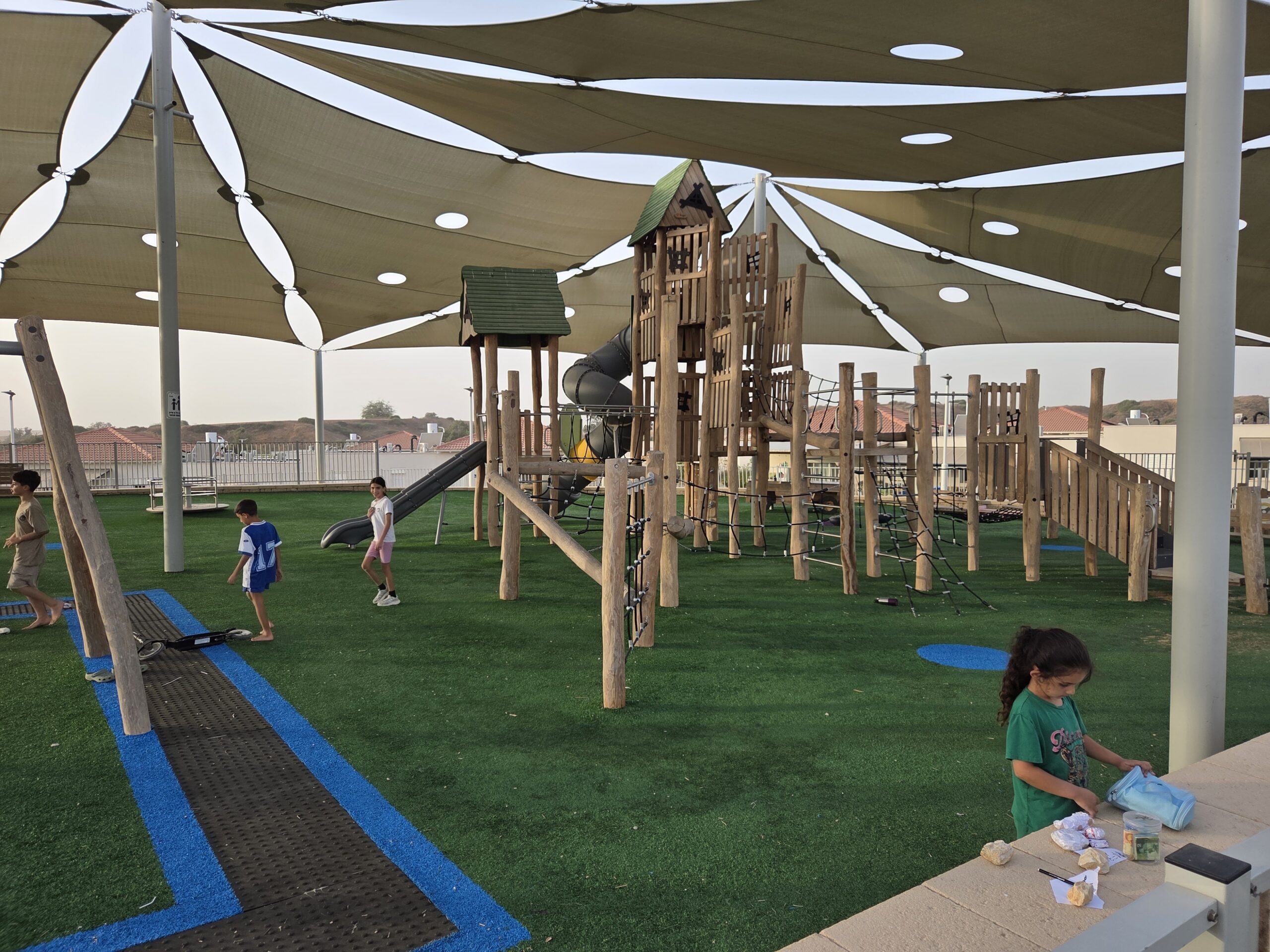
There, we dedicated a new playground from the South African Jewish community for the children of Kfar Aza. We also broke ground on a new resilience centre in the south, supported by our community, to help with healing. In doing so, we joined Jewish communities from around the world in the reconstruction effort.
That spirit is reflected in the scale of the work now under way. KKL-JNF approved NIS 750 million in 2025 for rehabilitating communities in the north and south, and this year a further NIS 859 million (R4.5 billion) over three years for northern Israel.
But bricks and mortar are the easier part.
Israel is now in the middle of a bitter election campaign. Everywhere there are accusations, recriminations, and political attacks. The campaign often seems more about personalities and settling scores than offering a serious vision for the country’s future.
Much of this anger is understandable. Three years on, Israelis are still demanding to know how 7 October could have happened. Why were communities abandoned? Who was responsible? And why do so many of those who suffered feel they have been left to fight for the support they deserve?
After years of war, repeated reserve call-ups, broken families, and exhausted soldiers, there is growing resentment towards the continued exemption of large numbers of ultra-Orthodox men from military service. For families who have buried sons, or whose fathers and husbands have spent hundreds of days in uniform, the argument is no longer theoretical. It is about fairness, and about whether all Israelis are prepared to share responsibility for the country’s survival.
And hanging over everything is the uncomfortable reality that the security threats have not disappeared. Iran, Hamas, and Hezbollah have all been weakened, but none can be considered permanently defeated. There is a foreboding sense that the conflict is not truly over. Israelis know that rebuilding their homes means little if they cannot be confident their children will be safe in them.
This is the contradiction of Israel today: a country capable of extraordinary unity in moments of crisis, yet deeply fractured in its politics. A people who can rebuild an entire neighbourhood in months, but struggle to rebuild trust in their institutions and in one another.
Perhaps that is the real challenge for the next generation of Zionism: not simply rebuilding houses, schools, and forests, but building a society in which people feel protected, cared for, and united by a common purpose.
For us in the diaspora, there is also an important lesson. Supporting Israel cannot end with defending it on social media or arguing with its critics. It must also mean helping Israelis rebuild their lives. Sometimes the most meaningful expression of solidarity is not a speech or a slogan, but a home, a playground, or a helping hand.
The prophet Amos spoke of a time when the people of Israel would return, “They will rebuild the ruined cities and live in them; they will plant vineyards and drink their wine; they will make gardens and eat their fruit” (Amos 9:14).
Nearly 3 000 years later, those words have extraordinary relevance. Israel is once again rebuilding its ruined communities. The challenge now is to heal the wounds of those who live in them.
And that may be the hardest rebuilding of all.
- Michael Kransdorff is national chairperson of the Jewish National Fund of South Africa and was on a JNF SA solidarity mission to Israel.