OpEds
The lesser of two evils

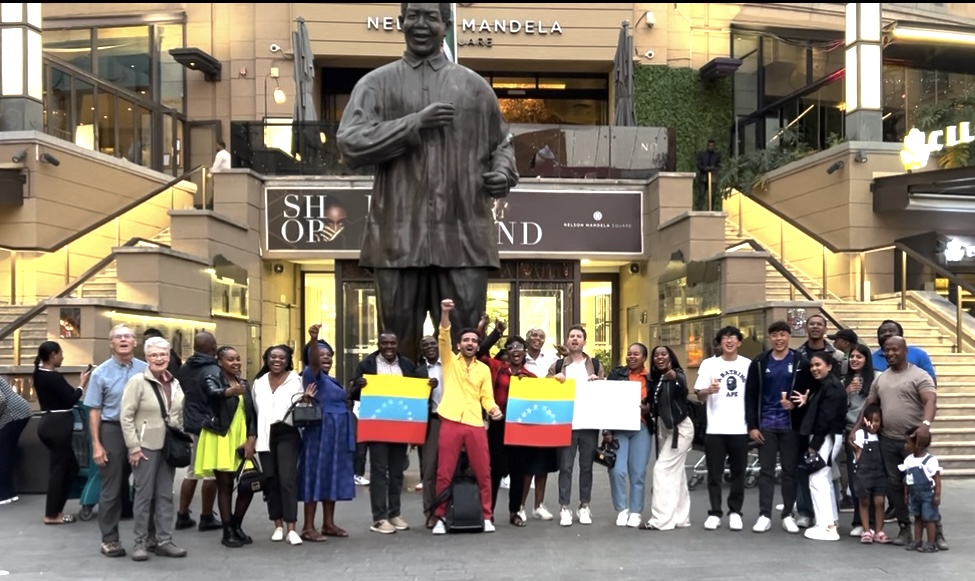
This past week, I flew between Lusaka, Harare, Johannesburg, and Cape Town for work. In every city, in taxis, café meetings, and conference-room small-talk, I was asked the same questions: “How do you feel about Venezuela?” And, almost immediately afterwards, “Aren’t you scared Venezuela will lose its oil now?”
Seven years ago, I was asked very different questions when Venezuela was a hot topic.
In January 2019, I spoke to the SA Jewish Report at a moment when Venezuela felt as though it stood on the brink of change. We believed, sincerely – or perhaps naively – that the Constitution would prevail. Juan Guaidó had invoked Article 233 – which outlines procedures for presidential vacancies – millions of Venezuelans flooded the streets; and the international community applied unprecedented pressure through countless sessions of global bodies, speeches, sanctions, and diplomatic statements. We believed that law, numbers, and moral clarity would be enough for a peaceful democratic transition.
They were not.
Guaidó never took power. Maduro stole that election, and then stole the last one as well, rejecting both domestic results and international observation. He tightened his grip, weaponised institutions, and ruled through fear. The lesson was painful but clear: when a regime has no limits, the law has no teeth.
I don’t think I was wrong in 2019. I just didn’t know then what I know now.
What collapsed in Venezuela wasn’t just leadership, but institutions, trust, and the promise of tomorrow. Those things are harder to rebuild, and harder still to wait for. Seven years later, urgency has given way to restraint and hope to a more disciplined realism.
That is why today, when emotions run high, I come back to facts.
Maduro didn’t suddenly become a wanted man. In March 2020, the United States formally indicted him on narco-terrorism and drug-trafficking charges and placed a $15 million bounty on his capture. That bounty was increased in January 2025, and again in August 2025 to $50 million, the largest ever placed on a sitting foreign head of state. This status wasn’t disputed. It was quietly accepted, even by those who defended him publicly. What happened recently wasn’t a moment of impulse; it was the culmination of a process years in the making.
Then there’s oil.
When people ask whether Venezuela will “lose its oil”, I ask a simpler question: what happened to it before? For decades, Venezuela was one of the world’s most oil-rich nations. Yet no-one audited where that wealth went. No-one explained how a country with the largest proven oil reserves on earth ended up with collapsing infrastructure, symbolic salaries, and a currency stripped of meaning.
A significant portion of Venezuelan oil passed through Cuba. It was resold, redistributed, and used to sustain a regime that has ruled since 1960, more than six decades marked by repression, poverty, and exile. Venezuelan wealth didn’t uplift Venezuelans; it helped anaesthetise populations and prop up allied authoritarian and terrorist systems.
At its peak, Venezuela produced about 3.5 million barrels of oil per day. Today, production struggles to reach a third of that. The resource was never the problem. Governance was.
The global oil industry isn’t unique to Venezuela. From Nigeria to Angola, drilling has long involved foreign operators, long-term contracts, and uncomfortable compromises. These arrangements aren’t romantic. To pretend Venezuela’s future oil agreements are unprecedented is to react to headlines rather than principles. What I told everyone who asked me this past week was, the real question has never been who drills the oil, it’s where the money goes.
The human cost of this collapse is absurd, and I see no headlines about it.
Since 1999, the Maduro-Chávez regime has illegally imprisoned thousands of political opponents. Even today, hundreds remain jailed without due process. Over the same period, Venezuela experienced one of the worst crime explosions in modern history, with hundreds of thousands murdered over two decades – nearly 30 000 in 2016 alone – kidnapping rates soaring, and entire neighbourhoods ruled by impunity.
Eight million Venezuelans fled. Not because they wanted to, but because survival demanded it. Almost 90% of the Jewish community vanished.
In 1999, a teacher or engineer could live with dignity. By 2010, purchasing power had eroded. By 2025, a university professor earned three or four dollars a month, a salary disconnected from any concept of life or future. The bolívar collapsed, savings vanished, and planning beyond tomorrow became impossible.
Food was distributed through the CLAP (Local Committees for Supply and Production) system, a food-basket programme that created dependency disguised as welfare and tied to political loyalty. If you didn’t show up to support the regime in the streets, your family wouldn’t get a food basket.
Nobel Prize-winning American economist and statistician Milton Friedman once warned that welfare doesn’t end poverty; it entrenches it. In Venezuela, that warning became reality.
My family left Venezuela after a kidnapping, growing insecurity, and the realisation that there was no longer a sense of “after”, only survival. For Venezuelan Jews, antisemitism added another layer of vulnerability. But for the millions who left, the common denominator was economic and institutional collapse.
There are moments when the choice isn’t between good and bad, but between bad and worse. What we call the lesser of the two evils.
This is why I struggle with the sudden moral outrage over how change came, rather than the decades-long silence over what we all wanted to end. For years, Venezuelans pleaded for attention while institutions collapsed, people fled, and violence became routine. Now that something has finally shifted, our energy shouldn’t be spent criticising the outcome we long hoped for, but on asking the harder, more responsible question: how do we move Venezuela forward?
Decades of failed hope have a sobering effect. They mature you, perhaps numb you. They teach you not to overreact, even to news you once prayed for.
My life today reflects that reality. I have recently become engaged to an incredible French woman. We have moved to Cape Town. I have doubled down and bet on this country and this community, not out of resignation, but out of clarity. My older brother lives in San Francisco; my two other brothers are in Namibia and Zambia. Like so many Venezuelan families, we are scattered, not because we wanted to be, but because history forced our hand.
Most Venezuelans won’t return. This isn’t a failure of patriotism. It’s our human response to prolonged uncertainty.
The Venezuela of tomorrow will not be rebuilt by nostalgia. It will have to compete for talent, for capital, and for trust. It will have to prove, not proclaim, that it can once again be a place where effort is rewarded and the rule of law is more than a slogan.
Seven years ago, I spoke with urgency. Today, I speak with patience.
I am at home in Cape Town. But like many others, I’m curious about the Venezuela of tomorrow, and hopeful, in a measured way, that one day, I might help rebuild not only a country, but its image.
- David Akinin is a Venezuelan Jew and entrepreneur who has lived and worked across Africa. He lives in Cape Town.