





News
The Hague Group gets tough on Israel and its supporters

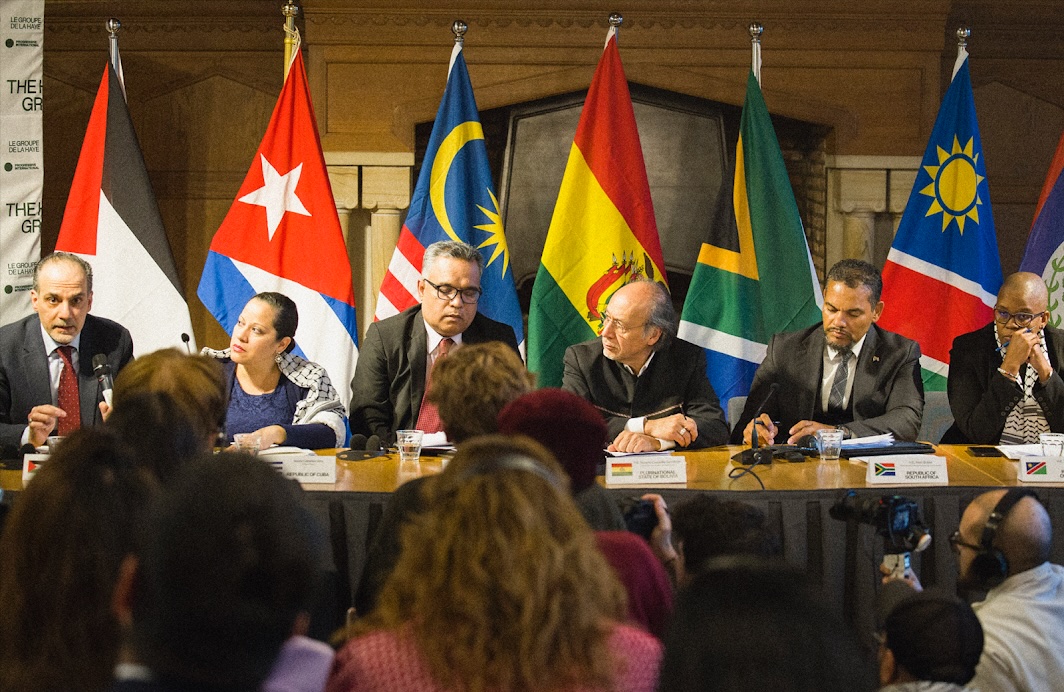
An “emergency” meeting of The Hague Group, an anti-Israel coalition of states led partially by South Africa, that convened on Wednesday, 4 March, made an official statement that it aims to ensure that there will be “no safe haven” for “perpetrators of genocide, war crimes, crimes against humanity, and the crime of aggression.”
The statement made it clear that this only applies to Israel. It said that The Hague Group aims to implement “a disclosure requirement [in Hague Group countries] regarding service in the Israeli military, subjecting travellers with Israeli travel documents or arriving from an origin of Tel Aviv Airport to potential secondary screening at ports of entry.”
The statement said that this would be “under domestic war-crimes inadmissibility rules, or adjusted visa policies, in compliance with the obligation to ensure accountability for the most serious crimes under international law through robust, impartial, and independent investigations and prosecutions at national or international levels, and ensure justice for all victims and the prevention of future crimes.” The Hague Group is led by the governments of Belize, Colombia, Cuba, Malaysia, Namibia, Senegal, and South Africa. Forty states took part in the meeting on 4 March, but it is unclear if all will adopt anti-Israel measures. Bolivia and Honduras withdrew from the group on 4 March.
The statement was signed by representatives from South Africa and Colombia – the co-chairs of The Hague Group. It was released by South Africa’s Department of International Relations and Cooperation late on 4 March, the day of the emergency meeting.
The statement also said Hague Group members would “refuse to recognise settlements as legally valid, and prohibit the import of settlement goods and prevent domestic companies from operating in settlements,” and “prevent the transfer, transit, or carriage of arms, munitions, military fuel, and dual-use items to Israel”.
They would also conduct “urgent reviews of public procurement and contracts to ensure that no public institution or public funds sustain Israel’s unlawful occupation”.
Analysts and Jewish organisations are also questioning the timing and relevance of the “emergency” meeting.
The Hague Group describes itself as a forum for governments seeking to coordinate state action in response to Israel’s policies in the Palestinian territories.
Their reason for this urgent meeting in The Hague, just three days into a war between the United States-Israel and Iran, was to coordinate international action against Israel over the war in Gaza and the status of the Palestinian territories.
Critics say the meeting appears clearly detached from developments on the ground and reflects South Africa’s long-standing campaign against Israel, rather than a meaningful diplomatic intervention.
A political analyst and professor at the University of Cambridge, Glen Segell questioned why the group was convening an emergency session at a moment when separate international efforts are focused on stabilising Gaza and advancing a possible peace framework. “What are they on? There is only one stumbling block to moving forward on Trump’s 20-point peace for Gaza,” Segell said.
“Washington is expected to issue a 60-day ultimatum for Hamas to disarm and fully demilitarise Gaza. Billions of dollars of aid have been pledged, and an international force is about to be deployed.”
Other analysts say the initiative reflects a broader pattern in South African foreign policy.
“If there is one issue that South Africa’s foreign affairs bureaucracy is consistent on, and in its own frame of reference principled on, it is Israel and Palestine,” said Terence Corrigan of the Institute of Race Relations. “I don’t think I’m suggesting anything too controversial when I say that South Africa has identified Israel as an enemy, and one towards which it harbours unique enmity. The Hague Group is a mechanism through which it hopes to prosecute this agenda along with like-minded states.”
Corrigan said the initiative appears aimed at keeping international condemnation focused on Israel at a time when geopolitical dynamics in the region are shifting. “My sense is that The Hague Group is trying to refocus condemnation on Israel at this time. Call this an attempt to prevent Israel from being seen as anything other than the irredeemable oppressor of the Palestinians,” he said.
South African Jewish organisations have also criticised the government’s role in convening the meeting. Rolene Marks, national spokesperson for the South African Zionist Federation, said the country’s claims to be acting in defence of international law ring hollow when compared with its responses to other global crises.
“South Africa’s role in convening this Hague meeting would carry far more weight if its application of international law were not so blatantly selective and hypocritical,” Marks said. She pointed to South Africa’s response to the Iranian government’s crackdown on protests earlier this year.
“You cannot pose as champions of human rights while staying silent, or worse, when the perpetrator is a BRICS ally,” she said. “Civilian lives are sacred everywhere, not just when it suits ANC geopolitics.”
In announcing the meeting, the group said it would focus on implementing legal obligations identified in the International Court of Justice’s advisory opinion of July 2024 concerning Israel’s presence in the occupied Palestinian territories.
Varsha Gandikota-Nellutla, executive secretary of The Hague Group, said the meeting aims to translate legal rulings into concrete action. “The focus of the 4 March 2026 meeting is simple: How do we give international law teeth?” she said. South Africa’s minister of international relations and cooperation, Ronald Lamola, who is co-chairing the initiative, said the meeting reflects a broader effort to ensure international law is applied consistently.
“The application of international law can no longer be selective: punitive for some and totally disregarded by others,” Lamola said.
Some analysts say the initiative also raises broader questions about South Africa’s foreign policy priorities. Political analyst Frans Cronje told the SA Jewish Report that countries generally structure foreign policy around economic and strategic interests.
“South Africa is of course free to pursue whatever foreign policy it wishes. It’s a democracy and if people object to the policies of the government they are able to set that right via elections,” Cronje said. “The question is therefore whether South Africa’s foreign policy is prudent and in the interests of not just the country but also the state.”
Cronje argued that foreign policy institutions are typically directed toward expanding trade and investment relationships. “A prudent policy would see South Africa strike vast new trade and investment deals with the United States, Europe, India, and China. That is what the foreign policy infrastructure of the country should be directed at, the ruthless pursuit of national interest. It is hard to see how its present foreign policy comes close to qualifying as that.”





yitzchak
March 5, 2026 at 12:44 pm
and there’s the case of the South Africans who have been rescued from the Russian military and repatriated to south Africa with 2 having succumbed to war injuries.Very probably high level collusion.
They were clearly mercenaries who were not deceived as to their final destination. A clear violation of the foreign mercenary act. Mr Lamola welcomed them with open arms with no prosecutions in sight. Their recruiter in SA is yet to face trial.
Does SARS regard their pay as taxable since they are tax resident in RSA?
South African in USA
March 6, 2026 at 12:10 am
Why are the using cell phones computers and medical equipment that where developed in Israel and any othe sophisticated equipment that was developed Israel