


Holocaust
The SA legacies of those who fled Germany

The story of the SS Stuttgart, the last ship to sail from Germany with Jewish refugees before the start of World War II, can be told through numbers. There were around 500 Jewish refugees, one ship, and an arrival in Cape Town in October 1936.
But Professor Shirli Gilbert believes its history is better understood through the people behind those numbers, Jews whose lives were interrupted by Nazi persecution and who had to start again in an unfamiliar country.
Marking the 90th anniversary of the Stuttgart’s arrival on 27 October, Gilbert explored the lives of refugees who arrived on the Stuttgart and other ships, how they rebuilt their lives in South Africa, and the legacies they left.
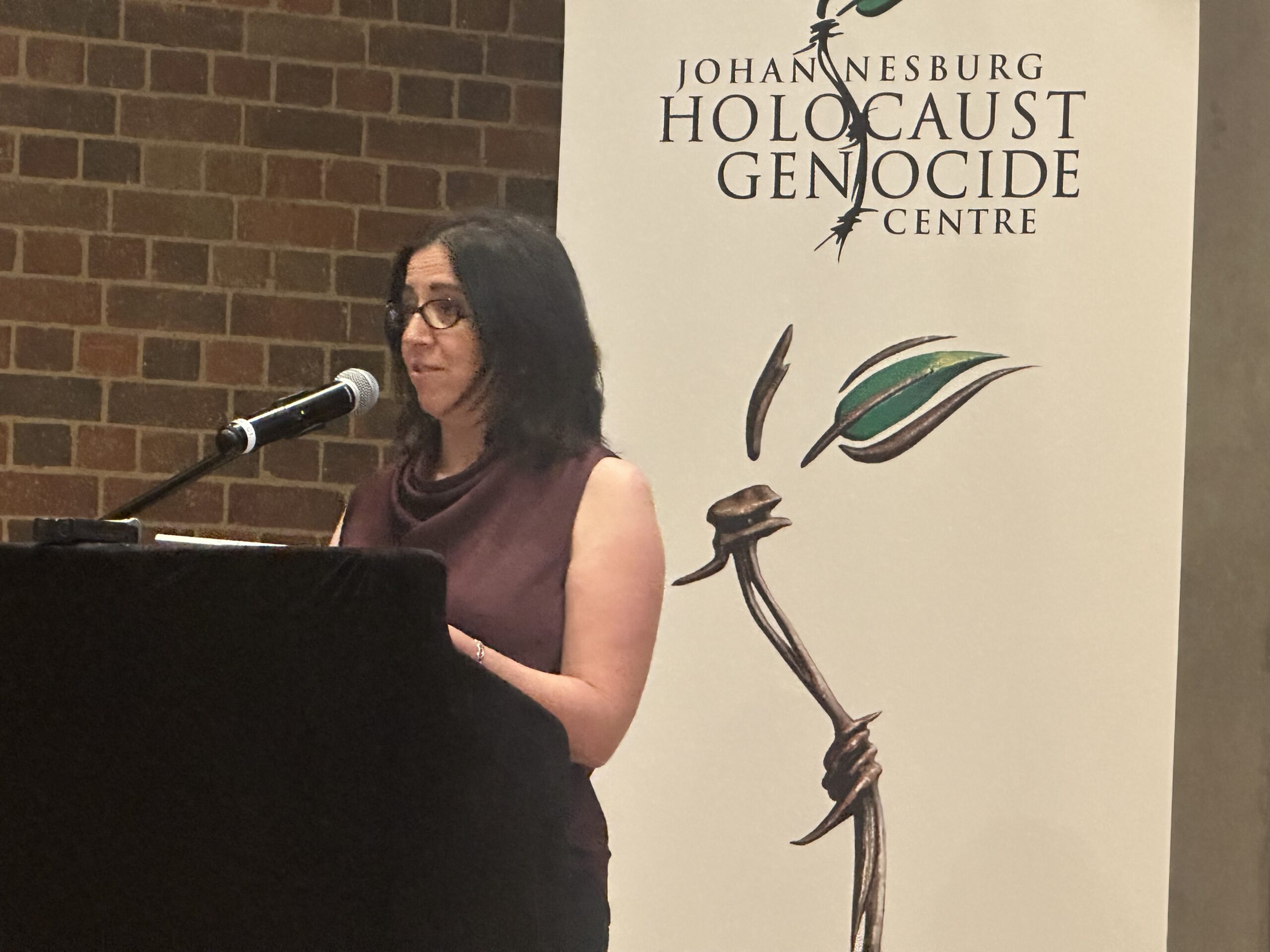
“The arrival of Jewish refugees in South Africa is fairly well known, but 90 years later, surprisingly little attention has been paid to their experiences and the impact they had on South African Jewish life,” said Gilbert, speaking at the Johannesburg Holocaust & Genocide Centre.
Gilbert chose to focus not on the more well-known German Jewish refugees, such as politician Harry Schwarz, journalist Ruth Weiss, and human rights activist Franz Auerbach, but rather on three of the thousands of refugees in her database who chose to rebuild their lives in Sub-Saharan Africa: Ernst Hochfeld, Willy Rosenstein, and Ruth Middelman.
“As a historian, I’m interested in a much wider and more multifaceted question, which is: How did the arrival of a cohort of educated, mostly middle-class, German-speaking Jews impact life and society in South Africa? What skills, ideas, and knowledge did they bring? And what happened in the chemistry of encounter between those skills and ideas and the reality of life here over the years?” she said.
Hochfeld, born in Germany in 1911, trained in chiropody but built a career as a shoe salesman. In 1935, he was dismissed along with the company’s other Jewish employees, prompting him to collect testimonials proving that he had lost his job because he was Jewish, rather than because of his abilities. After attending a Nazi rally in Nuremberg and concluding that he had no future in Germany, he left for South Africa, aged 24, arriving in Cape Town in May 1936.
With little to his name, Hochfeld worked as a barman, farmhand, chiropodist, and salesman before helping his future wife, Sigrid, escape Germany in 1937. He later began recycling discarded hessian bags from a furniture removal company, eventually turning the idea into his own business, which employed other German Jewish refugees.
In 1939, he tried to bring his sister Lotte to safety, but the £1 000 deposit required for a visa was beyond his means. Lotte and her family, Hochfeld’s mother, Paula, and Sigrid’s mother, Elsa, remained behind and later perished in Bergen-Belsen.
In November 1941, Hochfeld collected two more letters, one through the Jewish Board of Deputies, certifying that he was a reliable man with undoubted loyalty to the government and state. The second was from a Johannesburg solicitor, certifying that he was a Jewish German refugee and a loyal subject and against the Nazi regime.
“The first man who’s a Jew in Nazi Germany, the second who’s now an enemy alien in South Africa. Asking his employers to help him establish that he is not what the state expects him to be or suspects that he is, that he’s just an ordinary man trying to support himself,” said Gilbert.
Willy Rosenstein, a German Jewish fighter pilot and racing driver, arrived in Durban in 1936, aged 44. During World War I, he served in a squadron led by Hermann Göring, but left after confronting him over an antisemitic remark.
Unable to take his money out of Nazi Germany, Rosenstein secured permission to bring three aircraft to South Africa and established Union Aviation in Johannesburg, which trained more than 50 pilots by 1940. Yet, with the outbreak of war, he was classified as an “enemy alien” and became one of 86 German and Austrian Jews interned by the South African authorities.
“These refugee internment camp sites are dotted all around South Africa, but these sites are completely erased from the landscape of Holocaust memory,” Gilbert said.
Rosenstein survived internment and wrote his memoir while being held. After the war, he returned to flight instruction but was tragically killed in 1949 when a student pilot landed on his aircraft.
Middelman arrived in Cape Town in August 1930, aged 26, with just £10 and a collection of practical possessions – including a typewriter, sewing machine, and camera – that could help her earn a living. She initially struggled, working as a seamstress and governess while taking on additional sewing and photography work, before finding employment in photographic processing.
Her life took an unexpected turn in 1942 when she became fascinated by a protea she saw at a Cape Natural History Club gathering. She began experimenting with growing proteas from seed, and in 1947, she and her husband bought a largely unusable piece of mountain land. What began with selling a small bunch of wildflowers to a Sea Point florist grew into a thriving business supplying hundreds of dozens of proteas across Cape Town.
Middleman eventually became an internationally recognised authority on protea propagation, running a nursery and seed and book export business, while also mentoring some of South Africa’s leading botanists.
“There is something quite remarkable to me about the story of a refugee, a German Jewish refugee, who taught South Africa, her adopted land, how to propagate its own national flower,” said Gilbert.
She explained that the skills, ideas, and values these refugees brought with them made their way into South African society in ways not easy to quantify.
“But what is clear is that they were not simply ‘flotsam and jetsam’, as refugees are so often described, who quickly disappeared. They were agents of history whose presence made a distinct impact. As we think about the legacy of the Stuttgart today, it is an opportune moment to remind ourselves of how that generation helped shape the world, the community, and the society we inhabit today,” she said.