





Holocaust
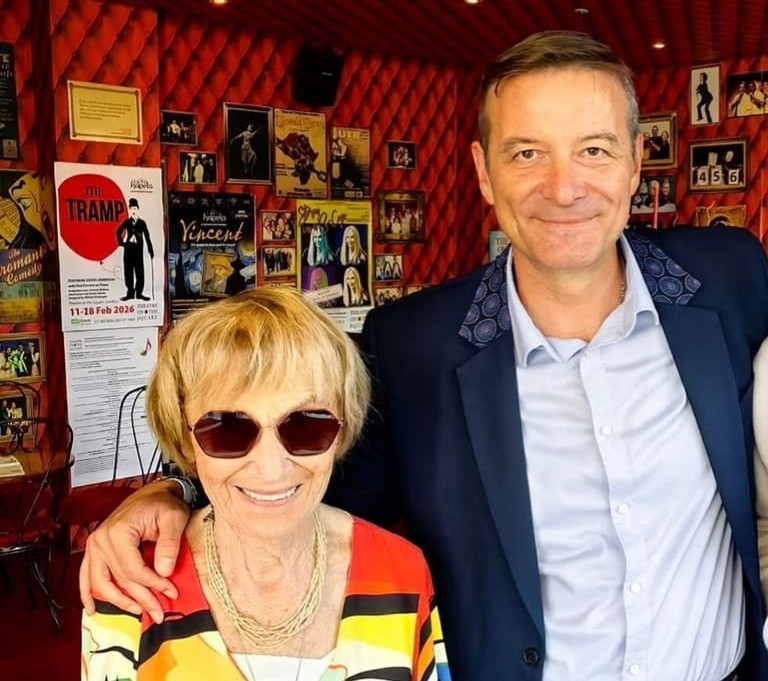
Holocaust survivor embraces Jewish identity with Hebrew name

Wanda Helena Albińska has taken a bold step in her 90th year – she adopted a Hebrew name, Channa, after having lived her life as a Catholic. Born to a Jewish physician mother, Dr Halina Rotstein, and a Polish Jewish father, Wladyslaw, in Warsaw, Poland, Wanda Rotstein survived the Holocaust by growing up and living as a Catholic.
For most of her life, Wanda kept this history a secret, not even telling her precious son, Luc. Wanda lost her mother in the Holocaust, and spent decades building a life far removed from the identity that had once placed her in mortal danger.
Now, at 89 – turning 90 on 11 May – she took a step that reflects a quiet but profound return to that past. She adopted the name Channa at the Hama’or Centre in Fairmount on Saturday, 14 February.
The name wasn’t chosen lightly. According to her son, Luc Albinski, who recently took on the Hebrew name Menachem Zachariah, the decision was both personal and symbolic. “Channa means grace or favour of G-d,” he said. “My mom was favoured by G-d by surviving the Holocaust and emerging unscathed from the Warsaw Ghetto.” After he acquired his own Hebrew name, “my mom was encouraged to do the same”, he said. For a woman who spent decades keeping that part of herself hidden, the moment carries generational weight.
By the age of five, Wanda was living inside the Warsaw Ghetto, where her family survived in the basement of the Czyste Hospital where her mother worked. She remembers the ghetto as a place of darkness, hunger, and typhus, with fleeting glimpses of sunlight when she and her siblings were allowed to play in the hospital yard. In September 1942, as deportations intensified, her mother made an impossible decision. To save her children, Halina arranged for Wanda and her three brothers to be smuggled out to the “Aryan side” of Warsaw.
They were taken in by Dr Andrzej Trojanowski, a friend of her mother’s, and his wife, Stefania. To protect them from Nazi persecution, the children were given false identities and later baptised as Catholics in 1945. Wanda grew up in a Catholic children’s home she remembers as nurturing and happy. She would go on to study chemistry at university, meet her future husband, Wojtek Albiński, in a café while on holiday, and build an adventurous life that took her to Iraq, Paris, Switzerland, Botswana, and eventually South Africa.
Survival, however, came at a devastating cost. Wanda’s mother had obtained what was known as a “life ticket”, a document that could have secured her escape. Instead, she gave it to a nurse and chose to remain with her patients whom she believed depended on her for their survival.
She was deported to Treblinka in 1942 and murdered at the age of 35. For much of her life, Wanda grappled with that loss, holding both the pain of feeling abandoned as a child and, later, a deep pride in her mother’s courage and selflessness.
For 40 years after the war, Wanda didn’t speak about her Jewish heritage. She raised her children as Polish Catholics, believing it would protect them from the burden and confusion of a dual identity. It was only in 1990, during a visit to relatives in the United States, that Luc discovered his Jewish roots. That revelation began a slow and deliberate process of rediscovery for him, one that would unfold over decades.
In her later years, Wanda began sharing her testimony publicly, travelling with her son to the March of the Living in 2018, and speaking at the Johannesburg Holocaust & Genocide Centre.
According to Holocaust historian Tali Nates, Wanda’s decision to take a Hebrew name is part of a broader, deeply human process. It reflects “a process of identity formation”, Nates said, moving from feeling “victimised by history” to reclaiming pride in what once made one a target.
Choosing a Hebrew name, she said, is “to reverse the fact that history targeted you. Now you are choosing a name that showcases that you are proudly embracing Judaism.”
Though many survivors changed their names immediately after the war, especially when immigrating to Israel, Wanda’s decision came much later. Nates cautions against framing it as unprecedented, but acknowledges its power. “Identity evolves and changes until we are very old,” she says. “It’s an amazing story that at the age of almost 90, she’s coming back to her Jewish side, to her Jewish identity.”
For Wanda, who still describes herself as “Polish first”, embracing her Catholic upbringing and her Jewish roots isn’t a contradiction. She sees in both traditions values of compassion, redemption, and moral responsibility, principles embodied most clearly in her mother’s final act.
Her life has since become the subject of her son’s book The Varsovian Covenants, as well as the documentary and stage play Nobody Told Me, works that explore the silence that shaped their family and the long journey toward truth.
Taking the name Channa doesn’t erase the decades Wanda spent as a Catholic wife, mother, and global citizen, she said. Rather, it completes a circle that began in a hospital basement in Warsaw. Nearly nine decades after surviving the ghetto, the child who was hidden, baptised, and protected has chosen, on her own terms, to reclaim the identity that once endangered her.
At 89, Wanda Helena Albińska isn’t rewriting her story. She is finally naming it.





Yoram Rubin
February 21, 2026 at 10:14 pm
I was delighted to read this story and to learn about Wanda Helena Albińska. I ran into this story as I was searching for information on Dr. Trojanowski. I recently discovered the important role he played in saving the lives of my father and grandfather. I wrote that story here:
https://underothernames.com/arturs-rules-of-conspiracy/
I am looking for a relative of the good Dr. Trojanowski in the hope of being able to share my story and express my gratitude.