





Featured Item
Board’s presence at G20 Interfaith Forum ‘significant’

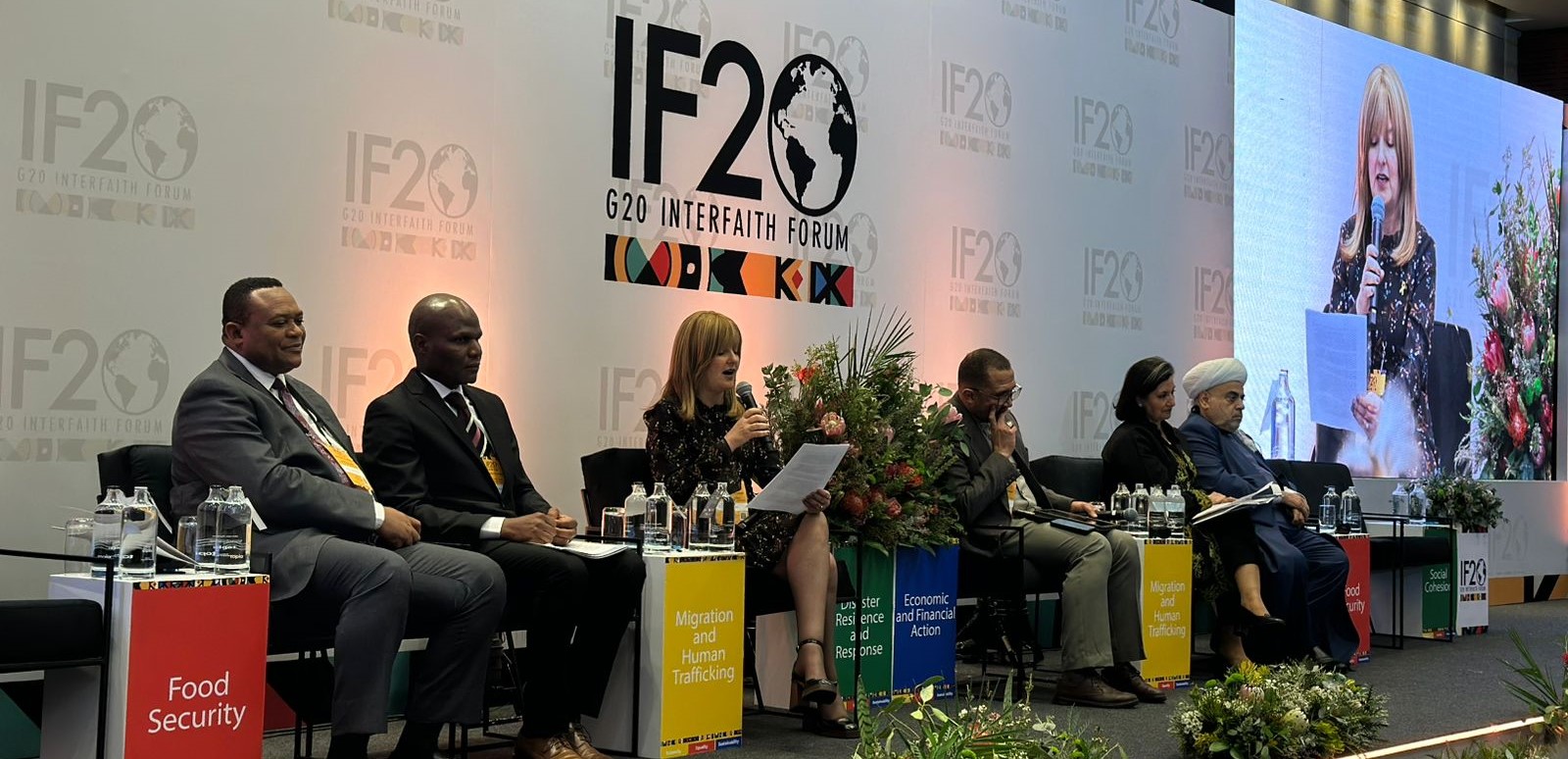
South African Jewish Board of Deputies (SAJBD) National Director Wendy Kahn was one of 20 representatives of the South African Jewish community to participate in the 2025 G20 Interfaith Forum held in Cape Town this week.
The forum, from 10 to 14 August, brought together diverse religious traditions to tackle some of humanity’s most urgent challenges, from hunger and displacement, to climate crises and peacebuilding.
Kahn spoke at the opening session alongside Archbishop Thabo Makgoba and other important leaders. She, and other representatives of the SAJBD, Alana Pugh-Jones Baranov and Gabi Farber Cohen, were among 350 invited faith leaders, scholars, and changemakers from around the world, including Israel.
Kahn told the SA Jewish Report that though it should be the norm for Jewish communal leaders to be invited, it was significant to be a part of it now. “Since 7 October, some of us have felt increasingly excluded from certain interfaith and political spaces, including ANC [African National Congress] pre-election events,” she said. “This disengagement with us was a break from three decades of engagement, so this is an important turning point.”
Kahn’s opening speech spoke of the importance of interfaith work in a world where tolerance for diversity is slipping. “Interfaith work demands a basic respect for the beliefs and principles of others,” she said.
Kahn also spoke about the concepts of shalom and ubuntu, in which we “share the same heartbeat” and “our humanity is bound together”. Both, she said, share a vision that “flows from embracing our collective wholeness”. She spoke about how this was linked to the country’s national motto “diverse people unite”, which she interpreted as not trying to erase differences, but to respect and value them.
Kahn recalled one of the darkest moments in South Africa’s democratic history, the 2008 xenophobic violence. During this time, foreign nationals were attacked and displaced. The Jewish community, alongside Muslim partners, provided food and shelter in makeshift camps, she said. Meal schedules were co-ordinated to respect Muslim prayer times and Shabbat.
“Our differences weren’t obstacles,” Kahn said. “They became the reason we could do more together. By respecting and leveraging them, we created solutions no single group could achieve alone.”
She drew on the words of the late Lord Jonathan Sacks, the chief rabbi of the United Hebrew Congregations of the Commonwealth, “Peace … will come not when all nations are conquered or converted, but when, under G-d’s sacred canopy, different nations and faiths make space for one another.”
She also brought biblical references into her speech, which led to Jews and non-Jews coming up to her afterwards saying that they were grateful that she had “brought Hebrew text into the discussion, and made reference to biblical text”.
Kahn said she was pleased that there was no protest at this forum. “The Israeli delegates were warmly received, as was the entire Jewish community. We had Jewish participants from around the world: one from America speaking on the ethics of AI [artificial intelligence]; another from Australia, addressing the issue of cyber hate. There were several others as well, all contributing meaningfully to the discussion.”
Pugh-Jones Baranov, the president of the KwaZulu-Natal SAJBD council and the director of HIAS South Africa, the world’s oldest refugee aid agency, was part of a panel on refugees and asylum seekers. She emphasised how important it was to respect people’s prayer times, dietary needs, and cultural traditions. “It isn’t a side detail, it’s the heart of humanitarian work,” she said.
Farber Cohen, SAJBD youth liaison, said she was deeply moved when Rabbi Pinny Hecht, alongside eight other faith leaders, led the opening prayer on Monday. Each represented different traditions with their unique attire and styles, and created a powerful display of unity, she said. Being at the forum was “ truly special, with a diverse audience of various cultures, religions, academics, and volunteers bowing their heads in respect to these nine faith communities, making the prayers an unforgettable and inspiring event”.
“It has been incredible to see not only the Jewish Board of Deputies included in the IF20, but also Israeli Jewish experts who have taken on leadership roles, speaking, moderating, and participating as panel experts,” she said.
She went on to say, “When Wendy went to give her opening remarks, she wore a yellow ribbon. And the Israelis came up to her afterwards to say, ‘You don’t know how much it means to us that you stood up on this international forum wearing a yellow ribbon, pledging solidarity with the return of the hostages.’ This was heartwarming.”
Small gestures like that from so many different people made them feel welcome, Farber Cohen said. “I especially appreciated what one of the panellists said: we must be conscious of the identities that brought us into the room, and the ones we may have had to leave at the door to be here. I’ve genuinely felt that, in this space, we haven’t had to leave any part of our identities behind.”
The establishment of a Muslim-Jewish forum was a particularly significant development for the communal leaders there, she said. “It promotes collaboration and connectedness between our two communities to address divisions. This is an official declaration, made by two rabbis and two imams, that marks a step toward creating a similar cohort in South Africa.” Interfaith work, Farber Cohen said, should go beyond mere tolerance or respect and foster “genuine partnership and unity” among diverse religions and traditions, with “everyone working together as brothers and sisters toward shared goals and uplifting one another within their communities”.
As discussions at IF20 feed into G20 policy, the Jewish delegation’s message was clear: difference doesn’t have to divide, it can be the very thing that makes unity possible.




Lance
August 19, 2025 at 9:57 am
Thank you for the report back it sounds very positive. Great to hear!