





Featured Item
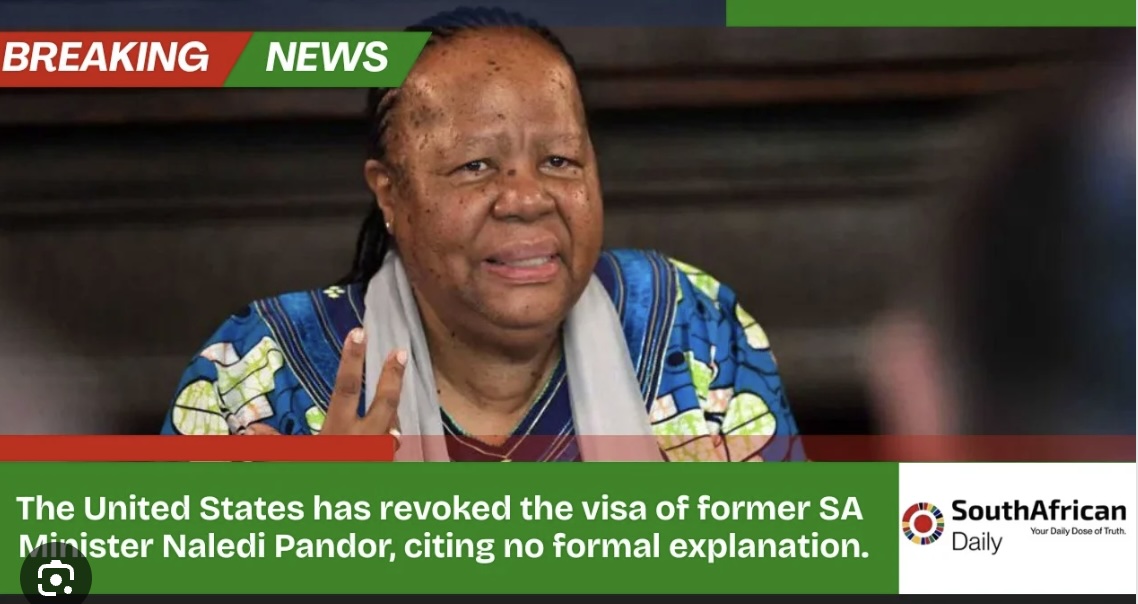
US slams door on Pandor as tensions spike

The abrupt decision of the United States to revoke former International Relations and Cooperation minister Dr Naledi Pandor’s visa drew a muted, cautious response from the South African government, underscoring deepening fractures in SA-US relations.
Last week, Pandor confirmed that she had received a short, formal email from the US consulate informing her that her visa had been cancelled without explanation.
A US government spokesperson told the SA Jewish Report that under US law, visa records are generally confidential.
“We will not discuss the details of this individual visa case,” the spokesperson said. “Visas are a privilege, not a right. Every country, including the United States, can determine who enters its borders. Visas may be revoked at any time, at the discretion of the US government, whenever circumstances warrant.”
The Department of International Relations and Cooperation (Dirco) hasn’t issued a statement or responded to questions.
The timing cast a long shadow over the diplomatic landscape. The revocation came just as South Africa hosted the G20 Leaders’ Summit in Johannesburg, which the US pointedly boycotted amid a dispute over the ceremonial handover of the G20 presidency.
The summit ended without the ceremonial handover to Washington, highlighting how fragile the relationship between the two countries has become. The friction follows rising tension over South Africa’s high-profile genocide case against Israel at the International Court of Justice (ICJ), a legal and diplomatic offensive that has placed Pretoria in direct confrontation with US foreign-policy priorities.
Pandor, who was Dirco minister between 2019 and 2024, is widely credited for spearheading the country’s case against Israel at the ICJ.
Minister in the Presidency, Khumbudzo Ntshavheni, said the visa revocation was of little consequence for South Africa.
Speaking on the sidelines of the G20 Leaders’ summit she said, “Former Minister Naledi Pandor isn’t a minister in Cabinet. Like any other country, they can decide to give you a visa or not. It doesn’t change the price of bread.” “Even if they revoke my visa, it’s fine. I would not have to go to the US. Most of us don’t go to the US.” She said those who do travel generally attend United Nations meetings.
Pandor herself echoed that stance. She said she was offered no explanation for the cancellation and understands that the US is under no obligation to provide one. Her comments align with government’s broader approach: acknowledge the revocation factually; avoid a public confrontation; and contain political fallout.
But diplomatic observers say the action has greater significance than Pretoria is willing to acknowledge publicly.
Brooks Spector, political analyst and former US diplomat, said the development needs to be understood against years of friction between Pandor and Washington. “She has been fiercely and vociferously critical of US policy for years,” he told the SA Jewish Report, noting that her confrontational posture on foreign-policy issues hadn’t gone unnoticed in Washington.
Spector said disengagement was rarely constructive. “From a diplomatic standpoint, dialogue is always preferable to building barriers. If I were managing the relationship, I would choose engagement over silence.
“It’s evident she rejects key US positions,” he said, “and Washington has now chosen not to engage with her.”
The South African Zionist Federation (SAZF) called the visa revocation predictable in light of Pandor’s behaviour. Pandor’s conduct had “for years placed South Africa in direct confrontation with American foreign-policy and national-security interests”, it said.
The SAZF highlighted a litany of actions it believes contributed to the US decision. It pointed to Pandor’s conversations with Hamas leader Ismail Haniyeh in the week immediately after the 7 October 2023 massacre, during which she conveyed South Africa’s “support and solidarity” despite Hamas being a US-designated terrorist organisation responsible for the mass killing and kidnapping of civilians.
The SAZF said her repeated public accusations that Israel was committing “genocide”, “war crimes”, and “apartheid” mirrored extremist propaganda rather than responsible diplomacy.
It also cited her calls for protests outside the embassies of the US, the United Kingdom, and Germany; her central role in South Africa’s ICJ genocide case; and her increasingly combative international rhetoric. The SAZF said these actions amounted to a deliberate targeting of key Western partners.
SAZF National Spokesperson Rolene Marks said, “When a senior Cabinet minister engages with terrorist leadership mere days after an atrocity; aligns with sanctioned actors; adopts extremist rhetoric; repurposes national institutions for ideological crusades; and deliberately antagonises Western partners, visa consequences aren’t surprising, they are inevitable.”
The SAZF went on to criticise Pandor’s leadership at the Nelson Mandela Foundation. Instead of protecting Mandela’s legacy of reconciliation, it said, she had turned the institution into a platform for a radical foreign-policy agenda aimed at isolating Israel and undermining Christian Zionist communities in South Africa.
It also noted her public alignment with Francesca Albanese, a UN official sanctioned by the US for what Washington described as advancing “political and economic warfare” against both the US and Israel. Albanese’s visit to South Africa was facilitated under the auspices of the Nelson Mandela Foundation, and Pandor publicly embraced her presence.
Pandor’s continued travel to Iran and Qatar; her engagement with officials linked to organisations identified by US authorities as supporting Hamas; and her rhetorical endorsement of terms associated with extremism, all compounded Washington’s concerns, the SAZF said.
The revocation casts a shadow over the direction of the bilateral relationship. The US rarely revokes visas of former senior Cabinet ministers unless the message is intended to be heard. Washington has chosen to close a door; Pretoria has chosen not to say anything.




David Polovin
November 27, 2025 at 2:36 pm
She stepped on the rake and the handle is only halfway up to her face. Are you watching Cyril?
Jessica
November 27, 2025 at 9:32 pm
Somebody please tell Pandor that Jihad per definition isn’t “sometimes” but “always”.
yitzchak
November 29, 2025 at 7:25 am
We celebrate the passing of resolution 181 in the UN general ASSembly on 29th November 1947 which saw the partition of Palestine and the declaration of Jerusalem as an international city.
In bemoaning their loss the Palestinians got their dates wrong and referred the date as 27th November1947.
VP Mashitale got his knockers in a knit by calling on Israel to “withdraw to the Egyptian border”.The Dirco spokesman certainly didn’t excel in his grade 7 geography class.
The Palestinians with selective memory and peaceful intentions forgot the part about internationalizing Jerusalem.
Meanwhile the IDF is mopping up in Gaza.Hamas is finished and klaar.Bye Bye.The Moslem brotherhood south african branch squeals on.
Alfreda Frantzen
December 4, 2025 at 10:24 pm
Love it.