





Featured Item
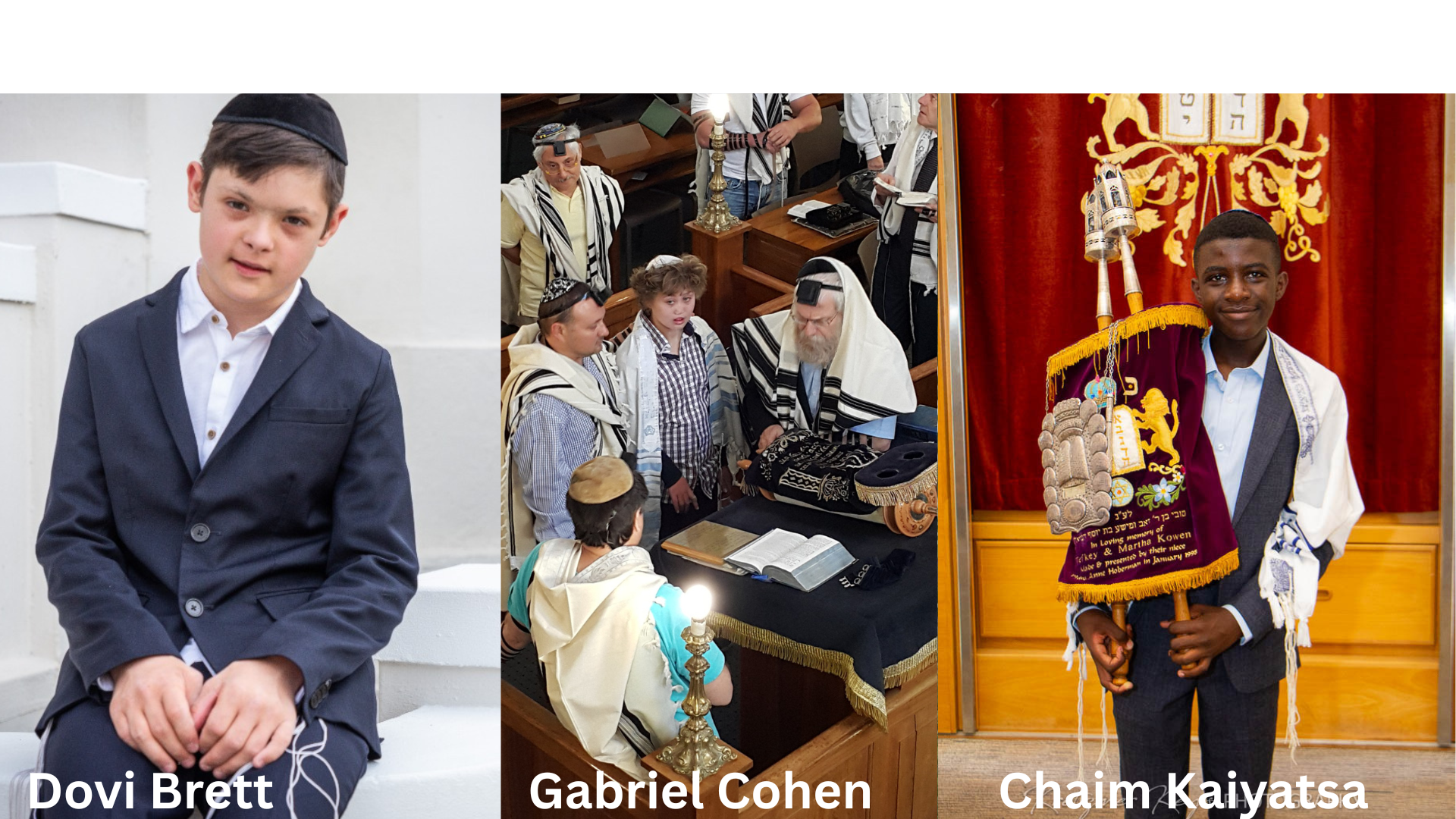
Against all odds, three boys proudly celebrate Barmitzvahs

Children across the South African Jewish community prepare for Barmitzvahs in their own way, each with a unique story. For three families, this journey began long before lessons or leyning.
Their sons had significant special needs and medical conditions, yet each reached the bimah surrounded by love, community, and a determination that shaped celebrations unlike any other.
Each reached his Barmitzvah with parents who refused to let challenges close the door on Jewish life.
When Ally Cohen’s son, Gabriel, was born, he had a cleft lip and palate. “We were told that there was something wrong with Gabriel when he was born, but the doctors couldn’t tell us what was going on until he was older and could have MRIs [magnetic resonance imaging] and CAT [computerised axial tomography] scans,” she recollected.
For six months, he hit all the expected milestones. Then something shifted. He struggled to crawl, and his parents sensed trouble long before anyone could give them answers. Overseas specialists eventually diagnosed him with holoprosencephaly, a severe brain malformation. They told the Cohens that their son was unlikely to survive past his first birthday. He’s now 23.
Gabriel learned to walk, attended specialised nursery schools, and spent years in programmes suited to his needs. Frequent illness meant he left school at the age of 12. Caring for him was constant. Even at seven, he still needed to be fed every two hours, while his newborn brother was on a four-hourly feed schedule. His developmental level remained between 12 and 24 months, and he requires full-time supervision to keep him safe.
For years, the family drifted between shuls, never feeling settled. Gabriel was vocal, and they often felt out of place until they found Chabad in Gallo Manor. It was the first time they felt fully accepted. As Gabriel approached the age of 13, the Cohens began to think about what a Barmitzvah might look like.
Rabbi Yossie Hecht said that a child with Gabriel’s pure neshama didn’t require a Barmitzvah, but the family wanted to celebrate him just as they would any other child. They arranged a gentle, intimate gathering with family on the Shabbat before his Hebrew birthday. On the Wednesday of his actual Hebrew birthday, they returned to shul where Gabriel’s father placed tefillin on his arm and stood with him at the bimah. Gabriel, usually excited and vocal in shul, was calm and quiet. Ally said, “It was like he had become an adult.”
In the years since, Gabriel has endured multiple medical emergencies and major back surgery. Each crisis tested the family’s resilience, yet Ally describes him today as “a very happy, loving, young man giving his family endless nachas”.
Another family’s journey began with the kind of uncertainty that arrives during pregnancy. When Rabbi Dani and Rebbetzin Nechama Brett’s son, Dovi, was born, they knew that there was a chance that he had Down Syndrome, but they wouldn’t know for sure until he was older. Genetic tests confirmed the diagnosis. “We had no idea what to expect” Nechama said.
As a rabbinical couple, the Bretts were surrounded by community from the start. Yet even with that support, many people were unsure of the right thing to say. Some hesitated between mazeltov and sympathy. The Bretts decided they would set the tone themselves. They shared the news directly to avoid any discomfort, and focused on their gratitude that their son had arrived safely.
Support grew around Dovi quickly. Rebbetzin Natalie Altman, the principal of Phyllis Jowell Jewish Day School at the time, visited shortly after his birth and assured the family he would always have a place there, and from pre-school throughout primary school, that’s exactly what happened. Cape Town Torah High picked up the baton, and Dovi segued into Grade 7 just as comfortably. At shul, the community embraced him wholeheartedly. “Shul was a place where he could be loved,” Nechama said.
As Dovi grew, the Bretts thought deeply about how to nurture him. Said Dani, “We’ve always strived to find the delicate balance between accepting him as he is, but not accepting his limitations. We didn’t want to push him too hard, but wanted to stimulate him as much as possible.” His siblings also played a vital role, folding him naturally into the rhythms of play, learning, and family life.
When it was time for Dovi’s Barmitzvah, the family approached it like they had for their other children, adjusting only where necessary. He spoke more slowly, so the service took longer. He learned Rishon; maftir; and haftorah. His older brother helped prepare his speech, but insisted that it remained true to Dovi’s voice.
When the Barmitzvah finally arrived, the Bretts witnessed how deeply the community cared for their son. When he received his first aliya at Ohr Somayach, the whole shul gravitated towards him and surrounded the bimah in support. “The Shabbos celebration at Morasha Shul was packed to the rafters on the day of Dovi’s Barmitzvah” Dani said. Said Nechama, “People were invested in Dovi, because they knew many have known him since birth.”
Dovi was also shaped by the work of his long-time facilitator, Charlotte Thurgood, whom the Bretts described as “an absolute angel” and “something between a teacher and a grandmother figure”, as well as all of his teachers and therapists over all the years. Reflecting on their goals, Nechama said, “We aimed as high as we could in the range of possibilities we had.” Dani saw how much Dovi gives back to the community, saying, “As much as people have given to him, he has also given to people.”
A third family reached the bimah from a very different starting point. Christian, who now goes by the name Chaim, was diagnosed as deaf when he was toddler in Malawi. His parents described those early years as “a mix of emotions: shock, sadness, and determination”. Access to appropriate schooling and medical care was limited, and the family eventually moved to South Africa in search of better support.
They found community at Temple Israel, a shul they chose “because of its welcoming and inclusive nature; strong sense of community; focus on ethics and prophetic tradition; and emphasis on the concept of tikkun olam”. Chaim’s father, Fred Kaiyatsa, has worked for Temple Israel for more than a decade. During that time, exposure to Judaism made the family realise that they held the same beliefs, and led to them converting through the shul’s Jews by Choice programme. Over time, they connected deeply with Jewish life. “We fell in love with the Jewish customs, traditions, values, and rituals, which are so profound,” they said.
Preparing Chaim for his Barmitzvah required careful planning. “Our main concern was ensuring that Chaim could fully participate in Jewish life and receive the support he needed,” his parents said. The shul collaborated with sign language tutors and interpreters, and congregants made an effort to learn basic signs. His family challenged the misconception that “deaf individuals are limited”.
On the day of the Barmitzvah, the community surrounded him with enthusiasm. “The atmosphere was overwhelmingly positive and supportive, full of love,” his parents said. They described the service as “magnificent, with no dull moments”, and said, “We are proud of Chaim’s growth and confidence.” They were moved by how fully he was welcomed, saying that within the community, “he feels loved all the time with much support”.
Three families, three boys, three very different paths to the same milestone. Their stories begin with fear or uncertainty, but each moves toward belonging. None of these children were defined by medical predictions or by the limits others imagined for them. They reached their Barmitzvahs surrounded by people who believed in them and by parents who insisted that every child has a place in Jewish life. Their journeys remind us that strength can take many forms, and that a community grows richer every time it chooses to open its doors a little wider.




Bev Goldman
January 4, 2026 at 12:25 pm
A most beautiful and heartwarming story written with so much sensitivity and empathy. Kol hakavod to three incredible sets of parents who took their sons as Hashem had given them and created space for them in the family of man. So much joy and so much achievement. Blessings on all three barmitzvah boys. May they enjoy life and love all the days of their lives.
Bev Goldman.