





OpEds

A little year-end wish for sanity in 2026

There is a strange kind of quiet at the end of each year, a moment where the noise softens just enough for clarity to slip through.
This December, that clarity arrived in the form of a column sent by friends from all over the world: the now viral essay by Lerato Mokoena.
It arrived in my inbox from New York, London, Sydney, and Johannesburg with the same message: “Have you seen this?”
I read it, and something suddenly shifted. Not because it revealed anything new, but because it articulated something many of us have felt building, slowly, insidiously, for years.
Except this time, the temperature didn’t rise gradually. It spiked. Suddenly. Visibly. Enough to wake even the most patient frog in the pot.
The spark was a resolution from the University of Cape Town (UCT) Convocation calling on South African Jews, all 50 000 of them in a nation of nearly 60 million, to renounce their religion, which is simply the belief in Jewish self-determination of their ancestral homeland, Israel.
Let’s pause on the numbers: 50 000 ÷ 60 000 000 = 0.083%. In other words: 99.917% of the country isn’t Jewish.
A sliver. A tiny speck.
And yet somehow, this microscopic minority has become the focus of a resolution demanding public ideological renunciation as the price of academic belonging. That unless Jews renounce the right of Israel to exist, they are no longer welcome at UCT.
What on earth is this? How can this possibly be normal? Or even legal?
To understand its strangeness, we need only imagine parallel scenarios.
What if UCT demanded that Roman Catholics worldwide renounce the Vatican and Rome?
What if Anglicans were instructed to repudiate the King, Westminster Abbey, and the symbolic heart of their own faith?
What if Muslims were told to renounce Mecca and Medina or not be welcome at UCT?
What if Hindus were asked to reject the Ganges?
What if Buddhists were told to disown Dharamshala?
We would be horrified at the prejudice and intrusion – spiritually, intellectually, and morally.
And yet this is what has been asked of Jews: to renounce the land that appears throughout the Torah; the Prophets; the New Testament; and the Quran; the land of Abraham, Isaac, and Ishmael; of Mary, Jesus, and the 12 Apostles; of Moses; Noah; and Kings Saul, David, and Solomon – the geographical cradle of the Jewish people. The place named more than 2 500 times in our texts.
To demand that a Jew denounce Israel is to ask a tree to reject its own roots.
And so, with genuine puzzlement, I find myself asking:
How did we arrive at this inexplicable place?
Who decided such a thing was reasonable?
What is the ideological machinery that turns 0.083% of the population into a public target?
Because while South African Jews are being instructed to renounce their ancestral homeland, the world is remarkably quiet – eerily silent – even on matters that seem at least as deserving of principled outrage.
Some obvious examples:
- In China, nearly two million Uyghur Muslims have been confined in Xinjiang “re-education” camps, one of the greatest religious persecutions of the modern era. Yet UCT has issued no convocation resolution demanding that Chinese students denounce Beijing;
- In Nigeria, Christians are being beheaded in acts of terror. Yet no African Christian student at UCT has been told to disavow their entire spiritual heritage; and
- Across Europe, people have been arrested simply for waving the Union Jack or the flag of St George, but British expatriates here aren’t asked to apologise for their homeland.
These examples aren’t raised to divert attention, but to expose the unfathomable selectivity.
That selective outrage tells its own story.
Because no rational person would propose that South African Muslims renounce Mecca because of wars occurring elsewhere in the Muslim world.
No-one would insist that Christians renounce Rome because of violence in other countries.
No-one would dare ask Buddhists or Hindus to denounce the sacred geography of their faiths.
It would be recognised instantly as absurd, bigoted, and fundamentally indecent.
Yet somehow, this same logic is applied, unapologetically, to Jews.
This isn’t an accusation, it’s a bewildered observation.
It leads us back to the central questions Lerato Mokoena’s essay forces into the light:
Who is driving this?
What ideological or geopolitical forces have gained such traction in our academic institutions?
How did a foreign conflict become a domestic purity test in a country that once championed freedom of conscience?
These are gentle questions. But they are necessary ones.
Because the idea that Jews, 0.083% of the population, should be required to renounce their ancestral home isn’t just discriminatory, it’s historically illiterate and constitutionally incoherent.
Universities should be bastions of inquiry, not engines of ideological coercion.
If such a resolution were imposed on any other faith community, the outrage would be instantaneous.
If Muslims were told to renounce Mecca, the country would be in flames – and rightly so.
If Christians were told to renounce Jerusalem or Rome, every civil rights group would mobilise.
If Hindus were made to repudiate the Ganges, Parliament would debate the violation.
If Buddhists were expected to reject Dharamshala, columnists would condemn the regression.
Why, then, is it permissible, even lauded in some circles, to impose such a demand on Jews?
South Africa prides itself on fairness, on ubuntu, on its moral instinct for justice. But somewhere along the way, the water has grown hotter. And now, thanks to this viral essay, many have finally felt the boil.
So as the year closes, I find myself returning to a very simple, old-fashioned wish:
May 2026 be a year in which sanity returns.
A year in which universities rediscover courage, integrity, and intellectual honesty.
A year in which South Africans of all backgrounds stand not only for themselves, but for the principle that no community should ever be bullied into renouncing its history.
A year in which Jews, one-tenth of just 1% of this nation, are granted the same dignity of belonging that every other group enjoys without question.
A year in which we cool the water, widen our gaze, and reawaken the South African instinct for fairness.
Because sometimes the gentlest questions are the ones that break the spell.
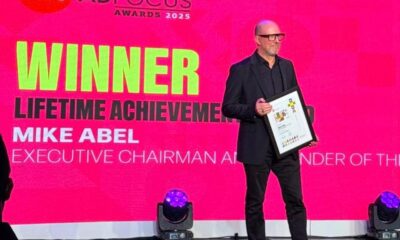
- Mike Abel is the founding partner and executive chairman of M&C Saatchi Abel and The Up&Up Group, South Africa.





Errol Price
December 11, 2025 at 10:06 pm
What a collection of mindless platitudes is this article. Is the writer so ignorant of history, of two millienia of Jew-hatred that he thinks the miniscule representation of the Jewish community in the South African populace has any bearing on the outrageous action of UCT?
Jews across the diaspora will have to make serious decisions about their futures in the coming years.
Pointless articles like this one do not help.
Clifford Quenneville
December 24, 2025 at 9:21 pm
People today are questioning what’s going on in the world events. But they don’t take into account what bible prophecy has to say. The prophet Hoshea, chapter 10 verse two tells us that two thousand years will pass, likely from the time that Jesus/ Yeshua ascended into heaven, and Israel would be revived as a nation, which took place in 1948. At the end of the two thousand years, the Messiah will come, and restore all things to Israel. That two thousand years is almost up, and the Scriptures tell us that Israel will experience violence until the coming of Mashiach. In fact, many will perish, according to Zechariah chapter 14, after which the Messiah will come down from heaven, not from the earth, and will destroy the enemies of God and Israel.