Featured Item
War above, Hamas below: Gazan activist speaks out

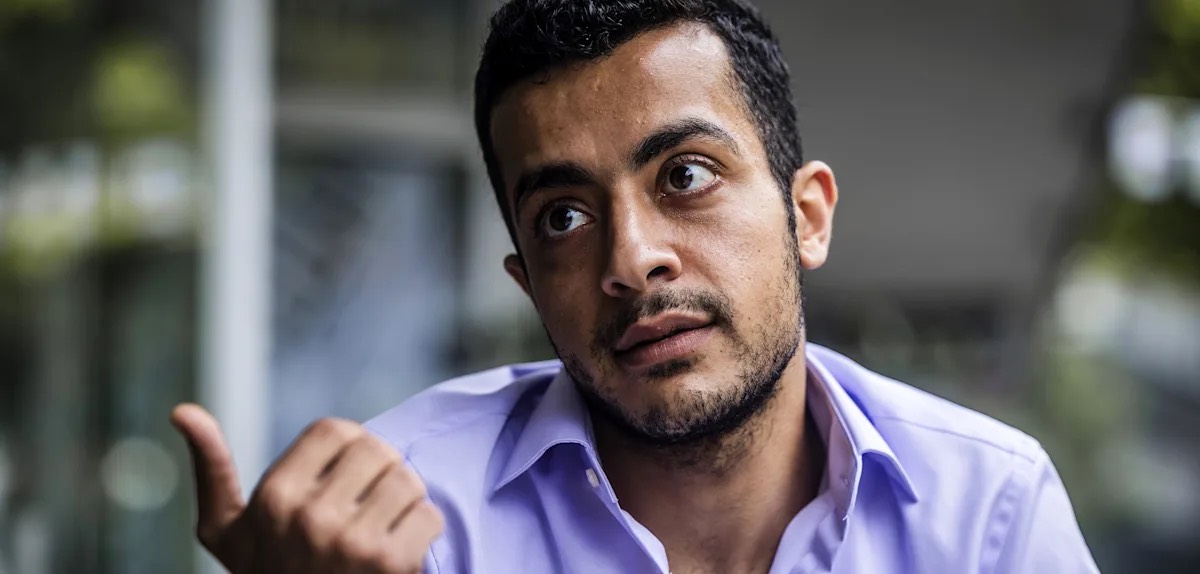
“I want a future without Hamas. Not for Israel, but for my people. For Palestinian children who deserve a life shaped by dreams rather than fear.” These are the words of Hamza Howidy, a Gazan peace activist who spoke at a SA Jewish Report webinar this week.
Howidy told how his life had been shaped by the realities of growing up under Hamas rule and by a personal journey that led him far from the beliefs he was raised with. “Recognising someone else’s pain doesn’t erase mine. And recognising my pain doesn’t erase theirs,” he said.
He described his childhood in the Rimal neighbourhood of Gaza City as one defined by control long before he understood the word. “In Gaza, you don’t choose politics. Politics chooses you,” he said. His family had no political involvement, but that meant little in a society where every institution, from the classroom to the mosque to the university, fed into a single ideology.
His first school was Dar al-Arqam, run by Hamas. “Every morning began with jihadi songs,” Howidy said. “Indoctrination wasn’t something we noticed. It was simply the air we breathed.” By the age of 10, he had memorised a third of the Quran. Later, at the Islamic University of Gaza, ideological instruction became part of every degree. “No matter what you study, you must study Sharia. You must study every Hamas leader. They try to shape you into the perfect ideological soldier.”
Behind the façade, he was quietly questioning everything. “I was an agnostic in a society where that cannot exist. So you learn how to pretend. You learn how to survive.”
In 2019, Howidy joined a civil protest movement called We Want to Live, made up mostly of young people demanding economic reform and free elections. “We had no weapons. We had no foreign support. We just wanted the chance to live normally,” he said. Hamas responded by arresting hundreds. Hamza was taken with them. “For three weeks, they tortured me in what we call the slaughterhouses,” he said. “They accused me of everything. Israel, America, the Palestinian Authority. I was just a student demanding dignity.” His family secured his release with a $3 000 bribe.
He tried to keep his head down, but in 2023, he joined protests again. This time, the consequences were even worse. “The second arrest was worse. They took my dignity, my health and my hope, and then demanded another bribe. Five thousand dollars,” he said. That experience left him convinced he wouldn’t survive if he stayed. “I realised they would kill me eventually. Not because I was political, but because I refused to be their puppet.”
He fled through Egypt and Turkey, eventually boarding what he described as “an immigration or death boat” to Greece. “When I stepped onto European soil, I felt relief for the first time in my life.”.
One month later, the 7 October 2023 massacre occurred.
He was in a refugee camp when the news broke. “I thought it was propaganda,” he said. “Even after 19 years under Hamas, I couldn’t imagine something so horrific.” As videos emerged, he realised the scale of the attack. “I still cannot comprehend how a human being can do what I saw that day,” he said.
His immediate fear was for Gaza. He called his family, who told him their neighbourhood was already collapsing. “My father said, ‘They destroyed Gaza. We have to run.’” Howidy begged them to head south. “I told them, ‘If you stay, you will die. Not because of Israel, but because Hamas will use you as shields.’”
They fled, but their safety didn’t last long. Hamas members arrived at their tent in southern Gaza, threatening them because Howidy had published an article urging Gazans to demand the release of Israeli hostages. “My family had the war above them, and Hamas beneath them. There was nothing left to stay for.” With help from donors, they managed to cross into Egypt. “It cost everything they ever saved, but they survived,” he said.
Earlier this year, Howidy took part in a Holocaust education programme in Poland. Some questioned why a Palestinian from Gaza would take such a trip, especially during a war. Howidy dismissed the criticism. “Recognising the pain of another group doesn’t take anything away from your own,” he said. At Auschwitz, he found himself staring at piles of belongings, “I asked why they would bring pots to a death camp. It made no sense to me.” The guide explained that Jewish families believed that they were being resettled. “That sentence broke something inside me. The idea that you can murder people and, before that, give them false hope.”
His account of daily life in Gaza before the war challenges some common assumptions. When asked how much ordinary Gazans knew about Hamas’s military tunnels, he said, “We didn’t know the tunnels were under our homes.” Residents suspected Hamas used hospitals or schools, but not the sheer scale of the underground network. He described a bombing in 2021 that left a crater in his street. “Later, I realised that I had been sitting above a tunnel days before. If we had known, we would have left. We know Israel targets tunnels,” he said.
According to Howidy, support for Hamas has all but disappeared. “The idea of armed resistance is broken,” he said. “Gazans saw Hamas steal aid, execute critics, and hide underground while children starved above them. Hamas betrayed us.”
Conditions inside Gaza today are devastating. “Eighty percent of civilian infrastructure is destroyed. Two million people are displaced. People have forgotten what privacy is. They have forgotten what a toilet is. Children have infections everywhere,” he said. Online videos of well-stocked shops, he said, aren’t representative. “Those shops exist, yes. But only corrupt officials and wealthy people can buy from them. Ordinary people rely on aid.” With no functioning police or civil order, “Gaza is no longer a functioning society. It’s a survival zone ruled by gangs, criminals, and armed men.”
He described corruption among Gaza’s leadership in stark terms. “Yahya Sinwar left prison with nothing. Within four years, he owned a villa, a hotel, restaurants, and a money exchange. Gaza drowned while the leaders became millionaires,” he said. “People think corruption in Gaza is political. It’s personal. Your life or their power.”
When asked about Western protests, Howidy said, “Some people truly want peace. Some are anti-Israel for ideological reasons. And some glorify Hamas without understanding what Hamas actually is.” On Queers for Palestine, he said, “In Gaza, Hamas would execute them. But I appreciate anyone who supports Palestinian civilians as long as they don’t support Hamas.
“Recognising Jewish pain doesn’t erase Palestinian pain. Recognising Palestinian pain doesn’t erase Jewish pain,” Howidy said. It’s a principle that has shaped his journey and his way forward.