



World
I went looking for Holocaust ‘upstanders’. I found a Nazi rescuer who chose conscience over complicity.

JTA – After publishing two books in 2023 and 2024 for young readers in our Upstander Stories – Brave People Who Saved Jews During the Holocaust series, my granddaughter, Lilly, the illustrator, and I, the author, began looking for another powerful story for a third book. The goal of the series is to introduce children ages eight to 12 gently to stories of courage and sacrifice during the Holocaust, inspiring them to become “upstanders” – champions for others in need of help.
What we found was a story of a little-known rescuer, the risks he took, and the lives he saved.
In September 2024, after several weeks of intensive research for a new story to bring our young readers, I came upon a curious reference to a man named Otto Busse. An unsigned letter to the editor published in the Yiddish-language newspaper Naje Israel Zeitung (New Israel Newspaper, now defunct), dated 5 December 1961, read, “I couldn’t believe that there was a German, Mr Otto Busse, who helped the Białystok [Poland] resistance fighters and the partisans in the forests, who risked his life and the life of his family in Germany. The faith in the human spirit isn’t lost…”
What? I sat back in my chair and took a deep breath. I knew that there were stories – though very few – of Nazi Party members or party officials who subverted genocidal policies or party directives during the course of the war. Oskar Schindler comes to mind. But I had yet to hear a story of a Nazi who supported the organised Jewish resistance – ostensibly in a significant way.
I had to know more. And so, the deep dive began. In the end, after reading newspaper accounts, searching through Yad Vashem’s database, interviewing family members of survivors, and hours spent uncovering any archival digital evidence that could display the fullness of Busse’s risky, righteous actions, we were able to tell a story that revealed itself to be a shocking, often distressing and yet poignant account that has been overlooked for close to 60 years.
Otto Busse (pronounced “büss-uh”) was born in East Prussia, parts of which are are now in modern-day Poland and Russia, in September 1901, the youngest of seven siblings. His devout Christian family lived and worked on a farm, yet Busse did not share his family’s penchant for a life of farming. He set out on his own, going from job to job to find an industry or a trade to pursue as a career. Soon, he decided to take up a course of study to become a master painter.
In the early 1930s, Busse opened his own painting business and, like so many other master craftsmen of the time, he joined the National Socialist German Workers’ Party, known as the NSDAP, to procure more painting jobs through the organisation’s business network. His company flourished, but only until 1935. That’s when the Nuremberg Laws were passed in Germany – antisemitic legislation that stripped Jews of their citizenship; banned marriage and sexual relations between Jews and non-Jews; and imposed severe social and economic restrictions. Although he carried the card of the NSDAP and wore the Nazi uniform as a member of the Third Reich’s Wehrmacht, or unified military forces, Busse – a devout Christian – was repulsed by the restrictive anti-Jewish covenants.
“In 1935, the party’s antisemitic campaign began,” Busse told an interviewer decades after the war. “I wondered how I could possibly get out of [the party].”
Soon after the Nuremberg Laws went into effect, Busse heard a radio broadcast featuring a swearing-in ceremony for new party members. Before the official swearing-in, Germany’s deputy führer, Rudolph Hess, gave potential party members time to reconsider joining the NSDAP, assuring them that there would be no economic consequences if they chose to withdraw. Busse immediately submitted his resignation letter from the party, stipulating that he was leaving “due to illness and religious inhibitions”.
Unsurprisingly, the repercussions were swift. Party officials took away his uniform and barred him from receiving any further painting contracts from the party.
Still Busse struggled along, taking any painting job he could find to sustain his livelihood. In the summer of 1939, as Germany readied its armed services for their impending invasion of Poland, the Nazi Party came calling for Busse again.
This time, it gave him little choice. Rejoin the party, or be sent to a concentration camp, consigned to hard labour. So, in June of 1939, Busse grudgingly put on the party uniform.
Germany invaded Poland on 1 September, with Britain and France declaring war on Germany just two days later. Then 38 years old, Busse was assigned to a military police reserve unit (gendarmerie) on the German Polish border. His commander was a landrat (district administrator) named Frederick Brix. Brix later became chief of civil defence in Białystok, Poland.
As a member of the Nazi police reserve unit, Busse was ordered by Brix to enforce the restrictive Nazi laws against Jews. He had to ensure that Jews didn’t enter German businesses, schools, public libraries, German doctors’ offices, theatres, and more. He had to place signs in windows and on sidewalks designating businesses that were owned by Jews.
In March of 1943, Busse was discharged from the military gendarmerie and reassigned by Brix to Białystok in eastern Poland. There, with his wife and two sons, he was ordered to direct the painting and restoration of hospitals and Jewish homes vacated after 50 000 Jews were forcibly taken from their homes in 1941 and imprisoned in the Białystok ghetto.
As a member of the Nazi Party who was supposedly contributing to the national effort of economic reconstruction, Busse, who had purchased a painting company in Białystok, enjoyed special protection in occupied Poland. He was permitted to employ local Poles, who were paid for their work, and had access to forced Jewish labour from the ghetto.
One of the forced labourers at the company was Bluma Erenkranc, a 20-year-old Jewish woman who lived in the ghetto with her three brothers, a sister, and her parents. She was sent into slave labour in 1942, just prior to Busse’s arrival, to prepare the company invoices. Seeing that Erenkranc was familiar with the accounts and how the business operated, Busse told Erenkranc he wished for her to remain with the company under his direction. Knowing that Busse was a Nazi, she was frightened but had to comply since she believed she could not refuse a Nazi’s request.
Soon however, Erenkranc learned that Busse was a benevolent man. Slowly, she began to confide in him about what was happening to the Jews of the town and about the horrifying conditions inside the ghetto. Busse started to give her regular parcels of food for her family, walking her in and out of the ghetto himself every day to be certain she wasn’t stopped and searched by the Nazi guards at the ghetto gates. He told her not to wear her yellow star marking her as a Jew when she was at work. He became her protector.
“My mother told me that when she worked for Otto Busse, he invited her to sit at the lunch table with the non-Jewish workers, which was unheard of at the time,” Barry Shapiro, Erenkranc’s son, told me. “She also said after she told Otto her father liked beer, he gave her some to take back to the ghetto for him. These may seem like little things, but back then, these were really great acts of heroism.”
One day, as Busse was inspecting an apartment for painting, he came upon two young women who were living there. A pleasant conversation, in German, developed, and because Busse needed more German-speaking secretaries, he offered them both jobs.
Unbeknownst to Busse, the women he hired – Chasia Bielicka from Grodno; and Haika Grossman from Białystok – were in fact Jewish and belonged to the leadership of a Jewish underground organisation with a mission to mount an armed resistance against the Nazis in Białystok. Bielicka and Grossman were able to live in an apartment outside of the ghetto because they were both somewhat fair-haired with light complexions and carried false papers with Aryan aliases.
It was through Bielicka and Grossman that Busse learned the full extent of the massive extermination campaign that the Nazis were waging against the Jewish people.
“When I then learned about the fate of the Jews up close because I was still allowed to employ Jews in my company, I was seized by a shudder [at the] Nazi methods used against the Jews and, to some extent, against Poles,” Busse wrote in the 1960s. “And at the same time, I was overcome by an unspeakable, deep pity for these persecuted people. The die was cast for me. The mission my heart and mind gave me was: fight the destroyer and help the persecuted!”
From Busse’s own writings, I learned that his personal resistance was fuelled at its core by his strong Christian faith and humanitarian values. He was repulsed by Germany’s dealings with the ghettoised Jewish population and the Poles. While he was in Bialystock, Busse learned that his brother had been imprisoned in Tilsit, East Prussia (now Sovetsk in Russia) for his own opposition to Nazi ideology.
The more he learned from Bielicka and Grossman, the more deeply he resolved to embrace the cause of the Jews against their Nazi oppressors. As a German employer, he could save the lives of some Jews by claiming them as his workers, which he did. That did save them, though temporarily, from being transported to the death camps.
But soon, he became more intensely and personally involved in the Jewish resistance movement in Białystok. As he did, his wife, who was vehemently opposed to his defence of Jews, left Białystok with their two sons. The couple eventually divorced.
Busse was able to help Bielicka and Grossman procure munitions – primarily pistols and homemade bombs – for resistance fighters. He also supplied them with warm clothing; extra food; batteries; and medicines, all at his own expense. He stored the cache of goods procured for the resistance in his own apartment. He offered his office and his personal typewriter to the fighters who were creating anti-fascist leaflets to be distributed to the Jews in the ghetto. This was all in preparation for their plan to stage an uprising in the ghetto so that the remaining Jews could flee and join partisan fighters in the nearby Knyszyn Forest.
The uprising in the Białystok ghettos took place from 16-20 August 1943, just as German forces began the final liquidation of the Białystok ghetto. Hundreds of Jews were killed in the violence, and even though Busse and the resistance fighters had amassed a considerable array of weaponry, the uprising couldn’t match the firepower of the Nazis and was ultimately crushed. The Białystok uprising remains one of the major Jewish acts of armed resistance during the Holocaust. Yet despite the failure of the uprising, hundreds of Jews from the ghetto were able to flee into the forest to join the resistance movement.
When the uprising ended, the remaining Jews in the ghetto – including Erenkranc, who was discovered by the Nazis hiding in a bunker – were marched to the train station for deportation to death camps Treblinka, Majdanek, Auschwitz and others. Busse thought about walking with them and getting on the trains himself. But then, he confessed, “I realised that it was more important to help the living.”
After the ghetto was liquidated, Busse moved the remaining resistance fighters – some into his office and some into his apartment – for their safety. He also built a double wall in his apartment to hide them from the Nazis if necessary.
According to Bielicka, Otto Busse had become a spy and a significant partner in the resistance. “And so it was,” she wrote in her 2003 book, One of the Few: A Resistance Fighter and Educator. “For almost a whole year, until August 1944, the man did not stop helping. At one point he was no longer just an assistant but became a partner and an entrepreneur in the resistance.”
In the summer of 1944, with the Russian army advancing into Poland and forcing the start of the retreat of the German forces, Bielicka and other members of the resistance were asked to draw up a map of all the German positions and bases in the vicinity of Białystok. Busse helped the remaining underground members by using his German contacts to collect field data, resulting in the creation of an accurate map of those areas. It was this map that was used by the Soviets during the liberation of Białystok, which allowed the Red Army and partisans to take Białystok without major casualties.
As the front drew nearer in the second half of 1944, Busse was ordered to leave Białystok and return to Germany, having been drafted at the last minute into army military service. The Jews of the partisan command in Białystok offered to give him protection if he chose to remain behind rather than return to Germany. “There is a collective German guilt, and I do not want to be an exception,” he replied.
Soon afterwards, Busse returned to Germany. He was captured by the Russians while following Nazi orders to gather Wehrmacht soldiers scattered near the front. For five years, until 29 November 1949, Busse was held in Kiev as a prisoner of war doing reconstruction work.
During his captivity and throughout the next 15 years, Busse couldn’t stop thinking about his fellow resistance fighters and the Jews he tried to save. He eagerly wished to learn of their fates and wrote to Jewish agencies and other contacts around the world to find them.
In 1958, Busse learned at last through the kibbutz-based movement of Hashomer Hatzair, to which Grossman and then Bielicka-Bornstein belonged, that both had survived. Then Bielicka-Bornstein wrote to Otto and told him that Erenkranc had survived imprisonment in four concentration camps, including Auschwitz, and she was living in America. He was so overcome with joy that he was hardly able to believe the words he had read.
Busse travelled to Israel in the autumn of 1961, where he was reunited with Bielicka-Bornstein and Grossman at Bielicka-Bornstein’s home in Kibbutz Lehavot HaBashan. In his journal, Busse recalled the moment of his arrival:
“When I then set foot on Israeli soil in Haifa, I was greeted by my friends from the old days after 18 years. I silently prayed to G-d to give me strength to endure this deeply moving moment, because we know that in those evil times, we were all standing right before the gates of death, and now I see these suffering and tormented people in their own country in 1961, and they are happy again. Yes, even happier than we were. These people who were threatened with death back then have wonderful children next to them today.”
During a gala dinner in Busse’s honour at the kibbutz during his visit, Israel Gutman, a survivor of Auschwitz who later became chief historian at Yad Vashem, Israel’s national Holocaust authority, and head of its International Institute for Holocaust Research, spoke about Busse, saying, “Our guest, Otto Busse, was one of the few righteous people in the modern reality of Sodom. He was not a [Nazi] party man. In all his actions, he was not guided by a political idea or a public organisation. As a private individual, personal and moral motives moved him. In his resistance against the Nazis, he saw a defence of the existence of the human race. In moments when he helped the Jews, he risked his fate. The danger that threatened us was also his.”
Busse’s visit to Israel was widely publicised in Israel and Germany. When he returned to his home in Bensheim-Auerbach, Germany, he was denounced as a “traitor of the fatherland” and a “Jew lover”. He lost his job as a department store manager and was forced to leave the city.
Several years later, Grossman arranged for Busse to live in Nes Ammim, a settlement in Israel’s Western Galilee, founded in 1963 by German and Dutch Christians. Its mission – to promote dialogue between Christians, Muslims, Arabs, and Jews – led it to agree to raise the money necessary to provide a home for Busse and his wife, Erna. The Busses returned to Germany in the late 1970s due to health difficulties acclimating to Israel’s warm climate.
In 1971, Erenkranc, her son, Barry, and his wife, Carol, came to Nes Ammim to visit Busse, where they were happily reunited for the first time. Several years before, Busse had sent Erenkranc several pieces of broken silverware through the Red Cross. Busse found the eating utensils in the summer of 1944 while going through the rubble of Erenkranc’s bombed out home in Białystok. He wanted to see what he could salvage for her if – against all odds – she somehow survived. Busse kept the utensils with him during his captivity in Kiev and throughout the years spent looking for Erenkranc. Until she died in 2021, Erenkranc cherished those utensils, the only remnants she ever had of her life and family before the Holocaust.
“Otto often talked about the terrible days when he was with Bluma,” Bielicka-Bornstein once recalled. “They had to walk past the sounds of the ghetto’s death cries, she in the street and he having to stay on the sidewalk. In those moments, he found comforting words for ‘Bluma’s tear-filled eyes’, telling’ her, ‘For you, you are a princess from the house of David.’”
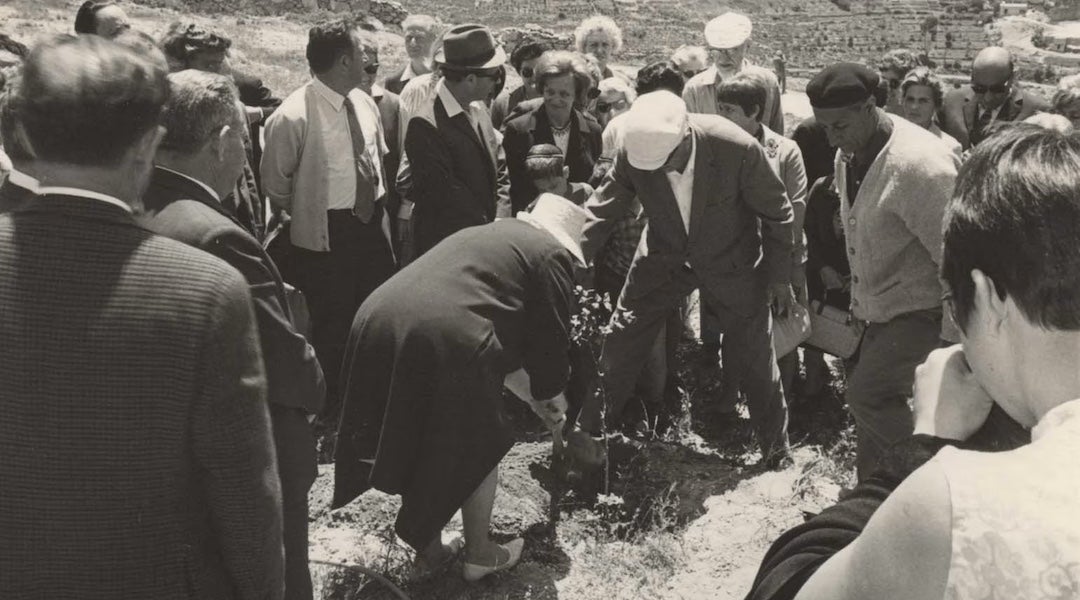
On 25 June 1968, after receiving and reviewing testimonies from those who witnessed Busse’s many acts of heroism at great risk to his own life, Yad Vashem recognised Busse as “Righteous Among the Nations”, and in so doing, awarded him Israel’s highest civilian honour. A few years later, he planted a pistachio tree on the Avenue of the Righteous at Yad Vashem, where it still thrives today.
After Busse returned to live in Germany, Grossman, then a prominent member of the Israeli Knesset, broke her own vow never to set foot on German soil again by travelling there to visit Busse just prior to his death in 1980. The Israeli government sent a delegation to Germany for Busse’s funeral.
Busse’s story reminds us on this International Holocaust Remembrance Day that courage is not always loud or public, it can take the form of quiet, principled action in the face of unimaginable danger. Today, when injustice, discrimination and oppression still touch countless lives around the world, his example is more urgent than ever. Being an upstander is a choice we make every day when we speak out against cruelty, protect those in need, and act according to conscience rather than convenience.
As Busse said at the gala held in his honour at Kibbutz Lehavot HaBashan while gesturing to the world the survivors had made, “All of this is due to a few humane actions that every human being should undertake.”
- The views and opinions expressed in this article are those of the author, and don’t necessarily reflect the views of JTA or its parent company, 70 Faces Media.