



World
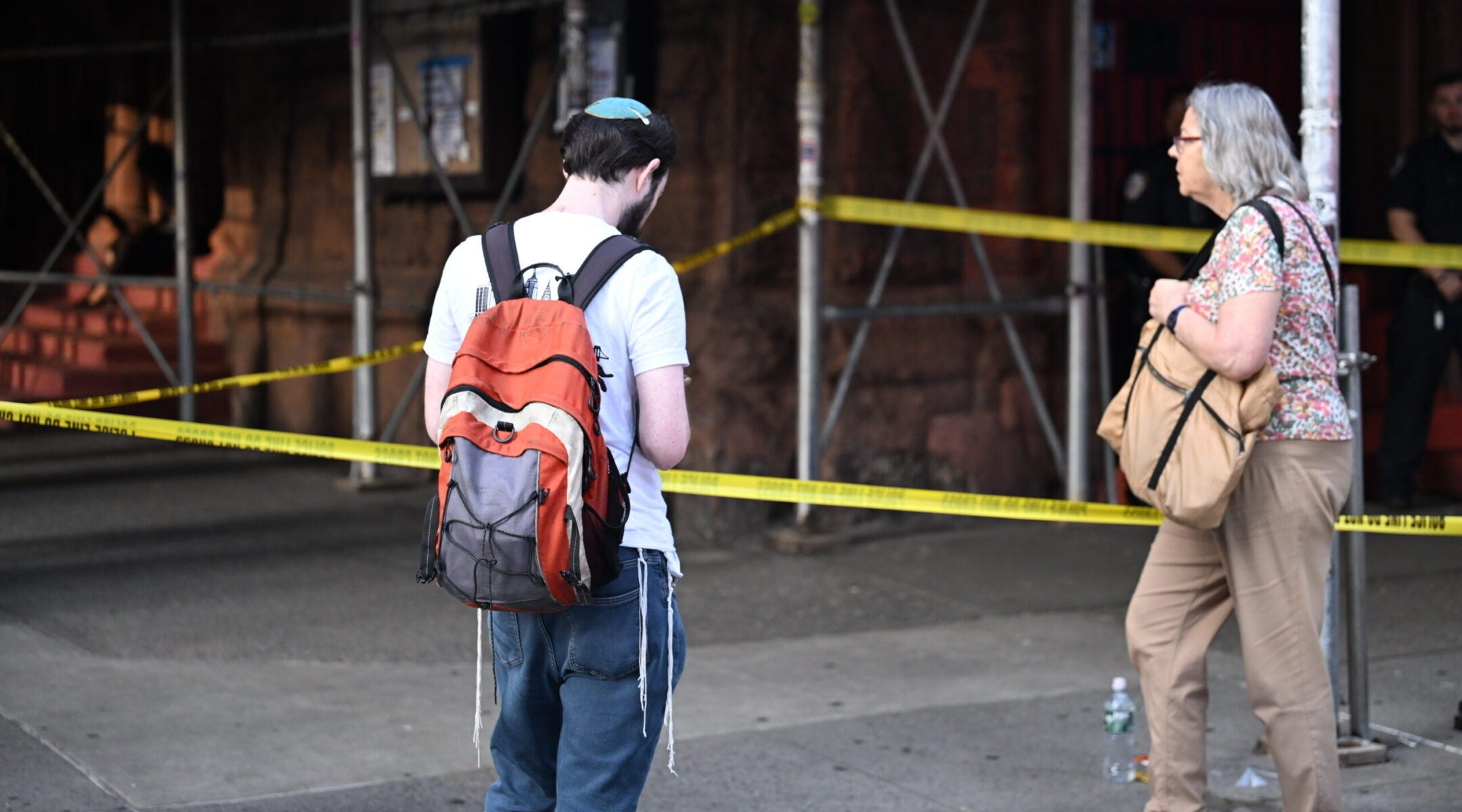
When antisemitic violence came to our synagogue’s doorstep, Tisha B’Av’s ‘narrow straits’ became frighteningly real

JTA – On Thursday, on Tisha B’Av, violence came frighteningly close to home to Congregation Rodeph Sholom, the synagogue I lead on Manhattan’s Upper West Side.
One person was stabbed a city block away, near 84th Street and Central Park West, followed shortly afterwards by a stabbing outside the Jewish Center on 86th Street. One of the victims was wearing a kippah. Witnesses, including members of our security staff, heard the assailant shout, “Allahu Akbar.” Both victims are reported to be in stable condition, and we pray for their complete healing of body and spirit.
Police apprehended the alleged perpetrator shortly after the attacks. New York City Police Commissioner Jessica Tisch has said the attacks are being investigated as possible antisemitic hate crimes. I am grateful to her, the officers who responded so quickly, and the local precinct officers who communicated closely with our security team and are increasing patrols around houses of worship.
Our entire security team responded immediately, supported the police investigation, and secured our buildings and summer camp. Their vigilance, judgement, and care were extraordinary, and we are grateful for them and the safety they bring to our community every day.
While the full motive for these attacks remains under investigation, the wider climate in which they occurred is already clear. Violent antisemitism has reached levels few of us imagined we would witness in contemporary America. Jews have been murdered, beaten, stabbed, shot, threatened, and attacked outside synagogues, at schools, on campuses, and in the streets of American cities. Here in New York, anti-Jewish hate crimes continue to constitute a profoundly disproportionate share of all reported hate crimes.
Violence grows within a climate shaped by words.
And, for years, we have watched rhetoric about Israel and Zionism grow increasingly absolutist and dehumanising. Political criticism of Israel, its leaders, and its policies belongs within democratic discourse. Israelis themselves engage in that criticism with passion and a sense of responsibility, just as we do so here in America. A different and more dangerous phenomenon takes shape when Israel is portrayed as uniquely monstrous, Zionism is treated as a form of evil, Jewish history and vulnerability are erased, and Jews are expected to denounce a central expression of Jewish peoplehood to prove their ethical acceptability.
Leaders bear responsibility for the climate their words create. Words do not wield the knife, but they make a target imaginable and violence justifiable. When public figures, including our mayor, repeatedly cast the Jewish State as singularly criminal, describe Zionism as an ideology worthy of contempt, and leave Jewish suffering outside the frame, they create permission for others to see Jews as representatives of an unforgivable cause.
History has taught us that rhetoric that strips a people of legitimacy rarely remains rhetorical forever. Horrifyingly, we see this lesson rising all around us.
On Tisha B’Av, the darkest day of the Jewish calendar, we recall the most painful and destructive moments of our history. As a community, we read from Eikhah, the book of Lamentations. Eikhah describes our people as being overtaken bein hametzarim (within the narrow straits). From these words, our tradition gives the weeks leading to Tisha B’Av their name.
A metzar is a constricted place, where breathing tightens and vision narrows. Antisemitism forces Jews into such places. It makes us calculate whether to wear a kippah, display a mezuzah, gather publicly, allow our children to move freely through the city, or trust that our neighbours will stand beside us.
Many of us feel that constriction today. We are frightened. We are angry. We are weary of being told that the hatred gathering around us is imaginary, exaggerated, or merely a response to Israeli policy. Tisha B’Av asks us to feel that fear and then to act from something larger than fear.
The prophet Zechariah imagined Tisha B’Av, this day of pain and shadow, eventually becoming a day of gladness. He named the pathway to such a transformation as ha-emet v’ha-shalom ehavu, “love truth, and peace”.
Truth without peace can harden into vengeance. Peace without truth becomes avoidance. Our tradition commands us to pursue both, as together they turn fear into vigilance and pain into purpose.
So now, we pray for the wounded. We give thanks to those who protect us. We demand responsibility from those whose words shape our society. We stand beside our neighbours against every form of hate.
And then we return to our streets and our sanctuary. We must gather, pray, learn, and live visibly and courageously as Jews. We will not allow hatred to narrow our Jewish lives or our vision.
- A version of this article was sent to congregants of Rodeph Sholom.
- The views and opinions expressed in this article are those of the author and do not necessarily reflect the views of the SA Jewish Report, JTA, or its parent company, 70 Faces Media.