


World
Bomb threat puts Florida’s united front against antisemitism to the test

A bomb threat at a Jewish preschool in Florida, United States this week triggered a swift, coordinated police response, highlighting the extensive security measures protecting Jewish communities amid growing concerns about antisemitism.
A threatening phone call to the Donna Klein Jewish Academy in Boca Raton, north of Miami, prompted the evacuation of several nearby buildings at the Jewish Federation of South Palm Beach County campus on Monday, 12 October. The campus houses four other Jewish schools.
“I received a message from the school around 16:45 to say the school was in lockdown as there had been a bomb threat,” said one mom who grew up in Johannesburg. “My son was on the soccer fields at the time. There are many South African expats here. You can imagine how we all charged to the school frantically to see what was happening.
“It was frightening. Police and campus security acted very swiftly, cordoning off the roads and making sure things were under control.”
Authorities subsequently determined there was no credible threat and all children and staff were safe.
The threat underscored the importance of close cooperation between Jewish institutions, communal security organisations, and law enforcement agencies, a defining feature of the approach that the SA Jewish Report witnessed on a recent trip to the United States.
Across South Florida, a coordinated effort involving police, government authorities, university administrators, religious leaders, and Jewish security organisations is helping communities confront threats through legislation, intelligence-sharing, government funding, and extensive security preparations.
For Johannesburg-born Jemma Blumenthal, 20, this commitment to protecting Jewish life in Miami is deeply personal.
At Florida International University (FIU) in Miami, where she studies, Blumenthal enjoys something increasingly precious on university campuses grappling with antisemitism: the freedom to be openly and proudly Jewish without fear.
“I love it here. It feels like a home away from home,” said Blumenthal, who matriculated from King David Linksfield before moving to Miami 18 months ago.
At FIU, a sprawling public university of approximately 55 000 students, including 3 500 Jewish students, Jewish life is visible and vibrant.
“Students can wear kippot, celebrate Shabbat, attend Jewish educational programmes, and openly express their connection to Israel,” said Jon Warech, executive director of FIU Hillel.
The university received an A rating from the Anti-Defamation League for its response to campus antisemitism.
Yet Blumenthal knows that even here, antisemitism hasn’t disappeared. On 7 October, the third anniversary of the Hamas massacre, protesters confronted Jewish students on campus.
“It was a very difficult day for us. Protesters chose that day to come and shout at us. It made me feel sick,” she told the SA Jewish Report. “It was a little scary, but the police and Hillel representatives made us feel safe at all times.”
For Lia Mitrani, 19, a business analytics and marketing student from Spain, the contrast with university life in her home country is stark. “No one wants to be a Jewish student in Spain anymore. Campuses are super pro-Palestine and super anti-Israel. It’s frightening, horrible,” she said.
On 7 October, FIU president Jeanette Nuñez addressed Jewish students in solidarity, while a minute’s silence was observed at a university sports match in memory of the Hamas victims.
FIU Chief of Police Alexander Casas said building relationships with students before crises arise is central to the university’s approach.
“The students see us as their friend. They feel seen,” he said. “Relationships happen when nothing’s going on, not when you are commemorating something.”
His officers know Hillel students personally and have attended Shabbat dinners.
Ahead of the 7 October protest, police conducted a major threat assessment, deploying additional officers to protect students while respecting lawful protest.
US Assistant Attorney General for Civil Rights Harmeet Dhillon warned on 6 October that universities failing to protect Jewish students risk serious consequences. “Universities that tolerate this behaviour or mollycoddle these students and faculty are doing so at their peril,” she said.
Universities receiving federal funding are bound by Title VI of the Civil Rights Act, which prohibits discrimination based on race, colour, or national origin, including certain forms of antisemitic discrimination involving shared ancestry.
The Trump administration has prioritised enforcement through federal investigations and potential funding consequences, although its approach has sparked debate over academic freedom and political expression.
Beyond university campuses, Miami’s law enforcement agencies have adopted a similarly proactive approach.
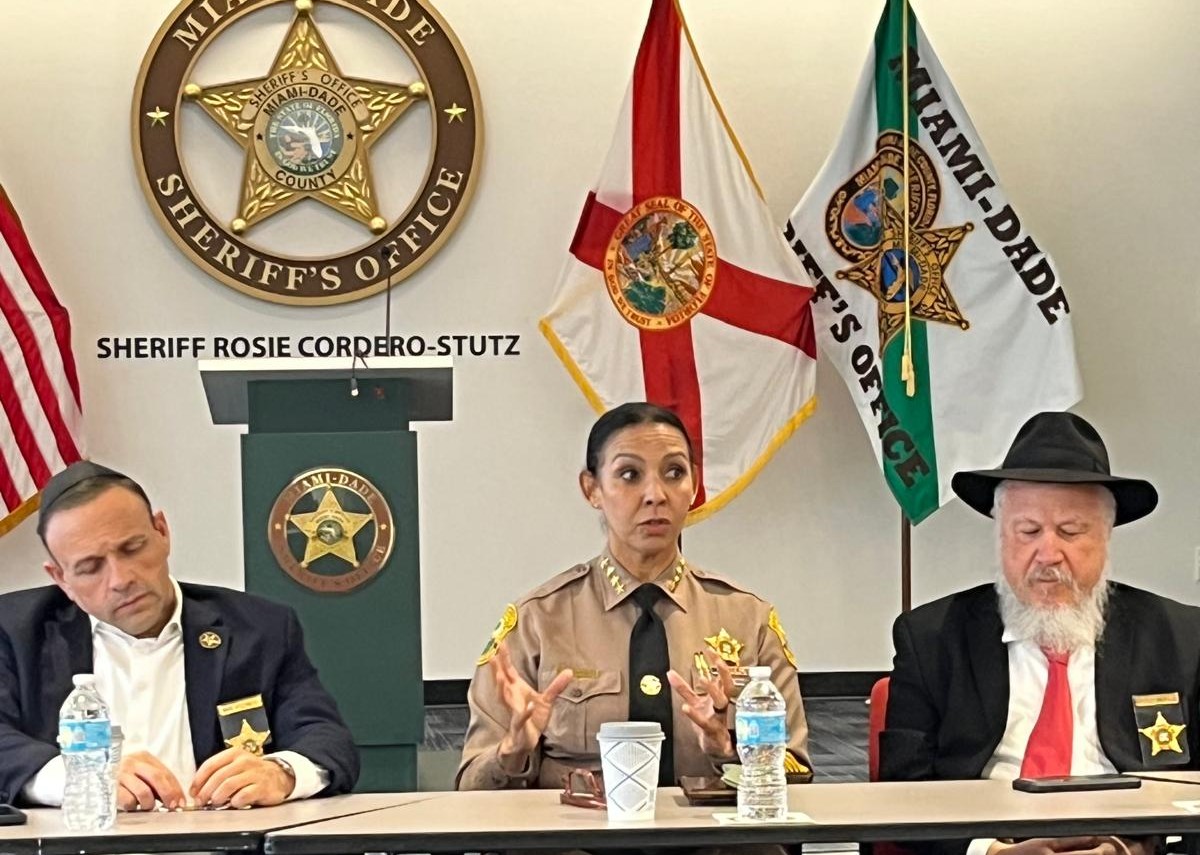
Miami-Dade Sheriff Rosie Cordero-Stutz declared, “We will not tolerate antisemitism or hate in any form.” Her office has increased patrols around houses of worship, conducted hate-crime prevention briefings, and reinforced security during Jewish holidays.
Unusually, rabbis play an active role within Miami-Dade’s law enforcement structure. Rabbi Mark Rosenberg serves as senior adviser to the sheriff and chief chaplain. Together with Rabbi Bentzion Korf, head emissary of Chabad-Lubavitch of Florida, they help bridge religious and cultural differences.
Rosenberg, who testified before the US Senate last year, stressed the importance of legislation in confronting antisemitism before it escalates.
Florida’s House Bill 269, enacted in 2023, introduced offences addressing certain forms of religious intimidation, harassment, and threatening conduct. Separately, painting a swastika on a synagogue wall can constitute a third-degree felony under Florida law, depending on the damage caused.
“If we take legitimate action like this today, then we can stop hate and antisemitism before it spirals out of control like it has so many times in history,” Rosenberg said.
The legislation doesn’t prohibit peaceful criticism of Israel or lawful protest, but seeks to distinguish constitutionally protected expression from criminal intimidation.
This collaborative approach extends to the Miami Beach Police Department, where officers work closely with Jewish communal leaders, synagogues, and schools.
Florida has also incorporated the International Holocaust Remembrance Alliance working definition of antisemitism into state law and adopted legislation restricting certain government contracts with companies boycotting Israel.
Crucially, Jewish institutions aren’t expected to shoulder the enormous financial burden of protecting themselves.
In 2026, the federal government made $300 million (R4.9 billion) available nationally through its Nonprofit Security Grant Program. Eligible institutions could apply for grants of up to $200 000 (R3.3 million) per site for security improvements, including surveillance cameras, reinforced entrances, protective barriers, and security personnel.
Working with the Secure Community Network (SCN) and Community Security Service, Miami’s Jewish community has developed sophisticated intelligence-gathering and threat-monitoring capabilities.
SCN uses real-time intelligence and digital mapping to monitor potential threats to Jewish communities, including internationally. Specialist analysts track extremist rhetoric, online activity and the digital footprints of potential threat actors.