



World
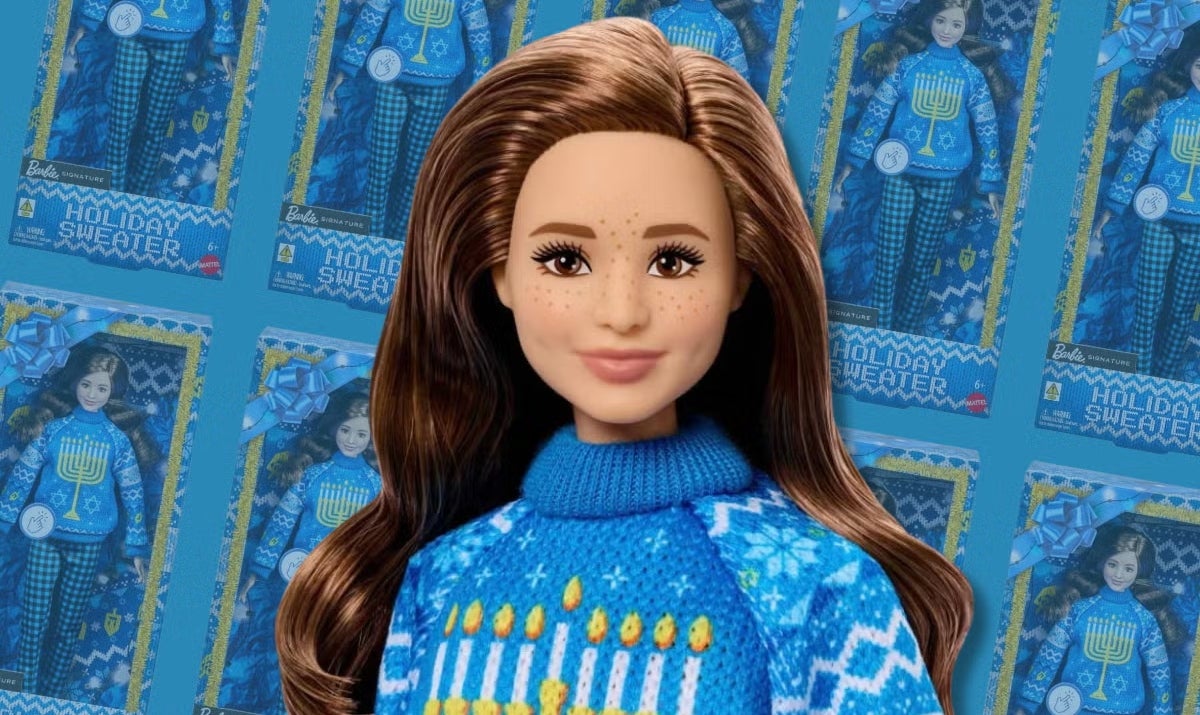
Chanukah Barbie is here – and she actually got the Jewish holiday right

JTA – The miracle of Chanukah came early this year: Chanukah Barbie is here.
Mattel would like us to call her “Holiday Sweater Barbie”. Respectfully, no. This is Chanukah Barbie.
She is dressed in the blue-and-yellow colour palette that retailers have apparently decided belongs exclusively to Chanukah. Her sweater is covered in Jewish stars and dreidels, with a light-up chanukiah built right into the front.
As if the sweater isn’t Chanukah enough, she also dons blue-and-white gingham pants. And then there are the tiny tan shearling boots, because Chanukah Barbie understands comfort.
Naturally, I bought her immediately.
Unboxing her involved approximately 613 tiny plastic ties, but once I finally freed her, I was even more delighted than I expected to be. I have spent an unreasonable amount of my adult life thinking about Chanukah merchandise, and holding an actual Chanukah Barbie feels slightly surreal.
This story also has a wonderfully Jewish twist. Barbie was created by Ruth Handler, the daughter of Jewish immigrants, who co-founded Mattel and introduced Barbie in 1959.
It feels almost bashert (destiny) that a doll created by the daughter of Jewish immigrants, which became woven into American childhood, is finally celebrating a Jewish holiday – more than six decades after her debut!
I’m not sure Handler ever imagined this particular outfit, but I like to think she would have loved it.
And judging by the frenzy around the doll, plenty of people seem to agree.
She has repeatedly sold out at major retailers, sometimes within hours of appearing online. Clearly, I wasn’t the only one determined to bring her home.
I understand the impulse. There are few shopping instincts stronger than a Jewish person unexpectedly encountering genuinely good Chanukah merchandise. You see it. You buy it.
Which is why I was particularly disappointed when some other outlets decided that the big Chanukah Barbie story was apparently her nose.
The articles drew on a handful of Reddit comments questioning whether Mattel had intentionally given its Jewish Barbie a larger nose. Chanukah Barbie had barely arrived, and somehow the conversation had already turned to one of the most tired stereotypes about Jewish appearance.
So, for reasons I absolutely did not anticipate when I ordered this doll, I have now become familiar with Barbie face sculpts.
The Barbie face many of us probably picture is known in collector circles as the Millie sculpt. Another existing Mattel face sculpt, known as Violet, dates to 2018 and has appeared on other Barbies for years. It has pronounced dimples, fuller cheeks, and a somewhat more prominent nose.
To my eye, Chanukah Barbie’s face looks like an iteration of Violet, but it does not appear to be the exact same sculpt. When I put her next to a Barbie with the Violet sculpt, Chanukah Barbie’s face looks more petite. And while Violet dolls are marked “2018” on the backs of their heads, the back of Chanukah Barbie’s keppe reads “2026”.
That doesn’t tell us exactly what changed, or why. Mattel has not identified Canukah Barbie’s face sculpt publicly, as far as I can tell. But based on my own side-by-side comparison, I see similarities to a face already used on other Barbies, not evidence that Chanukah Barbie was designed around a stereotypically Jewish nose.
If we’re going to scrutinise the choices Mattel made with Chanukah Barbie, I’d rather focus on the ones the company actually got right.
The Hebrew letters on the dreidels are accurate. Her chanukiah has the correct number of branches. The sweater lights up. Technically, the illumination reads more like three glowing sections than nine individually blazing candles, but I’m willing to give Barbie a pass for imperfect light-up-sweater technology.
Those details may seem small, but Mattel itself knows how quickly one mistake can become the story. In 2023, packaging for its Barbie honouring the Cherokee Nation’s first woman principal chief famously contained an error in the Cherokee text that turned “Cherokee Nation” into “Chicken Nation”.
This time, Mattel did its homework. And maybe that’s part of why the response from the Jewish community has been so extraordinary. There’s something pretty powerful about finally feeling seen.
I just have one more pressing question for Mattel: When are we getting the Chanukah Dreamhouse?
- This essay originally appeared on the Kveller website.
- The views and opinions expressed in this article are those of the author and do not necessarily reflect the views of the SA Jewish Report, JTA, or its parent company, 70 Faces Media.