Lifestyle/Community
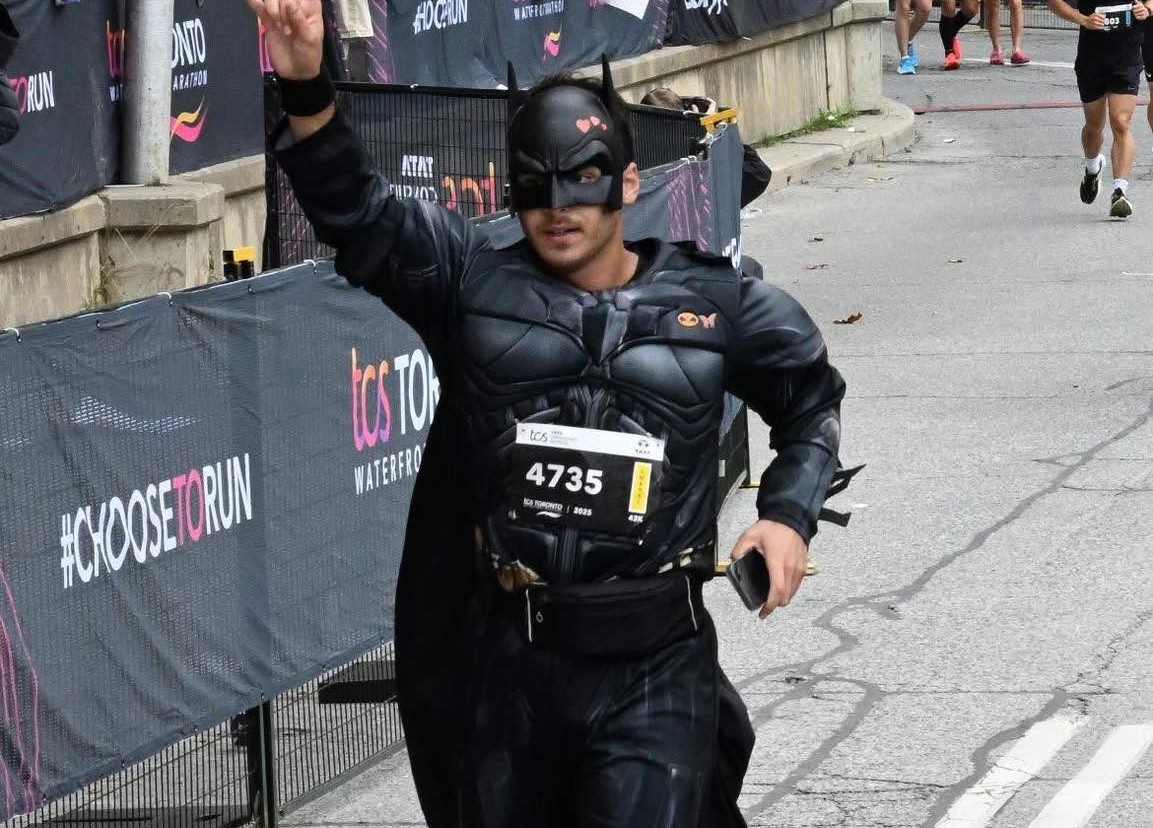
Jewish pride in a Batman suit and running shoes

What was meant to be a straightforward journey to Cape Town for this weekend’s marathon turned into a test of resilience for fitness coach and endurance athlete Yoel Levy.
Levy, who is known to more than 265 000 Instagram followers as @thejewishfitnesscoach, was en route to South Africa when his travel plans went awry. His flight at the beginning of the week was forced to turn back mid-air and was subsequently cancelled, leaving his arrival uncertain just days before the scheduled race on Sunday, 24 May.
“Bit of a crazy travel update,” he posted. “After flying for around 90 minutes, our flight had to turn back and was unfortunately cancelled. Safety always comes first, and I’m very grateful for that.”
Levy immediately shifted into logistics mode, determined not to miss the race or the community commitments surrounding it. He called for help and advice from his followers in South Africa. He told the SA Jewish Report, “Right now, we’re working as hard as possible to sort new flights and make sure I can still get to Cape Town in time for the marathon and the events we had planned throughout the week.”
On the night of Tuesday 19 May, after 60 hours of travel, three days without sleep, and a number of cancelled flights, Levy finally touched down in South Africa.
Since 7 October, Levy has been running marathons around the world specifically to remind people of the massacre and subsequent targeting of Israel and the rest of the Jewish world. He has run in Jerusalem, London, Sydney, Toronto, New York, Panama, Costa Rica, Mexico, Miami, Tel Aviv, Paris, and Boston. The run in Cape Town will be no different.
Levy says the overwhelming feeling is excitement rather than nerves. “I’ve heard South Africa has one of the most passionate and proud Jewish communities in the world. Especially when it comes to community spirit and supporting one another. So many people have already messaged me saying they’ll be coming to support during the race,” he says. “That genuinely means a lot.”
Levy is also eager to experience Cape Town for the first time. “I’ve heard Cape Town is one of the most beautiful marathon routes anywhere in the world,” he says. “I’m really looking forward to experiencing that atmosphere and hopefully meeting as many people as possible while I’m there.”
He generally runs marathons dressed as Batman, not to stand out for the sake of attention, but as a poignant reminder.
“After 7 October, like many Jewish people around the world, I was struggling with what I could actually do to help,” Levy says. “I’m not a politician. I’m not a journalist. I’m a fitness coach and content creator.”
Running, however, gave him something powerful: visibility. “The marathons gave me a way to create conversations,” he says. “People everywhere stop and ask the same question, ‘Why is Batman running?’ And that question opens the door to a story that should never be forgotten.”
Batman was the favourite superhero of four-year-old Ariel Bibas, who along with his baby brother and mother were kidnapped on 7 October and later killed in Gaza. The redheads became emblematic of the hostages held in Gaza for more than a year.
Levy wanted to honour the family in a way that would resonate with people across cultures and backgrounds.
“It started because Batman was one of the Bibas boys’ favourite superheroes,” he says. “But very quickly, I realised it became something much bigger. It became a way to use something positive through fitness and movement to help keep their memory alive.”
Running a full marathon in a Batman suit is physically demanding, hot, and exhausting, but Levy says the discomfort serves as a reminder of why he’s doing it.
“Growing up, Batman was just a superhero, like for so many kids around the world,” he says. “Now the character means something completely different to me. Wearing the suit for 42km is not easy at all. But in many ways, that discomfort reminds me this run has a bigger purpose than me.”
Fitness has played a major role in Levy’s life journey. Long before he built a social media following as “The Jewish Fitness Coach”, training was a source of confidence and stability during difficult years growing up. “Fitness honestly changed my life,” he says. “I struggled a lot with confidence growing up, and I was also dyslexic at school, which made things difficult at times.”
Even speaking on camera once felt intimidating. “Creating content didn’t come naturally to me at all,” he says. “For years, I posted three to five times a day, slowly improving my confidence, my speech, and my ability to communicate.”
Levy says he didn’t deliberately set out to become an influencer. “I genuinely just loved helping people and sharing my journey,” he says. “Over time people connected with it.”
His message, he says, has always been rooted in helping people become healthier without toxic pressure or unrealistic expectations. But over the years, the message evolved into something larger than fitness alone.
Now, his marathon runs are moments of connection with people all over the world. “The biggest surprise has honestly been how universal human connection really is,” Levy says. “You don’t need to speak the same language to connect through emotion, sport, or kindness.”
While travelling through Central America, he admits, he initially worried people wouldn’t understand the message because of the language barrier. “I was nervous because I don’t speak Spanish. I worried people wouldn’t connect with what I was doing. But the support was incredible. People wanted to learn. They asked questions. They wanted to understand.”
Some of the reactions during races have stayed with him long after crossing the finish line. “I’ve had non-Jewish people travel hours just to support during races. I’ve had strangers cheering, crying, and hugging me afterwards, sometimes without even knowing the full story at first.”
For Levy, those moments have reinforced how important visible Jewish pride can be.
“So many people quietly come up to me and say, ‘Thank you for representing us’,” he says. “I never take that lightly.” More than anything, he hopes people see his runs as a positive example. “I hope people see someone using fitness and positivity to unite people instead of divide them,” he says. “Even if someone never learns the full story of the Bibas family, maybe they still walk away wanting to ask questions, learn something new, support others, or simply become a little more compassionate.”
He is especially conscious of the message younger Jewish people may take from his visibility online and at races around the world. “I hope younger Jewish people see that they don’t need to hide who they are,” Levy says. “You can be proud and strong all at once.”