Lifestyle/Community
One man’s quiet archive of Israel news

A handcrafted collection of newspaper clippings offers a rare window into how Israel’s story was told, and why preserving it still matters.
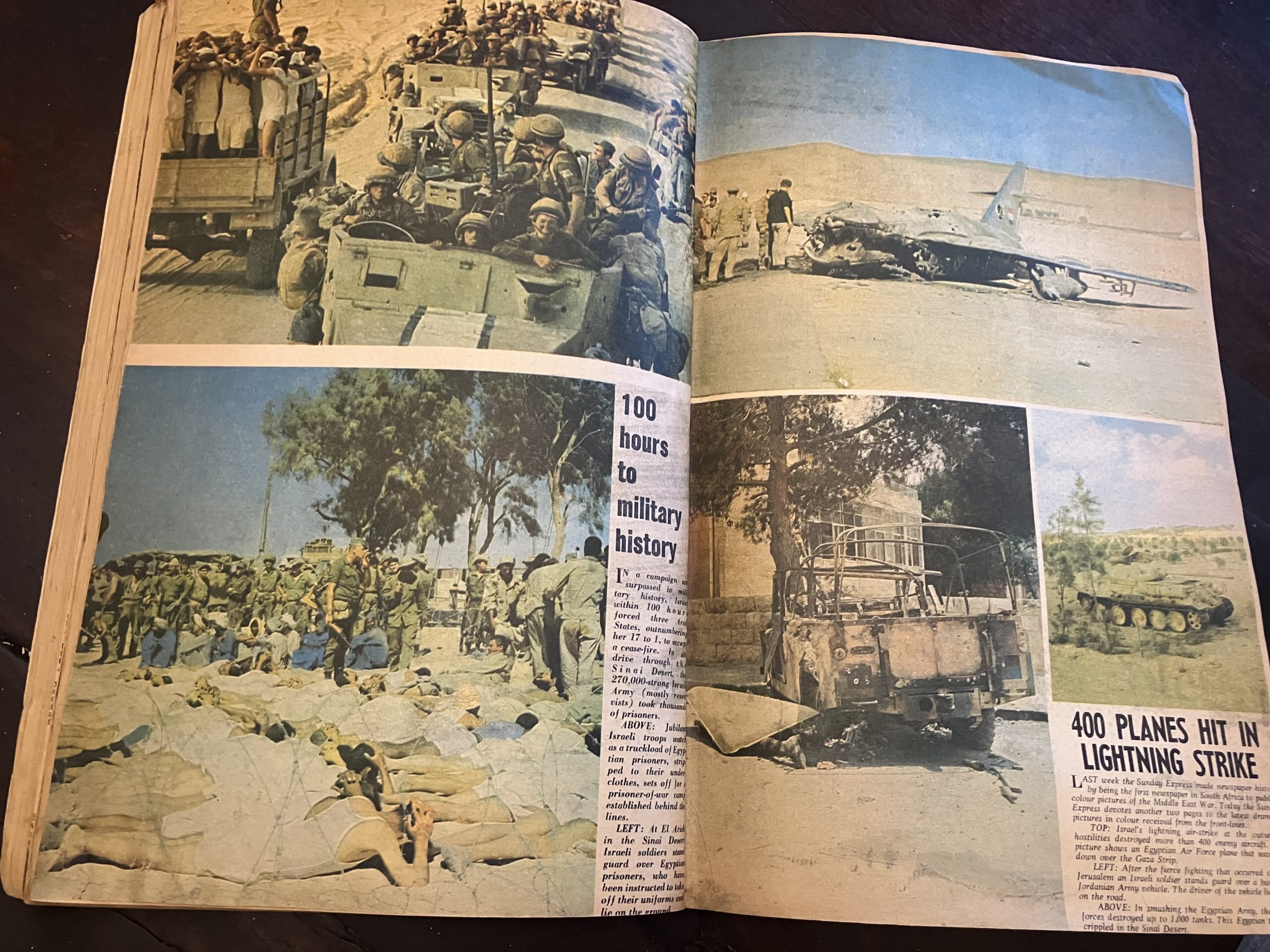
The book cover carries the headline “Israel and Arabs plunge into raging battle”, datelined Durban, 5 June 1967. The page is yellowed, the ink faded in parts, but the urgency remains intact. It’s not history retold, but history as it broke, captured in real time and carefully preserved by Robin Hugh Carter.
The handmade volume, centred on coverage of the outbreak of the Six-Day War, is a work of patience and conviction. Each clipping was deliberately selected, cut, and placed by hand. Each page captures not only what happened, but how it was reported and understood at the time.
Following Carter’s passing in July 2024, the collection was recently donated for public use to the South African Jewish Board of Deputies (SAJBD) archives, ensuring that what he quietly built over time will continue to inform and educate.
Carter was born in Oudtshoorn in 1943, his father ground staff for a Royal Air Force training base during World War II and his mother a nurse. When he was about a year old, the family moved to the United Kingdom, returning to South Africa roughly a decade later. Carter grew up near Durban and carried vivid memories of post-war Britain, including playing among bombed-out buildings in London, impressions that stayed with him throughout his life. After beginning a career in banking in Durban, he later moved to Johannesburg in 1976.
Though he had no direct geographical or religious connection to Israel, friendships with Jews deepened his lifelong engagement with Israel and the Middle East. What began as curiosity evolved into a commitment to documenting how the region’s story was carried in the press.
The result is a treasure, both simple and profound.
Inside the book, the past speaks in fragments: a monochrome map of a region in crisis, captions tracking troop movements, headlines cutting through the noise. One declares, “We’re winning, say both sides”, a stark glimpse into competing narratives unfolding in real time.
There’s no commentary from Carter, no footnotes, no interpretation. He allows the reporting to stand as it was ‒ urgent, contradictory, sometimes incomplete. In doing so, he preserves not only events, but perspective. That restraint gives the collection its power.
In an age of instant updates, shifting narratives, and real-time distortions, where facts blur into opinion and trends move faster than verification, Carter’s archive reflects a different rhythm. News fixed in print, carrying the assumptions and limitations of its moment. These clippings are snapshots of understanding before the acceleration of the digital age, when information moved more slowly and remained, in a sense, finite.
Across the pages, a broader picture emerges not only of conflict, but of how it was understood far from its centre, in places like South Africa. The Durban dateline is a subtle but important detail, pointing to a global conversation in which Israel’s story has always been interpreted through different lenses.
For Carter, preserving those lenses mattered.
His son, Gareth Carter, who facilitated the donation, describes the collection as part of his father’s enduring legacy, a reflection of intellectual curiosity and careful attention. It’s a gift not only of content, but of continuity: a reminder that history is shaped not just by what happens, but by what is kept.
To cut out a newspaper article is to pause and decide that a moment is worth saving. To paste it into a book gives it permanence ‒ an act that becomes a quiet resistance to forgetting.
Turning the pages now, long after the ink has dried, that intention is undeniable.
“Israeli jets bomb Cairo”.
“World leaders called together”.
“Pilot speaks”.
Each line carries the immediacy of its moment, even though time has filled in the gaps.
Placing Carter’s collection within the SAJBD archives ensures it will become a shared resource for researchers, students, and anyone seeking to better understand not only what happened, but how it was told.
In a time when narratives around Israel are contested and continually reframed, such primary material carries added significance. It offers an unfiltered glimpse into the past, inviting readers to engage critically and reflect.
Beyond its historical value, the collection also reveals another story: one about the individual behind it. Carter wasn’t a historian or journalist, but a careful observer and collector by nature. Family and friends remembered him as an honest family man – principled, diligent, and quietly generous. His archive is modest, but meticulous and deliberate in spirit. That spirit now endures in the pages left behind.
A man shaped by the aftermath of World War II documented another region’s unfolding story not through grand narratives, but through the everyday language of newspapers. He captured history as it happened.
The book remains. Not as a statement, but as a record of what one person chose not to let disappear.