





Featured Item
Madiba’s cousin visits Israel, defying SA hostility

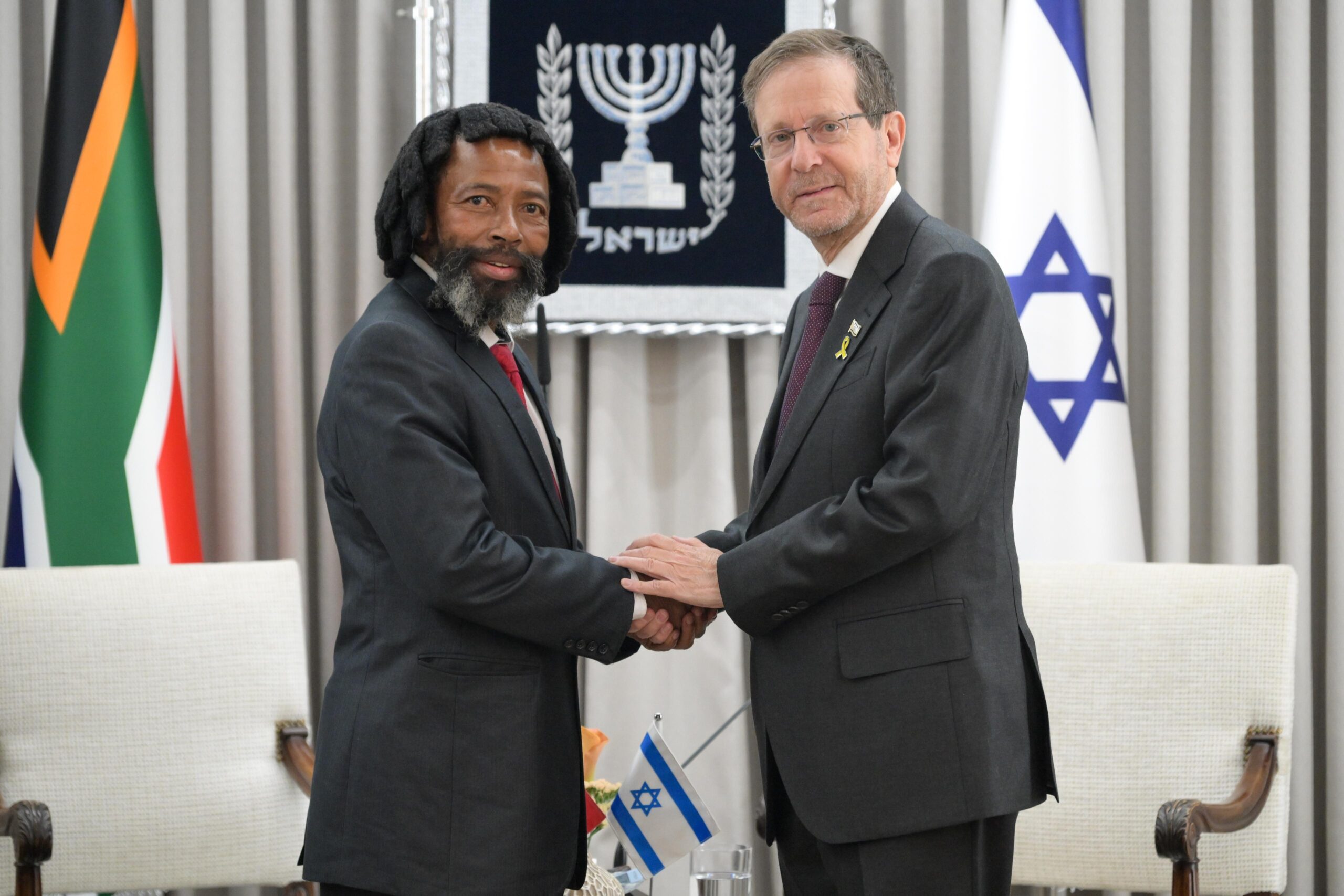
Nelson Mandela’s cousin, King Buyelekhaya Zwelibanzi Dalindyebo, visited Israel for the first time this week, in stark contrast to the ANC’s hostile stance towards the Jewish state.
The trip comes just weeks after Mandela’s granddaughters, Zaziwe Dlamini-Manaway and Zamaswazi Dlamini-Mandela, visited Israel and said they were “shocked to the core” by the way “people were killed simply for being Jewish” on 7 October 2023, emphasising that there is suffering on both sides of the conflict.
Dalindyebo is the king of the AbaThembu Kingdom in the Eastern Cape. He was invited to Israel by its Ministry of Foreign Affairs (MFA). Israeli and South African flags stood side by side as the king’s delegation was warmly welcomed in Jerusalem on 1 December by Israel Foreign Affairs Minister Gideon Sa’ar. They met Israel President Isaac Herzog the next day.
In the past month, four separate South African delegations have visited Israel, showing that South Africans are eager to engage with the Jewish state despite the prevailing anti-Israel ANC narrative.
Mandela is a direct descendant of the AbaThembu royal lineage, and his moniker, “Madiba”, comes from this clan’s nickname. It was Dalindyebo’s great-grandfather who raised Mandela from the age of nine after Mandela’s father passed away.
In going to Israel, Dalindyebo continued his late cousin’s commitment to engagement, understanding, and bringing people together. Meanwhile, South Africa’s political leaders have diverted from this legacy, refusing to engage with Israel or play a role in the peace process.
In Jerusalem, Ambassador David Saranga from the MFA, who recently spent several months in South Africa, delivered an official address. Saranga said that when he met the king in the Eastern Cape, “you and your advisers asked many thoughtful questions. I told you, ‘Come see what the media in South Africa doesn’t show.’ Immediately, you said you would visit. And three months later, here we are in Jerusalem.”
Saranga urged the king and his delegation to “ask every question, challenge every speaker, and seek every clarification” during their time in Israel. “What matters is that you receive the broadest and most authentic picture possible.”
Dalindyebo’s delegation included the chief of the Twelve Apostles Church in Christ; several AbaThembu chiefs; and royal family members. They will meet hostage survivors and visit sites attacked by Hamas on 7 October.
They will also learn about Israeli technology and water management, desperately needed in the Eastern Cape’s rural communities. Saranga says that this an important focus of the visit, and that Israel is happy to share its expertise, assisting communities directly.
For example, when Saranga visited the Eastern Cape in August, communities were devastated by floods which had claimed 100 lives. Together with representatives of the Embassy of Israel in South Africa, he pledged funds to assist a soup kitchen and feeding stations. The humanitarian aid was provided by Israel’s MFA through Israel’s Agency for International Development Cooperation.
At the time, Saranga said, “I came here as a symbol of the longstanding friendship between the royal families of the Eastern Cape and the people of Israel, with a commitment to find ways we can work together for the well-being of our communities.”
Now, he says, “What’s important is that we build relationships between the peoples of Israel and South Africa. Even if the ANC is hostile to Israel, this shouldn’t affect the relationship between people. Traditional leaders represent the people, so engaging with them allows us to strengthen the connection.”
A source in the MFA told the SA Jewish Report that “next year, we will have many more South African traditional leaders coming to Israel”.
Recent delegations to Israel included a group of 10 South African academics, who chose to visit the Jewish state with the South African Friends of Israel (SAFI) despite many institutions being virulently anti-Israel.
The delegation included professors; heads of department; researchers; and lecturers from the University of Cape Town (UCT), University of Johannesburg, University of Pretoria, Stellenbosch University, University of the Free State (UFS), and University of South Africa (Unisa).
SAFI spokesperson Bafana Modise said the trip formed part of SAFI’s “ongoing effort to promote academic diplomacy. The ceasefire has opened a window to rebuild academic bridges and renew channels of cooperation between South Africa and Israel.”
South Africa’s academic environment has “become consumed by polarising elements”, said Modise, but this trip shows “how universities can be the vehicles for dialogue, knowledge exchange, and constructive engagement”.
The group met academics from Israeli universities, research centres, and innovation hubs across Jerusalem, Tel Aviv, and the Negev. They explored opportunities for joint research, student exchanges, and long-term institutional partnerships.
“Several heads of department confirmed their interest in pursuing formal cooperation agreements with Israeli institutions,” says Modise. Delegates also engaged with peace building initiatives and cross-border dialogue.
The visit comes in the wake of the ongoing legal dispute surrounding UCT’s anti-Israel resolutions.
A UCT staff member speaking anonymously because of the anti-Israel sentiment at UCT, said he saw the trip as “an opportunity to learn from Israeli institutions and understand the culture of the country”. For him, the most surprising aspects were “the peace, the food, the culture, and how advanced the country is”.
Given the “geopolitical differences” at UCT, he is hesitant to speak about his experiences with colleagues, but some that he has spoken to are “also keen to embark on the journey to Israel. I am happy to share with those that show interest in open conversations and meaningful engagements, but with those that are resentful, I will not waste my time,” he says.
To fellow South Africans, he says, “Go see it for yourself, and ask as many questions as you want while you’re there. That’s the whole point – to learn and understand.”
Limukani Mathe is a research associate at Unisa, which has a hostile attitude to the Jewish state. Despite this, he decided to visit Israel. “I never thought Israel was so peaceful,” he says. “I was really impressed by how people co-exist.”
Going to Israel “gives a balanced perspective – not biased, but balanced”, he says. “Seeing the sites of the [7 October] attacks showed why Israel had to defend itself.”
Dr Shelton T Mota Makore is a senior lecturer at UFS, which has a positive relationship with Israel. “I wanted firsthand information about Israel,” he says. “Most of the information I had was hearsay or from social media. The most surprising aspect was the fact that Israel is a multicultural society, including 20% who aren’t Jewish.”
He has found that most of his colleagues “don’t know much about what is occurring in Israel and how its society is constituted. I urge people to go to Israel and find out these things for themselves.”
All three are Christian, and found the trip spiritually meaningful.
“As the world moves on from the hyper-politicisation of the Israeli-Palestinian conflict, so too must South African institutions,” says Modise. “The academic sector should prioritise integrity, knowledge exchange, and academic freedom above political posturing.”





Portia
December 4, 2025 at 5:13 pm
I am very proud of the Thembu King may God be with him and his Tribe after the June floods and Thank you for your help.
Sipho Sithole
December 4, 2025 at 8:56 pm
The visit to Israel by AbaThembu king sends a very interesting message. The most important message is that South Africa is a truly democratic country. Second, is that the people of this country are either split in the middle by what is happening between Israel and South Africa.
I strongly believe that our foreign policy priorities must be clear and should include the wellbeing and stability of our country. As it is inevitable that we are part of the geopolitics we have to remain neutral in words and deeds.
Alfreda Frantzen
December 4, 2025 at 10:14 pm
So good that South African delegations are realising the real truth about a wonderful, historical and brave people.
Jessica van styns
December 7, 2025 at 6:55 am
Once all journalism outlets and non government regulated media is allowed to operate in the country again there will be transparency. Until then its a planned sham. Usual lobby tour for support/ word of mouth. 97% of adults are militants. Seeing the masses go about shouldn’t be a suprise. Israelis have spoken out and so have Palestinians.