OpEds
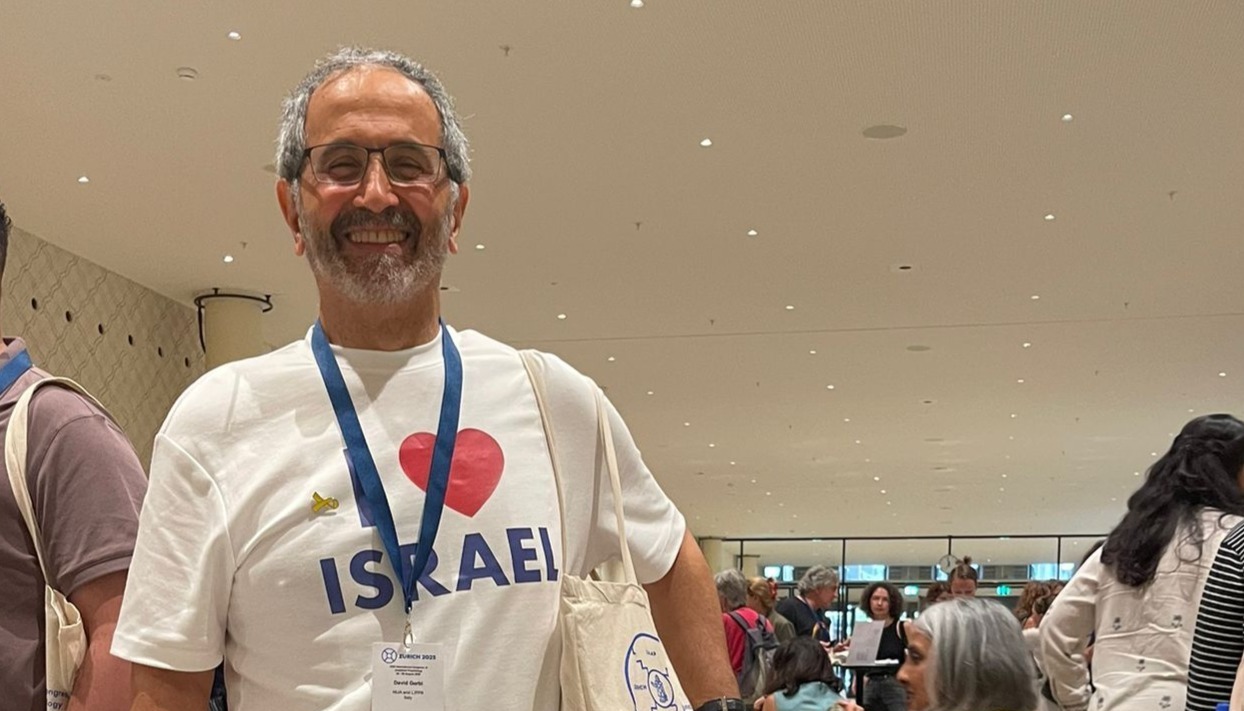
Psychoanalyst refuses to be silenced on Israel trauma

From 24 to 29 August, more than 2 000 Jungian psychoanalysts from all over the world gathered in Zurich for the international congress of the IAAP (International Association of Analytical Psychology).
It was supposed to be a meeting of dialogue and research, but for many, it became a showcase of silence and censorship.
As a psychoanalyst and representative of LIRPA (Laboratorio Italiano Ricerche di Psicologia Analitica), I arrived with an official gift: 200 copies of LIRPA International, containing one of my articles translated into 10 languages on the theme “Trauma and healing, individual and collective, of the Jewish people”. The copies were destined for the presidents of Jungian associations, carefully arranged and ready for distribution after my short presentation.
I spoke for eight minutes, wearing a t-shirt with the words, “I Love Israel”, and on the back, “Peace, Shalom, Salaam”, a tallit katan, and the Star of David. A few minutes later, the hall emptied. The delivery of the journals, already agreed with the organisers, was postponed several times with different excuses. When everything finally seemed ready, the new IAAP president gave the order to withdraw the material, pile it in a corner, and make it disappear.
No explanation, no thanks. When I proposed to distribute the journals freely to all participants, another refusal came. In effect, I was censored. While the journals disappeared, a flyer titled, “A call to communitas” appeared at the congress reception. It was an appeal to unity, but only in appearance. It mentioned “genocide in Gaza” twice, and invited participants to send messages of solidarity exclusively to Palestinian colleagues, ignoring the Israeli ones, many of whom were present at the congress with significant contributions. A gathering of activist psychoanalysts influenced the congress and reinforced the climate, circulating the word “genocide” with increasing frequency. Contacted by Il Riformista, I said, “Many colleagues pressured me to declare that Israel is committing genocide. It’s moral blackmail that doesn’t open dialogue, but deepens wounds.”
It wasn’t an isolated episode. In June 2024, in Rome, an international conference on trauma and healing, organised by myself with Israeli and Jewish analysts, and scheduled after six months of preparation, was cancelled at the last moment due to internal pressure within AIPA (Associazione Italiana Psicologia Analitica). The speakers, already prepared to travel, were left shocked.
In Zurich, however, I decided to react. With the help of a graphic designer, I had 120 posters and four large placards printed, posted at strategic points at the congress. The aim was to remind participants of the images of the 7 October 2023 hostages; the women raped; the murdered children; and the massacred Israeli civilians. A gesture that deepened my isolation.
“No, Israel is not committing genocide,” I reiterated. “The Jewish state is trying to free the hostages kidnapped by Hamas. Once they are freed, everything will end.” Many colleagues stopped greeting me, and long-established relationships suddenly cooled. Yet there were also signs of support: a representative of CIPA (Centro Italiano di Psicologia Analitica) in Milan observed that it would have been appropriate to observe a minute of silence for all victims.
The most intense moment came on the final day, during the panel dedicated to “Unity and collegiality in a divided world”. In front of eight former IAAP presidents, I took the floor, saying, “During the congress, I felt incomplete inclusivity. To be accepted, I was asked to condemn Israel. But love for Israel cannot be put on trial.” At that point, I proposed that the next congress have as its theme “Unity in diversity and the union of opposites”. The moderator thanked me for my courage, and accepted the proposal, while the other presidents remained silent.
Despite the official coldness, from the audience came hugs, handshakes, and sincere words. “What you did required real courage, and I want you to know that there are people who see it and are on your side,” a young English analyst told me. Colleagues from Germany, Switzerland, Argentina, Peru, Japan, Israel, and the United States expressed solidarity. An Israeli colleague was moved and commented, “He spoke with his heart, and when one speaks with the heart, the hearts of others are opened.”
The pro-Palestinian campaign grew increasingly insistent: by now, the thesis of genocide had corrupted the soul of the West. But one must not give up. That’s why I concluded by quoting Rabbi Tarfon, “You are not obliged to complete the work, but neither are you free to desist from it.”
- David Gerbi is a Libyan Jewish Jungian psychologist who tried to persuade late Libyan leader Muammar Gaddafi to let Jews into Libya.