


Holocaust
Restitution of Nazi-looted art a blurred picture

For decades after World War II, Europe tried to move on. Collaboration was minimised, silence became habitual, and questions about stolen Jewish property were postponed or ignored.
Yet thousands of artworks taken during the Nazi occupation hadn’t vanished. They passed quietly through borders, markets, and museums, carrying histories that few were willing to confront. In Looted: Nazi Art Plundered from Jewish Families in France, historian Peter Elliott returns to those unresolved legacies and asks what justice looks like when time itself becomes an obstacle.
Elliott’s book, recently discussed in a webinar hosted by the Cape Town Holocaust & Genocide Centre and the Jacob Gitlin Library, examines the wartime and postwar fate of four French Jewish families whose art collections were confiscated under Nazi and Vichy rule. “I decided to tell the story from the point of view of the art collectors,” Elliott said. “That was the missing perspective in the story of looted art.”
The families he focuses on weren’t marginal figures. Many originated in Alsace-Lorraine and moved to France after 1870, where they became prominent industrialists, financiers, and entrepreneurs. Their businesses made a significant contribution to French economic and cultural life, and their art collections reflected a deep engagement with French modernism. “As well as being a story of looted art, it’s a story of four families who made a significant contribution to France,” Elliott said.
By the time Germany occupied France in 1940, antisemitism had already been sharpened by economic crisis and political instability. Jewish business owners were dismissed from their own companies, properties were seized, and art looting became embedded in law. “Art looting was a fundamental part of Nazi dehumanisation,” Elliott told his audience.
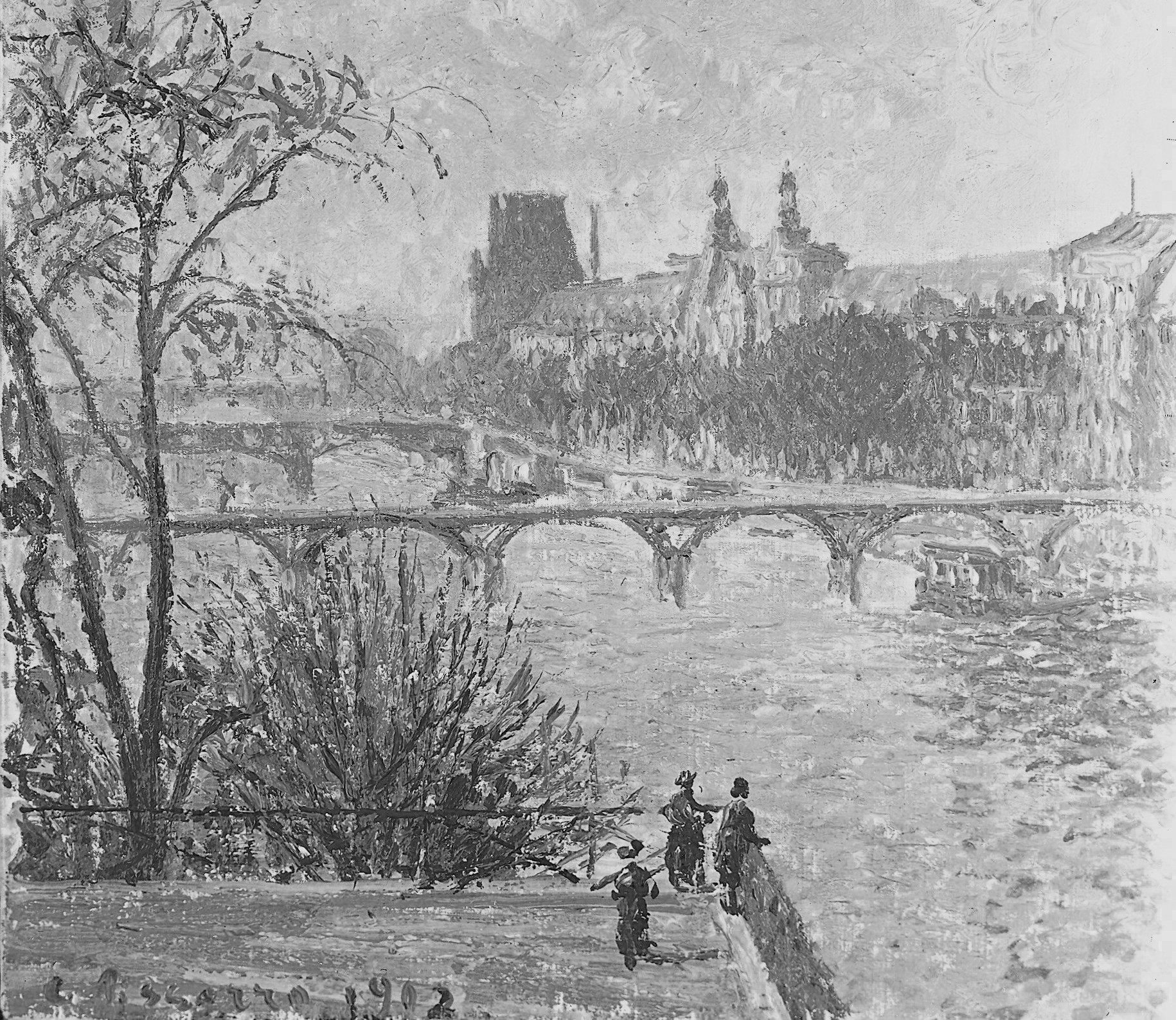
Confiscated artworks were funnelled through the Jeu de Paume museum in Paris, which became the central depot for looted art. There, the Einsatzstab Reichsleiter Rosenberg, or ERR, oversaw a meticulous bureaucratic process. “Each painting was photographed, catalogued, and entered into a card index,” Elliott said. “This was bureaucratic looting.”
Central to the book is the family behind the Paris department store Galeries Lafayette, founded by Théophile Bader and later run by his sons-in-law, Max Heilbronn and Raoul Meyer. Their story anchors the book because their collection was looted in what Elliott describes as “absolutely copybook German ERR fashion”.
From the Galeries Lafayette family alone, 26 paintings were taken. Each was assigned an inventory number, measured, and photographed. Ironically, this administrative precision later worked against restitution. Where measurements were incorrect or photographs missing, claims failed. “It’s very difficult to identify a painting if you don’t have a photograph,” Elliott said, “and particularly if you don’t have dimensions.”
Elliott’s research draws extensively on the archives created by the looters themselves, including German photographic records and French diplomatic files. Though the evidence has long existed, he noted that access has changed dramatically since the mid-1990s. “The internet and access to digital data have enormously improved our ability to know about looted art and indeed to find it,” he said.
One key resource is a centralised database known as the ERR Project, which consolidates looting records by collector. “The starting point for me in each case was to go through that database with a fine-tooth comb,” Elliott said, and then to build each family’s story by cross referencing fragments of information scattered across archives.
Despite these advances, recovery has been inconsistent and often deeply frustrating. Many paintings resurfaced decades later in private collections or museums, having passed through multiple owners. Legal outcomes frequently turned on technicalities. “The law courts are just about the worst venue to try to resolve issues like this,” Elliott said.
In several cases examined in the book, families with clear evidence of wartime theft lost claims because collectors asserted good-faith purchase or because too much time had passed. Elliott is careful not to flatten these cases into simple moral binaries. “You can’t just make a general sweeping rule,” he said. “You’ve got, on the one hand, a painting that was clearly looted, and on the other, someone who held it for decades believing they bought it in good faith.”
Rather than offering easy solutions, Elliott argues for transparency and historical acknowledgement. In cases where ownership cannot be resolved, he believes museums should make the history visible. “Wherever it is held, it must be labelled with the history in relation to the looting,” he said. “I want to see the history commemorated.”
The book also traces how memory and responsibility passed to the next generation. In several cases, it was children or adopted descendants who pursued claims long after survivors had died. One such claimant described her efforts as “a duty to remember”, a phrase Elliott quotes to underline how restitution is often about memory rather than material recovery.
After three years immersed in the subject, Elliott says the project has reshaped his relationship with art. “I’ve turned into a huge enthusiast of French modernist art,” he said. “You get to know these collections so well that your focus changes.”
Looted isn’t simply an account of stolen masterpieces. It’s a study of belonging, dispossession, and the long afterlife of persecution. By restoring individual families to the centre of the story, Elliott challenges readers to consider what remains unresolved when history is allowed to fade into silence.