





Personal Story
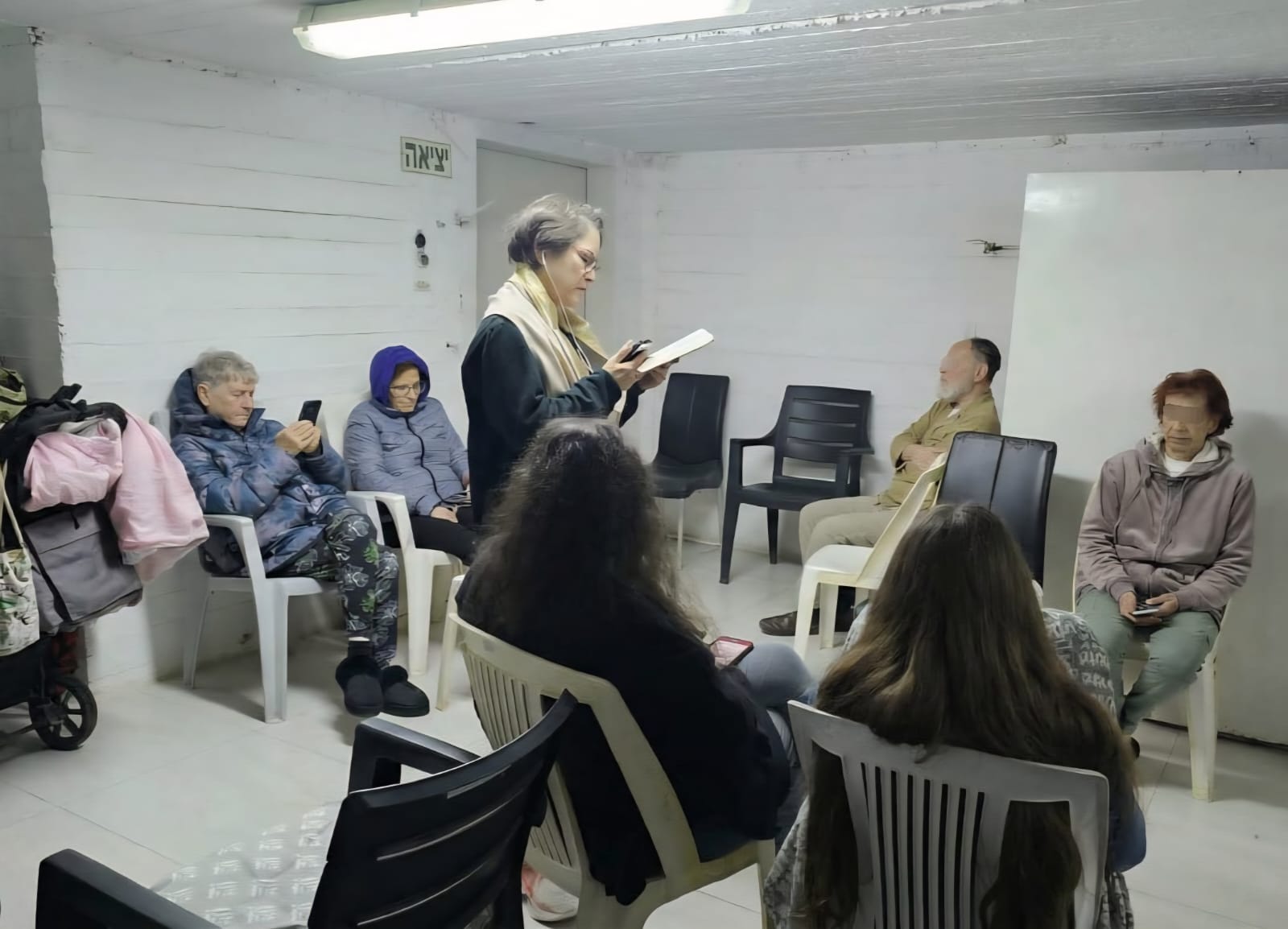
Saying kaddish in the bomb shelter

I had big plans for my father’s first yahrzeit on Taanit Esther, the fast of Esther, right before Purim. Recite the mourner’s kaddish at the 06:00 minyan at the Orthodox shul on Yael Street three minutes from my apartment in southern Jerusalem, where I’d been warmly embraced as a kaddish reciter. Plunk 18 (“chai”) coins in the plastic pushka, the tzedakah box, counting out each one for my beloveds who could use an extra blessing. Compile a list of my father’s favourite jokes to recite at the gravesite. Like this one, an original: “A synagogue without a rabbi is like a car without a flat tyre.”
My mother, sister, brothers, three spouses, and the grandchildren who could make it were slated to gather around the grave in a sought-after section of Har Hamenuchot, Hebrew for “Hill of Eternal Rest”, at 11:00 and remember Sam Ebenstein, the only child of Adolph, an immigrant who fled Vienna the night before the Nazis came to get him, and Ruth, a teacher of English and maths from Duluth, Minnesota, who wed late in life. Aba was happily married to my mother for nearly 60 years. Father of four and grandfather of 11. Maths professor, engineer, alumnus of Ford Motor Company and the US military, holder of 19 patents.
The plan was to be together in the brokenness of our hearts. We’d probably extol Saba Geza’s prescience 30 years ago, purchasing burial plots for my parents near the plum location he’d secured for himself and for Savta Lili. Prime cemetery real estate. When my grandfather sheepishly handed my mom the deed from the Chevrah Kadisha, Jerusalem Burial Society, as a birthday present, he feared she’d find it morbid. Instead, she congratulated his savvy. Our time at the cemetery was likely to blend sorrow, tears, and jokes. Aba had told the same jokes so many times we all knew them by heart.
I’d braced myself for that kick in the gut when your eyes zero in on your loved one’s name engraved in stone. The realness of death, its finality. I also prepared to be emotionally dishevelled. The inevitable pang of remorse, a legacy of a complicated relationship with a parent. Carrying grief threaded with regret.
Instead, I found myself reciting-shouting Yitgadal v’yitkadash sh’mei raba into the cracked screen of my iPhone 15 in our building’s bomb shelter, joining the Cloud of Your Glory egalitarian online minyan established during the COVID-19 pandemic. Wrapped in my beige wool tallit, trimmed with gold and evergreen, atop my fleece, I tried to find the sweet spot where the Zoom connection wouldn’t cut out amid a near unbroken stream of sirens warning of incoming missiles headed in our direction. Unserendipitously, my phone’s Wi-Fi signal was strongest when I faced the bathroom.
I wanted to tell the app, “I’m already safe. I’m right here, standing in the middle of our building’s tiled bomb shelter.” But you can’t talk to the app. It’s a one-way communication system. It talks to you. Or rather, roars at you. So I endeavoured to turn the shelter into a sacred space.
When we got the all-clear – strangely phrased in the vernacular of the Home Front Command app as “The event has ended” – we trekked up the 50 stairs to our top-floor apartment, passing Yitzhak, our 90-ish neighbour in his wheelchair, clad in flannel pyjamas and draped with a blanket. He was sheltering in the stairwell next to his wife, Marcel. Her back was stooped with age, and concern splayed across her face.
I felt her pain. Adrenaline still coursed through my body. I too would worry if I couldn’t trudge safely down to the bomb shelter. That was day three of Iran 2.0. We’re now at the end of the fourth week.
Since the 12-day war with Iran in June last year and through much of this springtime war, my relationship to our building’s bomb shelter has evolved from strange to familiar. And it’s strange that it’s grown familiar. How familiar. Soon it won’t be strange at all.
When we bought our apartment nearly 20 years ago, I noticed the sign “miklat” (shelter) near the driveway. I thought it was kind of quaint, a relic from the 1970s. “Good, I’ll have a place to go to the bathroom.” I was very pregnant with my second son, and we popped over periodically to check on the renovations. I always had to go to the bathroom. Could I bother neighbours I didn’t yet know? I don’t remember if the bomb shelter’s bathroom was broken, gross, or locked. I think it was probably all three. So I bothered neighbours I didn’t yet know.
As Saba Geza liked to say, a lot of water has flown through the Mississippi since then. More than 18 years. I gave birth to my second son, and then my third. And in that time, we’ve had many wars. But they didn’t call for using the bomb shelter.
After 7 October, it suddenly felt urgent to make the decrepit bomb shelter usable. Even liveable. Industrious American gap-year students graciously volunteered to clean years of accumulated dirt, and the apartment building committee secured emergency lighting, plastic chairs, and a jerry can of water. All the tenants chipped in to repair the bathroom. But we never went down there. As in previous wars, we sheltered unceremoniously in the stairwell, which was deemed a safe-enough go-to location. A neighbour later initiated tiling the unfinished reinforced concrete floor. When we spent many a siren in the bomb shelter last year during the 12-day war with Iran, we thanked her for her foresight.
As in June, the bomb shelter is now our go-to place, our non-routine routine. A siren can sound at any hour, almost always with a pre-siren warning to signal “get ready, it’s coming”. The polyphone of anxiety can catch you naked in the shower, going to the bathroom, behind the wheel on the highway, or crashed out under the covers. That seismic jolt, a different pitch, spurs manic energy. That energy thrums through me as I corral my kids and husband to hurry to the shelter. Every one of us is habitually clad in a different colour wearable blanket.
If bomb shelters have personalities, ours is functional. Neighbourly. Familiar. It’s populated by the regulars, our neighbours from the two entrances in our apartment complex and from across the street. It’s stocked with two dusty six packs of bottled water, a space heater, and not enough rolls of toilet paper. Lots of plastic chairs and Marcel’s weathered dining set chairs under the glow of fluorescent neon lights. We all plop down in our regular seats. The immediate intimacy, woven with collective hurry-rush-we-made-it-relief, creates an instant sense of community. Even with the walk-ins and occasional dogs. Lives are joined together. Although many faces are slackened with fatigue, few of us are tetchy. We are fortunate to be safe, and we know it. So we pass the time with yakkety-yak. My sons slunk in a corner, play computer games that don’t require reception. With others, I trade friendly nods. Our eyes are trained on Tehran and Tel Aviv. Outside our shelter, the world brims with chaos. The spectre of death feels far. Then close. Boom. BOOM. BOOMBOOMBOOM. BOOOOOOOOM. Now far too close.
What makes our shelter special is the array of laughing, friendly, joyous toddlers. Their presence makes me forget the planes and missiles overhead, an escape from the wartime bluster. In one spacious corner Ezra and Annael, 18-month-old twins, play on a patterned turquoise mat around their parked twin stroller. Ezra trails around, clutching red trucks and a green plastic cellphone. He trades smiles with Shlomtzion, a spunky, brown-haired pixie 13-month-old. She takes his phone, cradles it to her cheek, and mimics a perfect French alo. Ezra starts to dance like it’s his breakout performance. Annael snuggles in her mom’s lap. Her mom, Avigayil, pecks her on the cheek, speaks to her soothingly in French in a remarkably sunny voice. Ivri, the oldest at two years old, negotiates sharing his treasure trove of trucks. Toddler to toddler. The hints of mischief on their faces shine a glow onto ours. Sometimes, all the kids blow bubbles. And some of the parents, too. So light and free. For a moment, we can pretend that we all are, too.
When sirens sound around midnight and the kids (and we) are half-asleep, we aim for whispery voices and faces that don’t betray worry. We try to gentle the emotional landscape. All is well in the otherworld peace of kids. Even if it’s not.
Days pile on top of the next. Does the shelter look tired, or am I just projecting? Today I put on my skinny blue jeans to feel more like a person. I dress for the day to join the regular world rather than be stuck in a COVID-19-esque malaise.
War destabilises in ways that are hard to articulate. I try to keep little things normal. Pluck parsley and basil from my rooftop garden to season my omelette. Write this article. I try to make a risk calculus that makes no sense. I cannot hold onto any data points. What’s the point? Fear infects movement, choice, mood. I stick to the tangible poetic. Crunchy green apples. Roasted almonds. Ann Patchett’s essay collection I’m excited to devour. Swimming laps, sirens permitting. The laundry, the most poetic chore of all.
Some nights I’m like a goldfish that cannot close its eyes. Other nights, I drape blackout curtains around my mind and sleep deeply. I’m not frayed to the breaking point, but not relaxed either. Occasionally I’ll watch videos of skies criss-crossed by jagged flashes and calculate how many missiles fell close to my beloveds. Some people don’t seem to care a lick about the danger. They have a higher tolerance for risk. When the siren warning sounds, my piano tuner says, “I believe in G-d. I’m not going anywhere.” And as we head down to the bomb shelter, he continues tuning our century-old Steinway.
When will life tilt back to normal? I’m aghast at how normal war has become. But there are the regular burdens like Passover cleaning. Our stairwell smells of cooking. At night I stroll under a prickle of stars, wending my way around the neighbourhood, not too far from the bomb shelter. When the war ends, we’ll gather at my father’s grave.
I reflect on my year of saying the mourner’s kaddish and the modified last line I chose to recite regularly, including on the yahrzeit in wartime. “May the one who creates harmony above, make peace for us and for all Israel, and for all who dwell on earth. And say: Amen.”
“All who dwell on earth” is a modern adaptation, not part of the original Aramaic text that focuses on Israel.
But it seems exactly what we need to say, and pray for, right now.
- Ruth Ebenstein is an American-Israeli journalist, historian, public speaker, and peace activist. She is writing a memoir about an Israeli-Palestinian friendship begun in a breast cancer support group. This piece was first published in Lilith Magazine.

Jonathan Maresky
April 15, 2026 at 12:26 pm
Fantastic insight, very well written!
Cynthia Maresky
April 15, 2026 at 3:43 pm
Ruth. Hi it’s Jonni from South Africa s Mom Cynthia….I have just finished reading your brilliant….funny ..poignant..heartbreaking…description of kaddish in the Mamad….you have said it all and I am so proud of you and what you have achieved over all the years since we first met so many years ago in Jerusalem….kol hakavod. Neshikot Cynthia