Question and Answer
Shift Happens when you take charge of stress

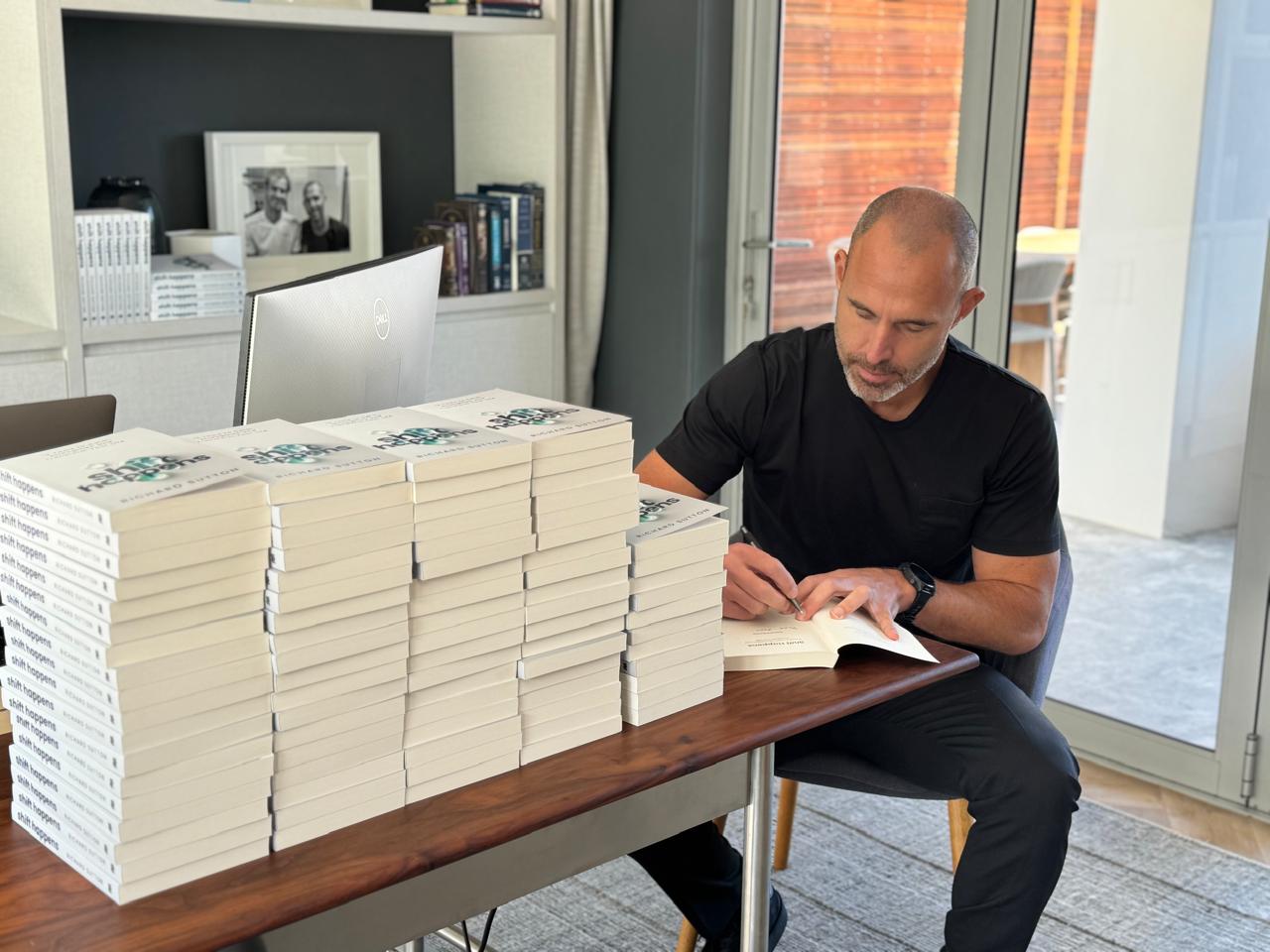
Richard Sutton writes books that help people manage stress and become more resilient. The SA Jewish Report speaks to him about his latest book, Shift Happens, which was number one on the V&A Exclusive Books bestseller list.
Tell us a little about you and your professional background.
My work has always been, in many ways, a search, an attempt to better understand myself while navigating periods of pain, rejection, and uncertainty. That personal journey shaped the direction of my career. I’ve spent the past two decades working with elite athletes, leadership teams, chief executives, founders, and artists – people operating at a high level, often under sustained pressure. But what drew me to that space wasn’t just performance. It was a deeper curiosity about how people hold themselves together when things become difficult.
What I’ve come to understand is that performance is rarely limited by talent or intelligence. It’s shaped by how we respond when things don’t go to plan, when we’re stretched, challenged, or forced to confront parts of ourselves we would rather avoid.
Today, my work focuses on helping people navigate that reality. I consult to businesses in complex environments, supporting leaders and teams to think more clearly, make better decisions, and stay steady under pressure.
Much of what I do is grounded in small shifts – how people regulate themselves, how they communicate, and how they recover – because those are often the factors that determine whether someone sustains performance over time, or begins to drift.
What inspired you to write Shift Happens?
About two years ago, my phone started ringing constantly. Messages, calls, voice notes – from friends, strangers, parents at my kids’ schools – all asking the same thing in different ways: How do I manage my stress?
Some were overwhelmed by the sheer volume of demands. Others were struggling to keep up with the pace of change. Some felt stuck, unsure of where they were heading in life. And many were simply anxious. About the future, about what was happening in their communities, and about the uncertainty unfolding in places like the Middle East.
What struck me wasn’t just the number of people reaching out, but how similar their experiences were. It became clear that people didn’t need more information. They needed something practical. Something that worked. Something they could access easily, without cost or complexity.
That was the starting point.
I wanted to create a resource where the tools are simple, effective, and grounded in real life, something people could return to when things feel overwhelming, and actually use.
What did/do you hope to achieve with it?
While managing stress and overwhelm is a core theme of the book, it’s about much more than that.
At its heart, it’s about helping the reader find clarity again. To step back and ask the questions that often get lost in the noise: Who am I? What do I really want? What needs to change?
I wanted the reader to feel like an active partner in their own story, not just someone consuming information, but someone engaging with their life in a more deliberate and practical way.
For some, that means reconnecting with a sense of purpose or rediscovering a passion that’s been pushed aside by life’s busyness. For others, it’s about bringing a sense of order to a world that feels increasingly chaotic.
Why do you believe this book is important for our community?
It’s important because it creates the momentum needed for meaningful change.
The book provides 12 science-backed tools that help optimise our internal state. They support us in feeling calmer, more composed, clearer in our thinking, and more energised, regardless of what’s happening around us.
When we shift our state, we gain clarity on who we are and what we stand for. That clarity drives action, and over time, those actions shape our behaviour.
And ultimately, it’s our behaviour that determines success in the areas of life that matter most.
The book offers a bridge between intention and reality by supporting consistency, especially during difficult and demanding periods, when it’s often hardest to stay aligned with ourselves.
So many of us live with stress in our careers and personal lives. How important is it for us to shift from that, and how?
I think it’s important to disentangle the concept of stress a little.
Stress isn’t simply good or bad, it’s both. Short-term stress that challenges and stretches us can bring out our full potential. Biologically, it can make us 15%–20% more capable across multiple domains. We see this when studying for exams, competing in sport, starting a relationship, or stepping into a new role.
But there’s another side to stress.
When the demands we face are too much for too long, we shift from a state of challenge into a state of threat. In that unregulated state, people often feel depleted, overwhelmed, and anxious. Confidence drops, performance declines, and over time, both mental and physical health begin to erode.
The difficulty today is that stress is no longer occasional. It has become constant. From rapid technological change and global uncertainty to rising expectations and personal demands, many people are operating in an “always on” state. And when the system is continually stretched, we lose the performance-enhancing benefits of stress because we’re simply too depleted to access them.
What we need to learn isn’t how to eliminate stress, but how to regulate it. To switch it off biologically when needed, to recover properly, and to rebuild capacity. When we do that, something shifts. Threat begins to feel like challenge again, and we’re able to function, perform, and even thrive, despite what’s happening around us.
You discuss 12 well-known figures, like Lady Gaga and Novak Djokovic. But they’re celebrities, who have so much at their fingertips. How can we really relate our lives to theirs?
That’s a common misconception.
In the book, I focus less on their success and more on their journeys – the setbacks, the rejection, the periods of doubt, and in many cases, very real experiences of pain and feeling lost. When you look closely, their stories aren’t that different from our own.
What separates them is not access or advantage, but how they responded to those moments.
They developed ways of thinking, behaviours, and practical tools that allowed them to move through difficulty and, over time, rise above their circumstances, no matter how challenging those circumstances were.
Those same principles are outlined in the book. They’re not reserved for elite performers. They’re accessible, and can be applied in everyday life.
Can you share a few focused anecdotes about singers Lady Gaga and Billie Eilish?
Both are extraordinarily talented. But what stands out isn’t just their talent. It’s what they’ve had to navigate along the way.
Billie, for example, wanted to become a dancer. She was deeply committed to it. Being home-schooled and often socially isolated, dance became both her outlet and her identity. But like many dreams in life, it didn’t unfold as expected. She has systemic hypermobility, which made her joints unstable and prone to injury. Around the age of 13, she suffered a significant growth plate injury in her hip. It wasn’t only physically painful, but marked the end of her path in dance.
At that point, she could have stopped. Instead, she redirected her energy and focus into music.
What followed is well known. Grammy Awards, an Academy Award, and global recognition. But what’s less often spoken about is that she achieved all of this while managing Tourette’s syndrome, a neurological condition that can be both physically and emotionally demanding.
What she came to understand is that if her hopes were to become reality, she needed to learn how to regulate herself, how to steady her mind and body under pressure. Practices like conscious breathing and other forms of state regulation became central to how she performed and sustained her career.
Her story is a reminder that the path we imagine isn’t always the one we walk. But with self-awareness, self-control, and accountability, new paths can emerge, often leading further than we initially thought possible.
I love the idea of it being small shifts rather than an overhaul, because it seems more realistic and doable. Where should we start?
Start with who you want to be. Identity is powerful, it shapes how we think, how we act, and ultimately the direction our lives take.
Then ask a simple but important question: What do I actually want for my life?
It may sound straightforward, but life has a way of pulling us off course. It gets crowded with responsibilities, fatigue, expectations. Over time, many people shift from living with purpose to simply trying to get through the day.
The next question is: What am I doing that I genuinely care about? What am I passionate about?
Here’s the insight: If you don’t decide what you want, life will decide for you.
Write it down. Who you want to be. What you want. Why it matters.
Because clarity fuels action. Action builds momentum. And momentum is what creates real change over time.
What signs should we be looking for in terms of how close we are to burnout?
In many ways, burnout is the combination of sustained pressure and a lack of recovery. It builds gradually, often unnoticed (just a little more rigid, less open, more distant), until it starts to show up across different areas of life (depletion, low mood, negativity, overwhelm).
Chronic stress signs can vary from person to person, depending on their unique biology and life context. Emotionally, it may feel like increased anxiety, irritability, or a low mood. Physically, it can present as digestive issues, skin flare-ups, persistent fatigue, or recurring injuries and niggles.
Cognitively, people often notice reduced concentration, lower motivation, a lack of clarity, and poorer memory. Sleep is also commonly affected, with people either struggling to fall asleep, stay asleep, or waking up feeling unrefreshed.
What’s important is recognising that these signals aren’t random. They’re the body’s way of indicating that the system is under strain and needs attention.
Have you ever got to a point where you were worried about yourself being overwhelmed or overstressed and needing the shift?
Goodness, yes, Very much so.
About three years ago, I made a major career decision not to continue pushing into overseas markets. For more than a decade that had been a clear goal. It had materialised into work across Canada, the United Arab Emirates, the United Kingdom, and other regions. At one point, I was travelling internationally every second week and spending close to six months of the year abroad.
From the outside, it looked like progress. But at home, things were different. My wife and children weren’t thriving under that model and, if I’m honest, neither was I.
At the end of that year, I decided to step back and focus on local work. It required a full reinvention of my positioning in South Africa. I had lost traction simply because I wasn’t present.
It was a difficult period. The pivot came with uncertainty, anxiety, and more sleepless nights than I would like to admit.
But I went back to the fundamentals, the same tools I speak about in the book. I focused on regulating my state, creating clarity, and taking consistent action.
Looking back, it was one of the hardest decisions I’ve made, but also one of the best. My family came first, and I was able to build meaningful relationships and a body of work in the country I care deeply about.
Sometimes the shift isn’t about chasing more, but about recognising what matters, and choosing to align with it.
What prompted the title Shift Happens?
My wife, actually. I can’t take any credit. She’s really creative.
I had another title in mind, but in hindsight, it didn’t quite capture what the book is about. Shift Happens does.
It reflects a simple truth: we’re constantly faced with the unexpected. Challenges, setbacks, pressure—they’re part of everyday life. The goal isn’t to avoid what can’t be avoided, but to learn how to respond to it better.
And that’s something we do have control over.
What matters is the consistency of those responses. Over time, small, deliberate shifts in how we think and act begin to compound. They shape who we become.
In many ways, the title speaks to that process – that through repeated, measured responses, we can move closer to becoming the person we always believed we could be.
Who do you most want to read this book and why?
I’ve had mothers tell me their 12-year-old children read the book from start to finish, and friends share that their 80-year-old parents couldn’t put it down.
I think that speaks to something important.
If you’re going through a difficult time, whether at work, at school, with your health, or in your relationships, it can be a useful resource. But even more than that, it’s for the moments when you feel stuck. When you’re unsure of where your life is going, or even who you are anymore.
That’s where the book can help you find your way back to yourself, and to move forward again.