Question and Answer
Exhausting and addictive – advertising is his calling

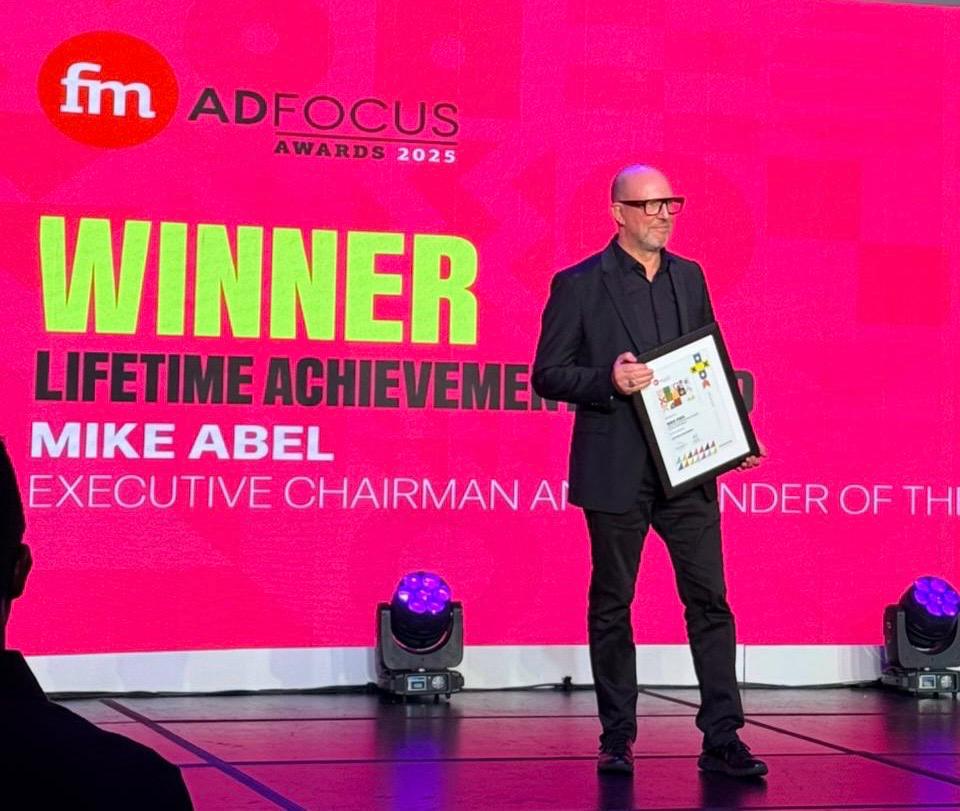
Mike Abel, the founder and executive chairman of The Up&UpGroup, was this week awarded the Financial Mail AdFocus Lifetime Achiever Award and the AAA Alumnus Luminary Award. The SA Jewish Report spoke to Abel, Jewish Achiever Business Award winner in 2018, about it.
What does winning the Lifetime Achiever Award mean in your industry and to you?
In our industry, it recognises the body of work, the consistency, the impact we have had on people over many years, and what we have contributed to the industry.
It’s an affirmation of the teams I’ve been privileged to build; the clients who entrusted us with their brands; and the belief that values-driven work still matters, especially in a world that desperately needs more consistent and clear leadership, courage, and backbone.
I don’t see it as a personal victory lap. I see it as recognition of the collective effort of many remarkable people I’ve worked with over decades.
How does one get chosen for this award?
You don’t campaign for it. You don’t angle for it. The Financial Mail AdFocus judges determine a worthy recipient, and then collectively vote for the recipient. You do the work; you maintain your standards; you invest in people; and eventually, the industry decides whether your contribution has been sufficiently meaningful.
The people who have received this award before me are individuals I’ve respected for decades, pioneers who built many foundations in our industry and pushed its creative, business, and ethical standards forward. To be included among them is significant and humbling in a very grounded way.
What were your first thoughts on being named the winner?
I felt grateful and reflective. After 35 years, you accumulate a great deal – relationships, lessons, scars, and triumphs. This award made me pause and take stock of the journey and the privilege of having spent my life in a field I genuinely love.
Mostly, I felt thankful for the people who stood alongside me along the way. It was also a lovely surprise as my companies were top three finalists in six categories, but we never won the big prize in any, until they called my name.
What drew you, as a young Jewish boy from Port Elizabeth, to the advertising industry, and how did your career begin?
I’ve always been drawn to ideas, imagination, persuasion, and that magical moment where insight turns into creative impact. Port Elizabeth is a major South African city with deep culture and strong Jewish roots, but it didn’t have a meaningful advertising industry. If you wanted to build a career in this field, you had to leave.
I first studied at the Nelson Mandela University and specialised in marketing, then did my postgraduate studies at the AAA School of Advertising, which opened my world. That’s where I realised that this wasn’t just a curiosity, but a calling, combining psychology with creativity.
I started my own tiny agency in Port Elizabeth advertising on the back windows of black taxis in the 80s using a perforated vinyl called Contravision. During apartheid, I was in a 50% partnership with Uncedo Black Taxi Association operating out of New Brighton, Zwide, Kwazakhele, and Motherwell. It was most unusual for a white kid at the time.
What stands out as the best and worst times in your 35 years in the industry?
The best times have always been about people: building agencies with soul; winning transformative pitches; seeing young talent grow into confident leaders; and creating work that genuinely made a difference.
The worst times were never about work, always about behaviour. When ego, politics, or misaligned values overshadowed creativity and collaboration, those were the moments that tested me. They also reminded me how important it is to choose the right partners in business and in life. And yes, they sharpened me too.
And, of course, the COVID-19 pandemic. Fortunately, we managed to keep 100% of our staff on 100% of their salaries, and even set up an emergency fund to help their extended families who may have been in stress. We drained our resources, but managed to make a huge difference and paid every single supplier on time. Values, as I said.
You wrote, “Advertising is infuriating, exhilarating, exhausting, and utterly addictive.” What do you mean by this?
It’s infuriating because it’s subjective and chaotic. It’s exhilarating because ideas still have the power to change markets, minds, and momentum. It’s exhausting because it demands emotional and intellectual energy of the highest order. And it’s addictive because nothing else blends creativity, commerce, psychology, and humanity with this intensity.
You either get hooked, or you run. I stayed. It’s a hard and demanding industry. Glorious, but difficult. And pitches are often awful. A beauty parade where a client often picks the best idea on the day, often not asking if these are exceptional partners, stable, smart, with a track record, and experience. I always look at the work after a pitch that we may have lost. Sometimes you think, “Wow, that’s excellent” or often the exact opposite.
What impact have you made on the industry, and how has it impacted your life?
My greatest contribution has been building values-centred cultures where talented people can thrive and where clients feel truly partnered. Whether at Ogilvy, M&C Saatchi Australia, or founding our group back home, I’ve tried to build places where decency and excellence coexist.
And, of course, our The Street Store concept, born in my agency in 2014, of which I am the patron. To date, more than 1 100 have taken place all over the world, clothing more than one million people.
A lot of that comes from a deeply held Jewish idea: to leave things better than you found them – whether it’s a team, a client, or a company.
The industry, in turn, shaped me profoundly. It broadened my perspective, challenged my assumptions, toughened me in some ways, and softened me in others. It has given me a life full of meaning, relationships, and purpose.
It has allowed me to travel the world, to work in different countries, and across geographies. To work with the very top leaders in our industry be they in the United Kingdom, United States, or Asia Pacific. And to contribute at an entirely equal level, at the same table.
What does it take to excel in this industry?
Marketing knowledge and savvy. Curiosity. Imagination. Resilience. Judgement. The ability to listen deeply. A strong moral compass. And the willingness to push yourself and your team, but with integrity. Above all: care. People can feel when you care.
Looking back, what would you have done differently?
I would have trusted my instincts sooner and stressed far less. Most missteps happen when you ignore your gut. I would also have protected my time earlier. But in hindsight, every lesson arrived when it needed to.
How would you describe the industry and the people within it?
It’s a fascinating mix of thinkers, makers, strategists, analysts, creatives, eccentrics, and visionaries. You encounter incredible minds and extraordinary personalities.
When the chemistry is right, the work is electric. When it isn’t, it can be chaotic. But the people who truly love this industry bring humour, humanity, and a level of creative bravery that you seldom find anywhere else.
What advice would you give young Jewish kids who want to enter the industry?
Bring your full self: your history; your curiosity; your resilience; your humour; and your values. Don’t make yourself small. Don’t dilute who you are to make others comfortable.
This industry rewards originality and backbone, qualities our community has in abundance.
Work hard, stay principled, and be generous with your mind and your heart. Your identity is an advantage, not something to camouflage.
This isn’t the only award you won this week. Why does the second one matter so much to you?
The inaugural Alumnus Luminary Award from the AAA School of Advertising means a great deal because that’s where my professional life began. AAA was the place that opened the world of advertising as a career for me. To be honoured by the institution that first shaped my path feels profoundly meaningful.
It wasn’t only nostalgic, it was grounding and joyful. It reminded me where the spark first caught. For me, it was a truly full-circle moment.