News
South African neo-Nazi’s visa revoked after Sydney rally

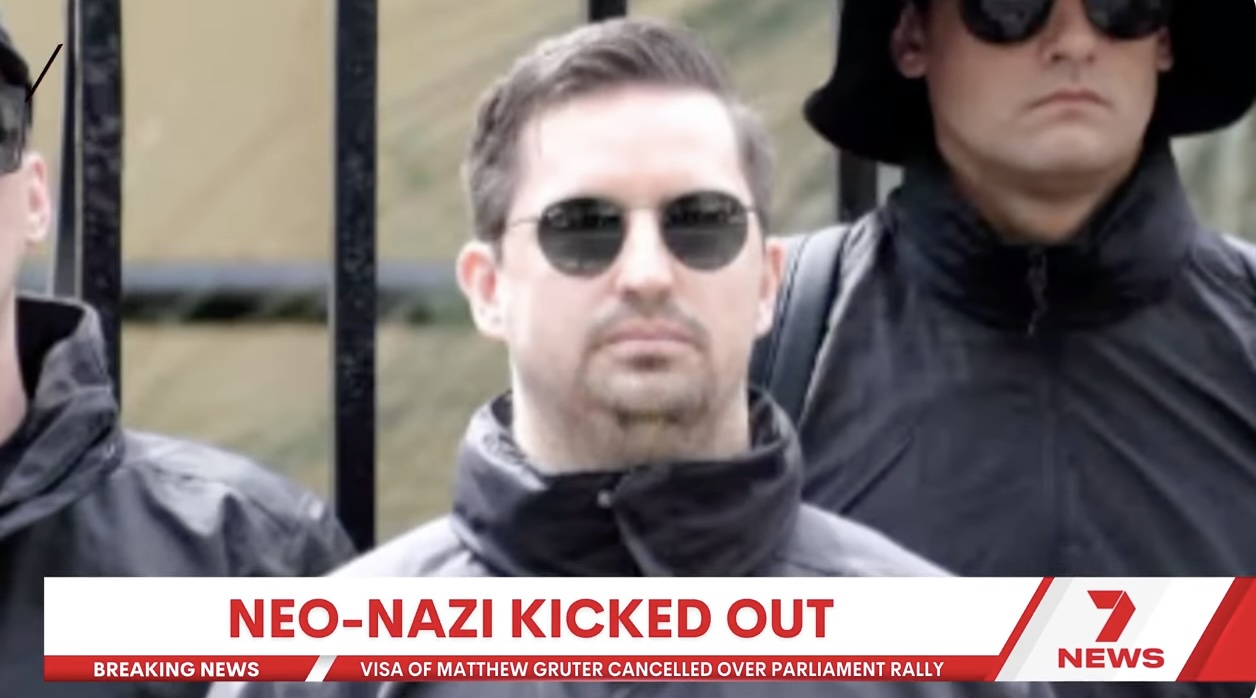
Matthew Gruter, a South African civil engineer, was identified participating in a vehemently antisemitic neo-Nazi rally outside the New South Wales Parliament in Sydney on 9 November. This week, the Australian federal government revoked Gruter’s visa, and he is likely to be heading back to South Africa soon after three years there.
The rally involved about 60 members of the National Socialist Network (NSN), Australia’s largest neo-Nazi organisation. Gruter appeared unmasked and was photographed wearing a silver wristband inscribed with the Hitler Youth slogan “blood and honour”, which indicates senior status within the group.
Australian Home Affairs Minister Tony Burke confirmed that Gruter’s visa had been cancelled. Burke said people living in Australia had freedom of speech, but the government decided whether someone could enter or remain in the country if they are involved in activities that incite discord. The Home Affairs department said it couldn’t comment on individual cases.
According to news reports in Australia, Gruter has been living in Sydney for three years and worked in his profession. He is reported to have listed the engineering firm Aurecon as his employer. Aurecon has held contracts with the Australian Defence Force and the New South Wales government. The company hasn’t publicly confirmed his employment, nor replied to the SA Jewish Report’s requests for comment.
The rally outside the New South Wales Parliament featured a large banner reading “abolish the Jewish lobby”. Photographs published by Australian media show Gruter standing in the front row of the group. He was one of several participants identified by name after they appeared unmasked.
The New South Wales Police Service confirmed that the group had been granted permission to protest. Police later said an internal breakdown in communication contributed to the authorisation being issued. The demonstration proceeded despite hate speech and incitement laws already in force in the state.
South African-born former chief executive of the New South Wales Jewish Board of Deputies, Dr Vic Alhadeff, told the SA Jewish Report that the rally occurred during an already difficult period for Jewish communities in Australia.
He said that since 7 October 2023, there had been 2062 antisemitic incidents reported to Jewish communal bodies. These included the destruction of a synagogue in Melbourne; vandalism at Jewish schools; doxxing of Jewish artists; and incidents at universities. He said young people were instructed not to wear their Jewish school uniforms on sports fields, and some individuals felt unsafe displaying visible Jewish symbols.
“This has been an extraordinarily traumatic time for Australian Jewry,” Alhadeff said. He said this rally was especially concerning because until very recently, people participating in such a demonstration “would have had masks on their faces. Now they were unashamedly identifying themselves.
“Media identified a number of the participants,” Alhadeff said. “One worked for the railways; another worked for Australia Post; another was a fitness trainer; and the South African person was a civil engineer working for a senior engineering firm that had contracts with the Australian Defence Force and the New South Wales government.” He said this indicated a spread “across civil society”.
Alhadeff said the response from Australian authorities was swift once the identities of the participants became known. The Home Affairs minister had recently taken similar action against other controversial figures, he said, pointing out that though Australia was experiencing significant social tension, “the overwhelming majority of Australians are fair-minded, law-abiding people.
“The issues that our country has encountered in recent times have emanated from a small but vocal minority,” Alhadeff said. “What’s needed more than ever is for civil society to recognise the erosion of social harmony and unequivocally condemn it.”
Alhadeff said the NSN had declared its intention to form a political party called the White Australia Party. Under New South Wales law, a party requires only 750 signatures to register for the legislative council, and 1 500 signatures to register federally. He said lawyers were examining whether registration could be blocked on the basis that the name or logo may be offensive.
Alhadeff said that the New South Wales premier was considering extending the parliamentary session in November to introduce stricter anti-Nazi legislation. Proposed measures include banning swastikas and Hitler salutes, and tightening restrictions on hate speech.
South African Jewish Board of Deputies National Director Wendy Kahn said her organisation welcomed the action taken by the Australian authorities.
“We applaud the firm stance taken by the Australian authorities in deporting South African national Matthew Gruter following his neo-Nazi activities. This decisive action sends an important message to those who propagate antisemitic hatred and threaten Jewish communities that such behaviour carries consequences.”
Kahn said the Board was monitoring developments and “should Gruter attempt to import his message of hate into our country, we will respond swiftly and firmly”.
Dr Milton Shain, emeritus professor of Historical Studies at the University of Cape Town, said, “It comes as no surprise to read of Matthew Gruter. While I don’t know if he was on any watchlist in South Africa, I do know that we have had our fair share of neo-Nazis through the decades.” He referred to earlier individuals and organisations, and said, “Holocaust denial has flourished in certain circles. It will be interesting to know more about the South African circles in which Gruter operated.”
Long-time Australian educator Dr Hilton Immerman said the rally raised concerns about the state of public life in Australia. It “should never have been allowed to proceed”, he said, describing it as a failure of leadership by the New South Wales police.
Immerman said strong Jewish education and resilience remained essential for Jewish communities in Australia and South Africa and extremism should be addressed at legal and communal level. “Jews worldwide should stay resilient, united, and proactive. The key to doing so has always been commitment to providing strong Jewish education in the home, the school, and the community,” Immerman said.
At the time of publication, there was no public confirmation of the visa category under which Gruter entered Australia. Michelle Oztas, an Australian migration consultant, said that he probably entered Australia either on an Employer Nominated Visa or a Skilled Worker Visa. Both of these require that applicants sign a document called the Australian Values Statement, which binds them to adhering to Australian law and values. Oztas said it was unusual for Australia to cancel visas without warning, and she hadn’t seen it happen in her career before.
Australian Home Affairs declined to comment on this or on any future legal implications. It’s not yet known whether South African authorities will take any action following Gruter’s return to the country, nor the exact date of his pending return.