


News
US ambassador given SA clearance to put America first

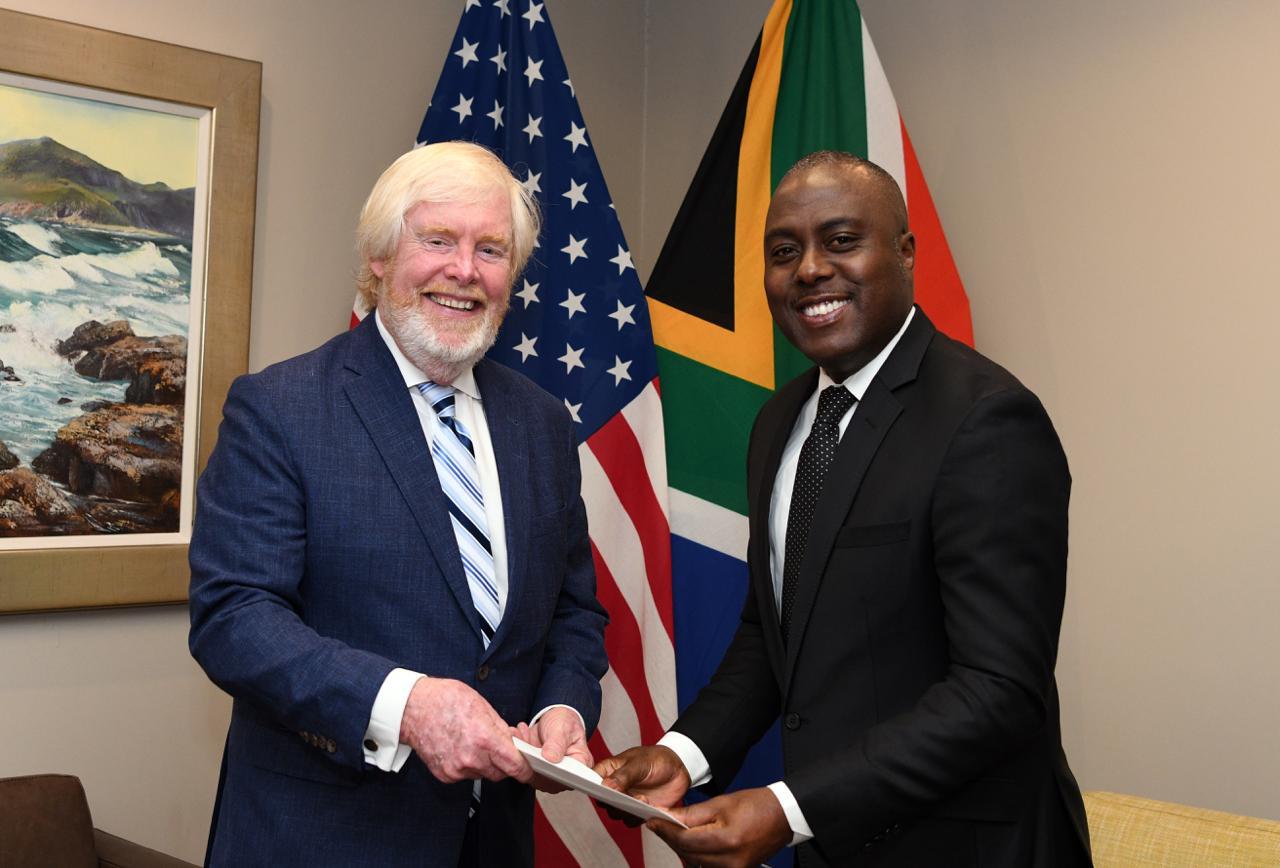
Many may consider it a snub when the credentials of the new ambassador of a world leader like the United States (US) is accepted by anyone but the country’s president. On Monday, 23 February, the new US ambassador to South Africa, Leo Brent Bozell III, had copies of his letters of credence accepted by an official further down the line, Department of International Relations and Cooperation (Dirco) Deputy Director-General Clayson Monyela, acting chief of state protocol.
While this definitely has less prestige, it does mean Bozell was accepted quickly, although not by President Cyril Ramaphosa, and can now commence his ambassadorial duties.
A Dirco spokesperson told the SA Jewish Report that procedures had recently shifted. “In the past, heads of mission were duly accredited only once they presented original letters of credence to the president. The procedure changed to align with what most of the world was doing. The ceremonies with heads of state were taking place once in a while and heads of mission would spend months without accreditation and therefore unable to work officially.”
Bozell, the controversial conservative picked by US President Donald Trump, was an outspoken critic of South Africa’s liberation struggle in the 1980s. He is unabashedly pro-Israel, and has vowed to try to convince Pretoria to drop its case at the International Court of Justice (ICJ) accusing Israel of genocide in Gaza. He’s made a career out of criticising the supposed liberal bias of US media. Bozell has the political left baying for his swift expulsion.
“I look forward to advancing US priorities to build a safe, stronger, and more prosperous America, grounded in American exceptionalism and shared opportunity,” Bozell posted on Facebook this week. He also said he sought to strengthen the bilateral relationship.
Analyst Terence Corrigan said, “Bozell will support the overall positions of America under Trump – and which predate Trump – particularly on South Africa’s foreign policy. South Africa’s position on Israel is, of course, important here, but South Africa has taken a hostile stance vis-à-vis the US and the West in general. Since I don’t think that South Africa will shift on this at all, I think the ambassador will be the bearer of a distinctly frigid relationship.”
On the ICJ case, Corrigan said there was no polling on whether ordinary citizens supported it. “Those pro the ICJ case are loud and public. They are also, I would venture, on balance inclined towards hostility towards the US. So expect a lot of vocal hostility. Since this is an issue that the South African government will not step away from, I can only see ongoing deterioration of the relationship.”
John Stremlau, honorary professor of International Relations at the University of the Witwatersrand (Wits), said, “I don’t expect much from Brent Bozell III. He lacks diplomatic experience and with the expulsion of [South Africa’s former ambassador to the US Ebrahim] Rasool, and Trump’s executive order back in February [2025], Trump declared that he didn’t like South Africa’s DEI (diversity, equity, and inclusion] policies and would halt all aid and welcome Afrikaners as refugees, betraying once again his well-known racism! Bozell conflates anti-Zionism and antisemitism as too many in South Africa do.”
Michael Walsh, a non-resident senior fellow at the US-based Foreign Policy Research Institute, noted that Bozell’s tenure began at an interesting juncture, with Republicans controlling the White House and Congress. “Within Congress, there is still bipartisan support for taking coercive policy interventions that are designed to reverse the geostrategic drift of South Africa toward China, Iran, and Russia. Those conditions will make it much easier for Bozell to pursue some of his strategic goals between now and the midterm elections [in November]. He will be mindful of that reality.”
But Walsh said Bozell must weigh up what and how hard to push. He could advance aims considered to be trying to outcompete other major powers. “Those include,” Walsh said, “motivating the government of South Africa to reorient itself back to the West; normalise its relations with Israel; dismantle international terrorist financing networks; and strengthen bilateral commercial, trade, and investment ties with the US on reciprocal terms.
“Alternatively, he could pursue the strategic goals [seeking to change] the political, economic, legal, and social systems that exist within South Africa. Those include countering corruption; enhancing border security; sidelining anti-Western political parties; reducing dependency on development funding; stopping wasteful government programmes at all levels; dismantling international narcotics trafficking networks; and repealing laws and ending programmes that are discriminatory in nature.”
Pursuing the second set could complicate achievement of the first set, Walsh said. Both seem extremely unlikely to be achieved.
Corrigan said the past two ambassadors, Reuben Brigety and Lana Marks – known as “the Bag Lady” for selling high-end handbags – followed the policy set in Washington at the time. “Marks – for all the scorn and ridicule directed at her when she came – was a standard, quite uncontroversial ambassador,” he said. “On Brigety, I suspect he’d been sent as someone with expertise to keep an eye on a relationship that wasn’t particularly healthy. When South Africa showed its diplomatic colours over the Russia-Ukraine War, he came out guns blazing. Bozell will be entering a situation in which the relationship has deteriorated badly, pre-dating Trump.”
Martha Bridgman, an American academic and editor living in South Africa, raised concerns about Bozell’s experience and political nous. “Bozell appears far less familiar with South Africa’s history, its position on the continent, and its current societal dynamics than either Brigety, who focused after his debacle over the Lady R on the shared histories of the US and South Africa in ‘fighting oppression’ invoking the spirit of Martin Luther King, and Marks, who was originally from Port Elizabeth.”
Dr Bob Wekesa, the director of the African Centre for the Study of the United States at Wits, somewhat disagrees. “Unlike Brigety, who disappeared from the scene when things got tough, he will not relent in pushing for US political interests. Unlike Marks, he will likely have more depth of understanding of South Africa’s ideological bent.”
Imperative to repairing the relationship is for South Africa to appoint its ambassador to Washington. “This would communicate a reciprocal willingness to keep lines of communication open,” Bridgman said.
“By focusing on points where there is some convergence in interests between the US and South Africa” – overcoming business barriers, critical minerals, peace-making in Africa – “Bozell is much more likely to develop some new bridges in what is otherwise a very strained relationship between Pretoria and DC.”
Former US diplomat and writer J Brooks Spector said, “I believe Bozell’s most important task will be to listen to as broad a range of South Africans as can be arranged. His advocacy of Trump administration positions on South Africa is a given, but he should try to appeal to those things, ideas, and values that both nations and their peoples share.”
“Moving quickly to conclude this accreditation,” Spector said, “could possibly be read as a tentative first step towards better relations. We shall see what the future holds.”